ZSI New Species Discovery in West Bengal Biodiversity
Source:The Hindu ↗
Why It Matters
Highlights India's hidden coastal and estuarine biodiversity, the role of parasitoid wasps in ecological balance, and the application of DNA barcoding in species identification. Highly relevant for Prelims Environment and Science & Technology sections.
Summary
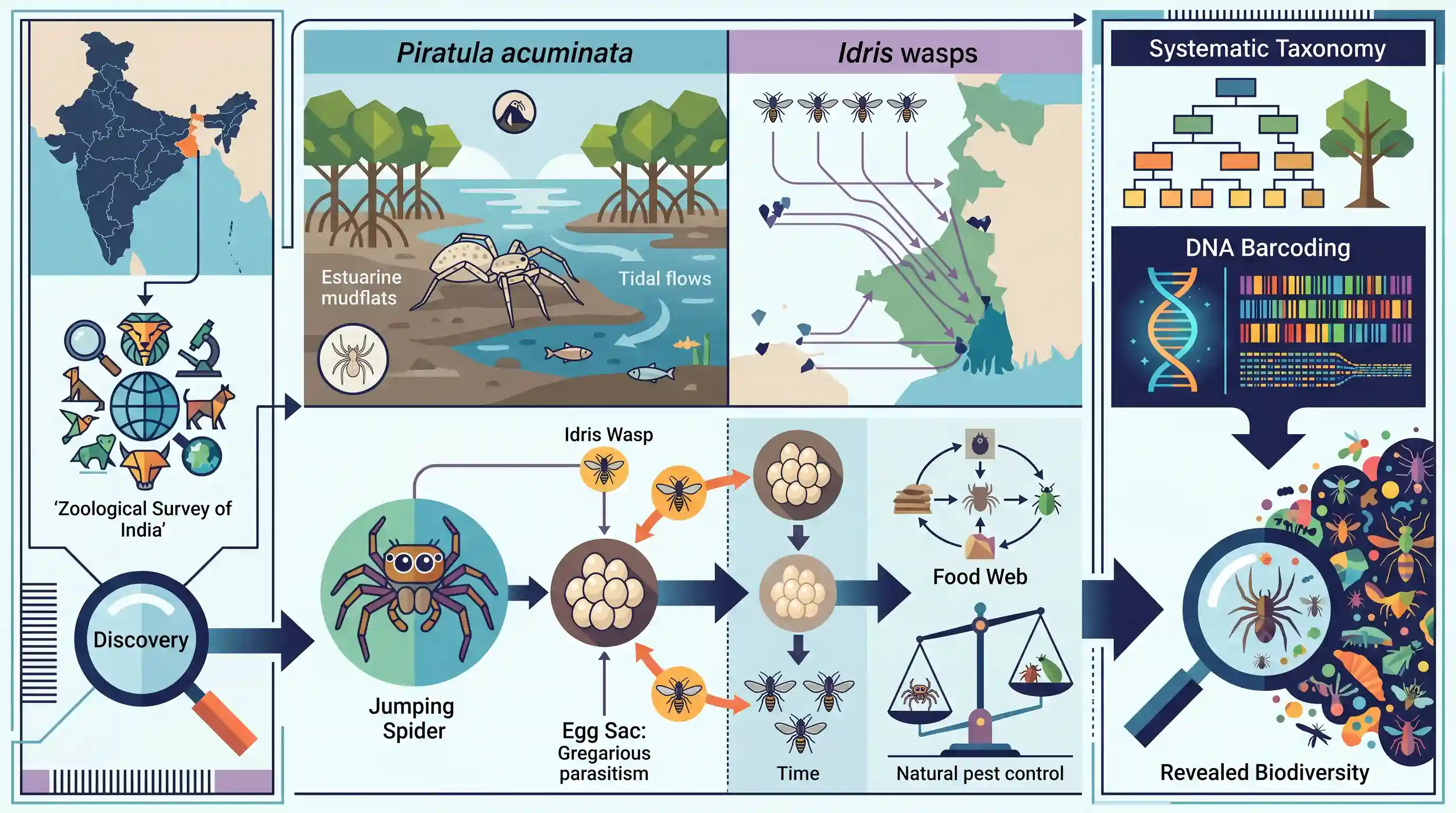
Scientists at the Zoological Survey of India (ZSI) have discovered a new species of wolf spider, *Piratula acuminata*, and four new species of spider-egg parasitic wasps in West Bengal. The spider was found on the estuarine mudflats of Sagar Island in the Sundarbans. The wasps, belonging to the *Idris* genus, were discovered in various coastal and inland locations. These wasps act as natural biocontrol agents by exhibiting gregarious parasitism on jumping spider eggs, highlighting complex food web dynamics. The findings emphasize the importance of systematic taxonomy and DNA barcoding in revealing India's unexplored biodiversity.
Key Points
- ZSI scientists discovered a new species of wolf spider (Piratula acuminata) in the estuarine mudflats of Sagar Island, West Bengal.
- Four new species of spider-egg parasitic wasps (Idris bianor, Idris furvus, Idris hyllus, Idris longiscapus) were also discovered across different locations in West Bengal.
- These newly discovered wasps exhibit gregarious parasitism, laying multiple eggs within a single spider egg, thereby naturally regulating spider populations and maintaining food web dynamics.
- The discoveries underscore the importance of systematic taxonomy and DNA barcoding in identifying and conserving unexplored biodiversity in specialized habitats like the Sundarbans.
Important Terms
Zoological Survey of India (ZSI)

India’s premier zoological research organization, established in 1916 and headquartered in Kolkata. It functions under the MoEFCC to survey, document, and study faunal diversity across the country.
UPSC context
GS Paper III (Environment/Biodiversity); tested for role in conservation and reporting national fauna status.
Sundarbans
The world's largest mangrove forest, situated in the delta of the Ganges, Brahmaputra, and Meghna rivers. It is a UNESCO World Heritage site and vital biodiversity hotspot.
UPSC context
GS Paper I (Geography) and Paper III (Environment); frequently tested for its unique ecology and conservation importance.
Ministry of Environment, Forest and Climate Change (MoEFCC)
The nodal central ministry responsible for planning and implementing environmental policies, forestry programs, biodiversity conservation, and climate change mitigation in India.
UPSC context
GS Paper II (Governance) and Paper III (Environment); institutional framework for environmental protection.
DNA Barcoding
A molecular identification technique using a short, standardized DNA sequence from a specific gene to distinguish species, offering higher precision than traditional morphological methods.
UPSC context
GS Paper III (Science & Tech); relevant for modern species identification and forensic wildlife applications.
Biocontrol Agents
Natural enemies, such as predators or parasites, used to manage pest populations in ecosystems or agriculture, reducing reliance on chemical pesticides.
UPSC context
GS Paper III (Agriculture/Environment); tests sustainable pest management and ecosystem dynamics.
Taxonomy
The branch of science dealing with the classification, identification, and naming of organisms, providing the systematic framework for biodiversity studies.
UPSC context
GS Paper III (Environment); essential for understanding biodiversity inventorying and species discovery.
Linked PYQs · 2
Linked PYQs · 2
- 2024PrelimsGS1
Consider the following : 1. Carabid beetles 2. Centipedes 3. Flies 4. Termites 5. Wasps Parasitoid species are found in how many of the above kind of organisms?
- 2022PrelimsGS1
DNA Barcoding can be a tool to: 1. assess the age of a plant or animal. 2. distinguish among species that look alike. 3. identify undesirable animal or plant materials in processed foods. Which of the statements given above is/are correct?
