Parliamentary Turmoil and Legislative Deadlock Over Exam Scandals
Source:Indian Express ↗
ఇది ఎందుకు ముఖ్యం
This article highlights key aspects of Indian polity and governance: parliamentary deadlock, the role of the Speaker in resolving legislative stalemates, executive accountability in the wake of policy/governance failures (exam paper leaks), and crucial legislative measures (the Public Examinations Amendment Bill) to reform the education and examination sector.
సారాంశం
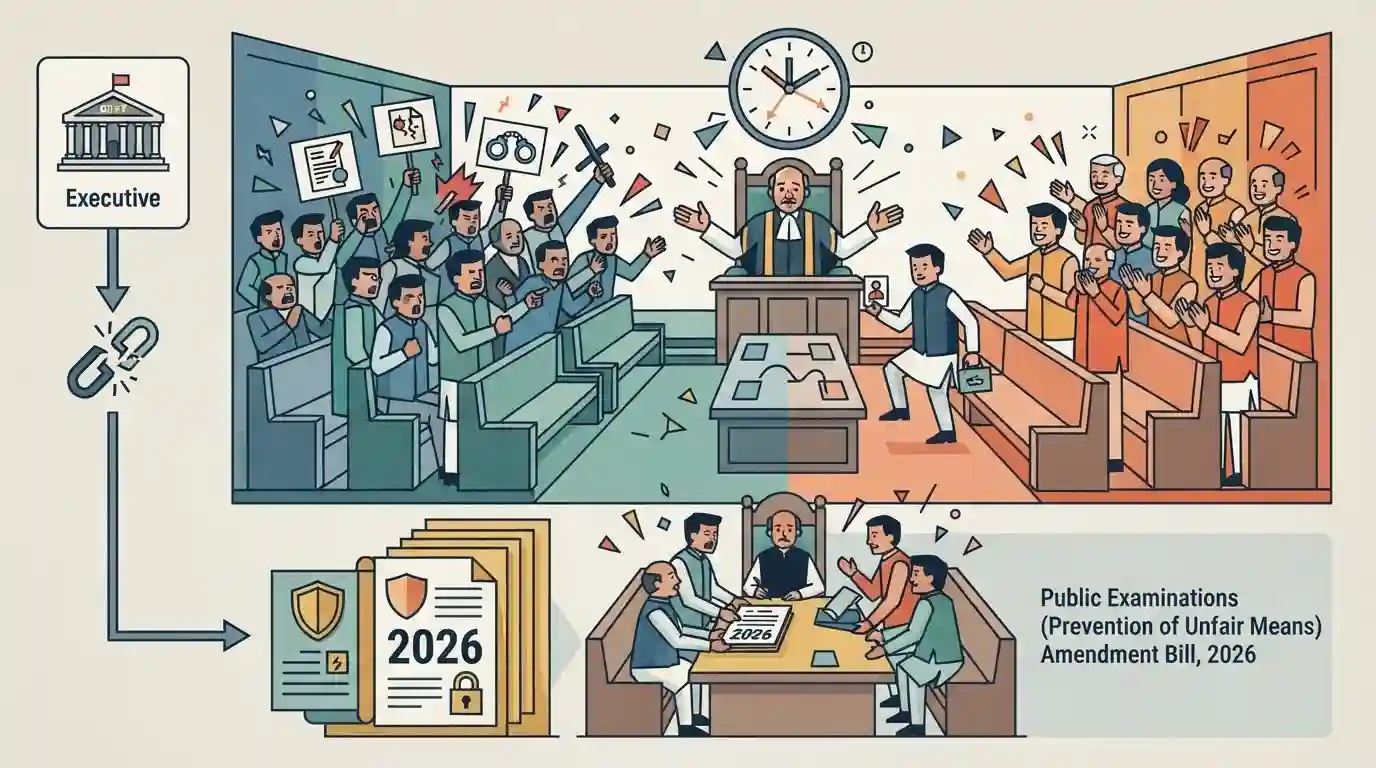
The article covers the developments in the Lok Sabha following the resignation of Union Education Minister Dharmendra Pradhan over competitive exam paper leaks. It describes the polarization between BJP MPs, who welcomed Pradhan warmly, and Opposition MPs, who protested against him and other governance issues like police crackdowns on protesters. Amid repeated adjournments, the Government introduced the Public Examinations (Prevention of Unfair Means) Amendment Bill, 2026, while Speaker Om Birla urged both sides to build a consensus to allow a formal legislative discussion.
ముఖ్య అంశాలు
- Former Union Education Minister Dharmendra Pradhan made his first appearance in Parliament after resigning due to nationwide protests and outrage over paper leaks.
- The atmosphere in Parliament reflected deep polarization, with BJP MPs greeting Pradhan with chants of 'Zindabad' while Opposition members jeered and protested.
- Lok Sabha proceedings were repeatedly disrupted and adjourned due to Opposition protests over a police crackdown on student demonstrators at Delhi's Jantar Mantar and the Ram Temple donation controversy.
- Amidst the legislative disruption, Union Minister Jitendra Singh introduced the Public Examinations (Prevention of Unfair Means) Amendment Bill, 2026.
- Speaker Om Birla gave a three-hour window for the Treasury and Opposition benches to arrive at a consensus to discuss the newly introduced bill, showcasing the Presiding Officer's active conflict resolution efforts.
ముఖ్యమైన పదాలు
Public Examinations (Prevention of Unfair Means) Amendment Bill, 2026

A 2026 proposed legislation amending the 2024 Act to curb organized exam leaks. It introduces Fast-Track Courts, Special Task Forces, and stricter penalties, including up to 10 years imprisonment and ₹10 crore fines for syndicates.
UPSC context
Relevant for GS Paper 2 (Governance). Highlights legislative measures ensuring transparency and integrity in public recruitment.
Lok Sabha
The lower house of India's bicameral Parliament, composed of directly elected representatives. It holds the Council of Ministers collectively accountable and wields exclusive powers over financial legislation like Money Bills.
UPSC context
Core to GS Paper 2 (Polity). Essential for understanding legislative procedures, representative democracy, and executive accountability.
Parliament of India
The supreme legislative body of the Republic of India, consisting of the President, Rajya Sabha, and Lok Sabha. It enacts laws, oversees the executive, and represents the electorate's diverse interests.
UPSC context
Fundamental to GS Paper 2. Tests focus on its structure, functioning, and the balance of power in Indian democracy.
Parliamentary Opposition
Elected representatives outside the ruling government who scrutinize executive actions, debate legislation, and voice public concerns. They are essential for maintaining democratic checks and balances against the majority.
UPSC context
Vital for GS Paper 2. Often tested on its role in ensuring executive accountability and preventing authoritarianism.
ప్రిలిమ్స్ ఉచ్చు
The Public Examinations (Prevention of Unfair Means) Act automatically applies to all state-level recruitment and board exams.
The 2024 Act and its 2026 amendment primarily govern central entities (UPSC, SSC, NTA, etc.). They do not automatically govern state board or state PSC exams unless the state explicitly consents or notifies application.
అనుసంధానమైన స్థిర భావనలు
What is the constitutional basis of individual and collective responsibility in India?
- Collective responsibility: Article 75(3) mandates that the Council of Ministers is collectively responsible to the Lok Sabha, meaning they stand or fall as a single unit.
- Individual responsibility: Article 75(2) establishes that ministers hold office during the President's pleasure, which practically enforces individual accountability of a minister to the Prime Minister.
What are the Speaker's procedural powers to handle disruptions and deadlocks?
- Adjournment powers: Under Lok Sabha Rules, the Speaker can suspend sittings or adjourn the House to defuse high-tension political standoffs and restore order.
- Conflict resolution: The Speaker uses informal channels and formal Business Advisory Committee meetings to negotiate consensus and resolve legislative gridlock between Treasury and Opposition.
అంతర-అంశ నమూనాలు
Exam leaks and demographic dividend
Recurrent paper leaks disrupt youth employment timelines, damaging trust in public meritocracies and stalling India's transition to a skilled knowledge economy.
Concurrent list and model laws
Because education is concurrent, unilateral central penal codes for state-level exams require states to pass matching legislation to maintain federal harmony.

The jurisdictional limit of the Public Examinations Act combined with the Speaker's conflict resolution tools is a prime 2026 target.
అనుసంధాన PYQలు · 3
అనుసంధాన PYQలు · 3
- 2024MainsGS2
What are the aims and objects of recently passed and enforced, The Public Examination (Prevention of Unfair Means) Act, 2024? Whether University/State Education Board examinations, too, are covered under the Act ?
- 2019MainsGS2
Individual Parliamentarian's role as the national law maker is on a decline, which in turn, has adversely impacted the quality of debates and their outcome. Discuss.
- 2020MainsGS2
Once a Speaker, Always a Speaker' ! Do you think this practice should be adopted to impart objectivity to the office of the Speaker of Lok Sabha ? What could be its implications for the robust functioning of parliamentary business in India?
