Heavy Metal Pollution in Urban Air Quality
Source:Indian Express ↗
Why It Matters
Air pollution is a recurring UPSC theme. The specific association of heavy metals with PM10 highlights a nuanced facet of urban air quality beyond mere particulate concentration, linking to public health, industrial regulation, and the functional role of bodies like CPCB and NGT in environmental governance.
Summary
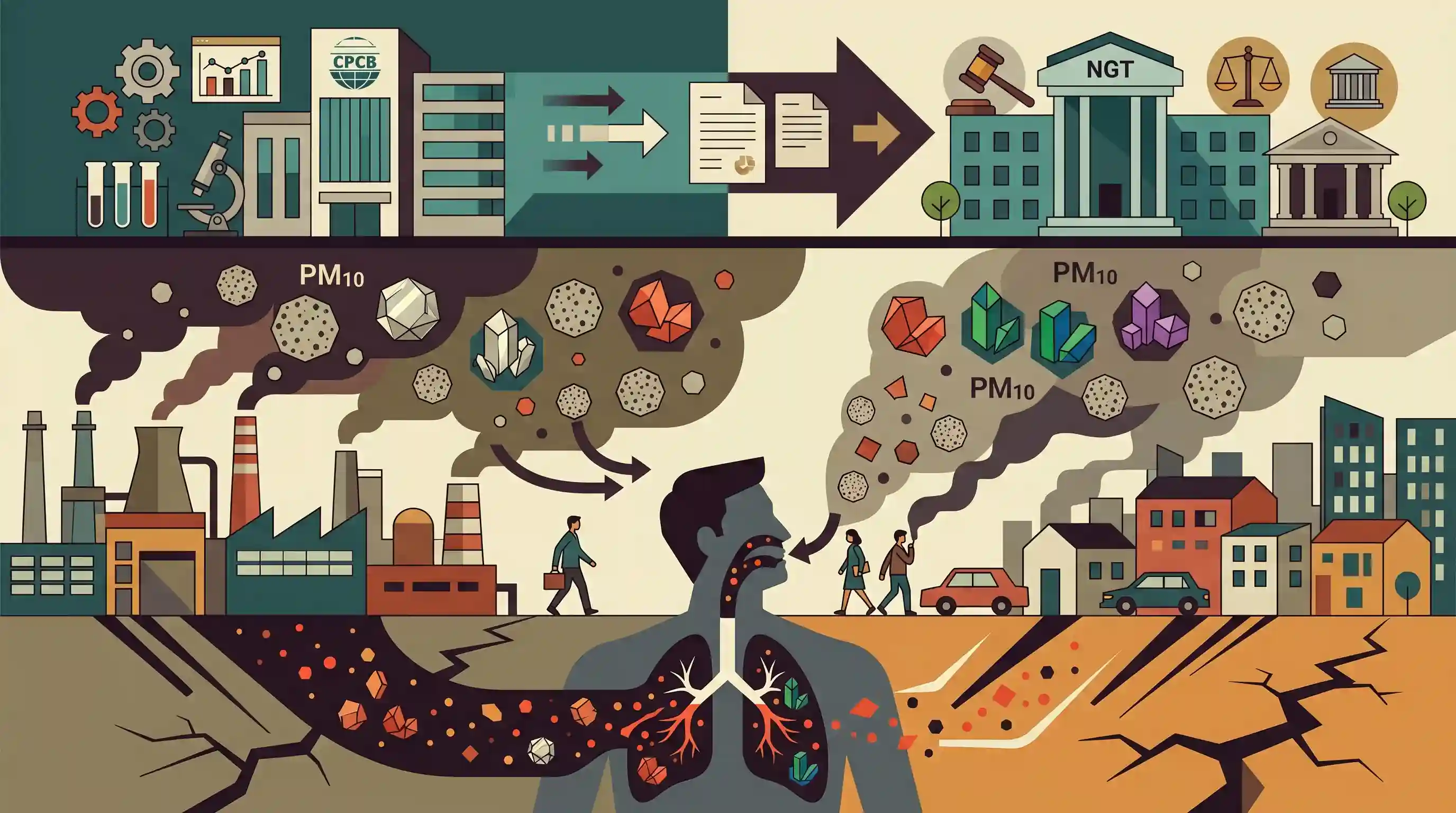
Data submitted by the Central Pollution Control Board (CPCB) to the National Green Tribunal (NGT) highlights a critical public health hazard in India's major cities: ambient air contaminated with heavy metals. In 10 metropolitan cities monitored, metals such as zinc, copper, chromium, and molybdenum were found bound to coarse particulate matter (PM10) in both industrial and residential areas. Delhi, where PM10 levels are nearly double the National Ambient Air Quality Standard, recorded the second-highest levels of copper and the third-highest levels of chromium and molybdenum, while Ahmedabad topped the list for zinc concentration. The steady inhalation of these toxic metals, primarily originating from vehicular and industrial sources, underscores the compounding severity of urban air pollution.
Key Points
- A CPCB report submitted to the NGT reveals the presence of heavy metals like zinc, copper, chromium, and molybdenum in the ambient air of 10 metropolitan cities.
- These metals are found bound to coarse particulate matter (PM10) and are prevalent even in purely residential areas.
- Delhi's PM10 concentration remains nearly double the National Ambient Air Quality Standard (NAAQS) limit of 60 µg/m³.
- While Ahmedabad recorded the highest mean zinc concentration, Delhi ranked second in copper levels and third in chromium and molybdenum levels.
- The presence of these metals is largely attributed to anthropogenic sources like industrial emissions, vehicular wear and tear, and construction activities, posing severe respiratory and health risks.
Important Terms
National Ambient Air Quality Standards (NAAQS)

Regulatory limits for 12 air pollutants (e.g., PM10, PM2.5, SO2) set by the CPCB under the Air Act, 1981, to define permissible levels for protecting public health and the environment nationwide.
UPSC context
GS Paper III (Environment); vital for questions on air pollution management, non-attainment cities, and environmental governance frameworks.
Central Pollution Control Board (CPCB)
A statutory body established in 1974 under the Water Act, later empowered by the Air Act (1981) to monitor air and water quality and advise the Central Government on pollution control.
UPSC context
GS Paper II (Governance) and III (Environment); tests knowledge of statutory bodies and their roles in environmental regulation.
National Green Tribunal (NGT)
A specialized judicial body established in 2010 for the expeditious disposal of civil cases related to environmental protection, forest conservation, and enforcement of legal rights under seven key environmental laws.
UPSC context
GS Paper II (Governance/Quasi-judicial bodies); essential for discussing environmental justice, judicial activism, and the "Polluter Pays" principle.
Prelims Trap
Zinc, Copper, and Chromium are heavy metals monitored under the National Ambient Air Quality Standards (NAAQS).
NAAQS monitors exactly 12 pollutants. Within heavy metals, only Lead (Pb), Nickel (Ni), and Arsenic (As) are notified. Zinc, Copper, and Chromium are currently unregulated regulatory gaps.
Static Concepts Connected
Which 12 pollutants are officially monitored under India's National Ambient Air Quality Standards (NAAQS)?
- Particulates & Gases: PM10, PM2.5, Sulphur Dioxide (SO2), Nitrogen Dioxide (NO2), Carbon Monoxide (CO), Ozone (O3), and Ammonia (NH3).
- Heavy Metals: Only Lead (Pb), Arsenic (As), and Nickel (Ni) are explicitly notified under NAAQS.
- Organic Compounds: Benzene and Benzo(a)Pyrene (BaP) in the particulate phase.
Under which legislations does the Central Pollution Control Board (CPCB) derive its mandate?
- Water Act 1974: CPCB was originally established as a statutory organisation under the Water (Prevention and Control of Pollution) Act, 1974.
- Air Act 1981: It was subsequently entrusted with powers and functions to monitor air quality under the Air (Prevention and Control of Pollution) Act, 1981.
- EPA 1986: It acts as a technical advisory wing to the MoEFCC under the Environment (Protection) Act, 1986.
Cross-Topic Patterns
Non-exhaust emissions and bioaccumulation
Zinc and copper emissions in cities stem heavily from vehicle brake and tire wear. Urban runoff washes these into water systems, linking airborne heavy metals to aquatic bioaccumulation and food-chain entry.
Executive vs. Adjudicatory environmental bodies
CPCB acts as the technical executive regulator collecting baseline pollution data, while the NGT acts as a quasi-judicial body relying on this data to issue binding directives and adjudicate disputes.

2026 Prelims will likely test the distinction between non-exhaust PM sources (brake wear) and heavy metals actually notified under NAAQS.
Linked PYQs · 2
Linked PYQs · 2
- 2018PrelimsGS1
How is the National Green Tribunal (NGT) different from the Central Pollution Control Board (CPCB)? 1. The NGT has been established by an Act whereas the CPCB has been created by an executive order of the Government. 2. The NGT provides environmental justice and helps reduce the burden of litigation in the higher courts whereas the CPCB promotes cleanliness of streams and wells, and aims to improve the quality of air in the country. Which of the statements given above is/are correct?
- 2022PrelimsGS1
In the context of WHO Air Quality Guidelines, consider the following statements: 1. The 24-hour mean of PM2.5 should not exceed 15 µg/m³ and annual mean of PM2.5 should not exceed 5 µg/m³. 2. In a year, the highest levels of ozone pollution occur during the periods of inclement weather. 3. PM10 can penetrate the lung barrier and enter the bloodstream. 4. Excessive ozone in the air can trigger asthma. Which of the statements given above are correct?
