West Bengal College Admissions: Zero Tolerance Against Extortion
Source:theprint ↗
Why It Matters
Highlights state-level governance measures taken to ensure fairness, transparency, and student safety in educational institutions, relevant to GS Paper II topics of social sector initiatives and anti-corruption administration in West Bengal.
Summary
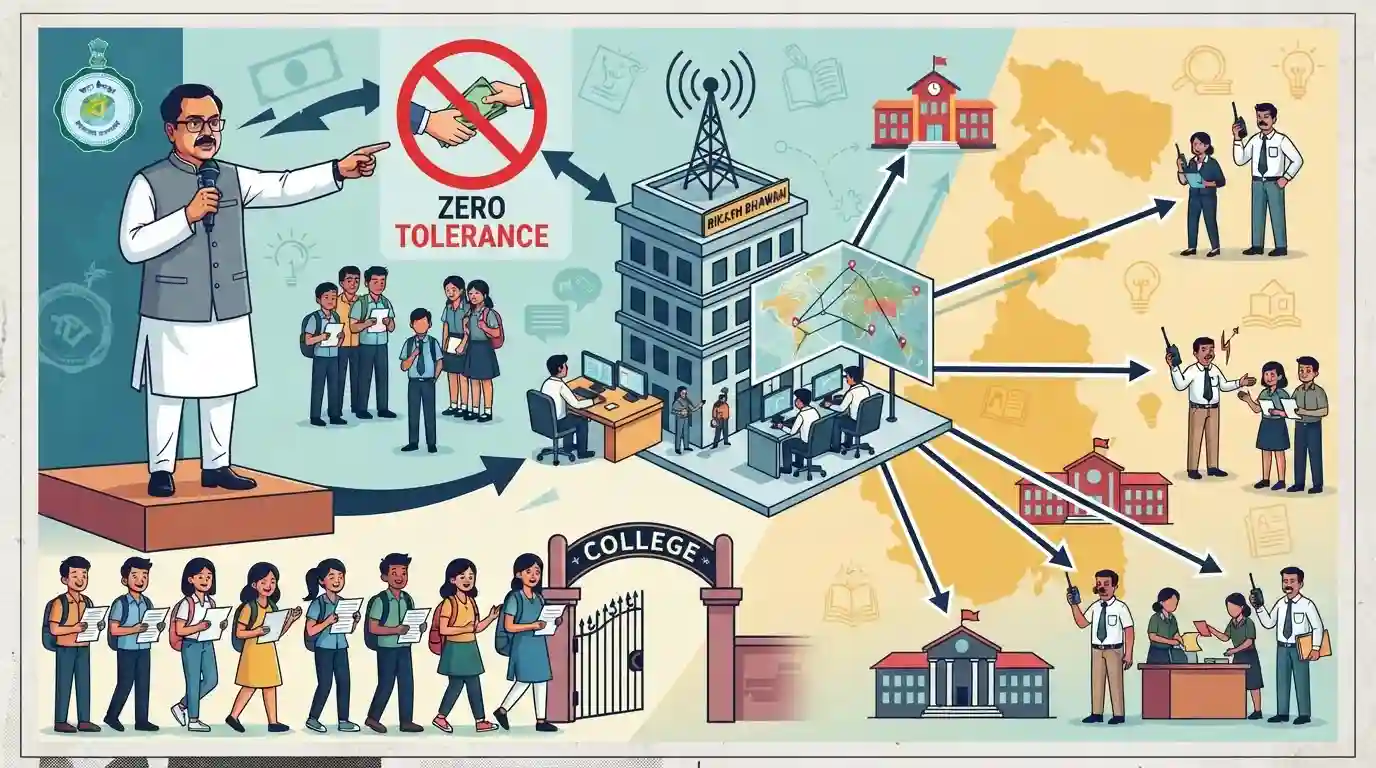
The West Bengal government has instituted a strict zero-tolerance policy to prevent extortion and bullying during college admissions across the state. Higher Education Minister Jagannath Chattopadhyay mandated that college principals remain alert and coordinate closely with the state education headquarters, Bikash Bhawan, to eliminate any scope of corruption or ragging in the academic induction process.
Key Points
- The West Bengal government announced a 'zero tolerance' policy against extortion during the college and university admission process.
- State Higher Education Minister Jagannath Chattopadhyay has issued directives to ensure no intimidation, bullying, or ragging occurs.
- College principals have been instructed to maintain direct coordination with the state education headquarters at Bikash Bhawan to report and manage any irregularities.
Important Terms
Higher Education Department (West Bengal)

The state government department responsible for the promotion, development, regulation, and administration of higher, technical, and specialized education in West Bengal.
UPSC context
GS Paper II (State Governance & Education). Tests knowledge of regional administrative structures and educational policymaking.
UGC Regulations on Curbing the Menace of Ragging
Mandatory 2009 guidelines issued by the University Grants Commission specifying measures, committees, and penalties to prevent and eliminate ragging in Indian higher educational institutions.
UPSC context
GS Paper II (Education & Governance). Tests understanding of regulatory mechanisms protecting student welfare and rights.
Raghavan Committee
A landmark committee appointed by the Supreme Court of India in 2007 to comprehensively study and recommend national policies to criminalize and prevent ragging.
UPSC context
GS Paper II (Social Justice). Tests familiarity with landmark committees addressing crucial student welfare and safety reforms.
Zero-Tolerance Policy
An administrative policy where any infraction, regardless of severity, is strictly punished with no leniency, used to deter corruption, extortion, and misconduct.
UPSC context
GS Paper IV (Ethics & Governance). Tests comprehension of governance strategies, public accountability, and ethical enforcement.
Prelims Trap
The Governor acts as the ex-officio Chancellor of state-run universities by virtue of explicit constitutional provisions under Article 163.
This role is entirely statutory (governed by state legislature acts), not constitutional. In this capacity, the Governor acts in an independent statutory role.
Static Concepts Connected
How is legislative authority over Education distributed under the Indian Constitution?
- 42nd Amendment: Transferred Education from the State List to the Concurrent List (Entry 25) in 1976, enabling both Parliament and States to legislate.
- Union List Entry 66: Grants Parliament exclusive power over the coordination and determination of standards in institutions for higher education or research.
- Repugnancy Clause: Under Article 254, in case of a conflict between central and state laws on concurrent subjects, the central legislation prevails.
What is the legal basis of the Governor's role as university Chancellor?
- Statutory Position: The Governor acts as ex-officio Chancellor based on specific state university legislative acts, rather than direct constitutional mandates.
- Independent Capacity: When acting as Chancellor, the Governor is generally not bound by the aid and advice of the state Council of Ministers.
- Sarkaria Commission: Recommended that while Governors should remain Chancellors, they must consult the state governments to prevent institutional friction.
Cross-Topic Patterns
Center-State Friction in Higher Education
State bills replacing Governors with Chief Ministers as Chancellors reflect deeper federal tensions over legislative control under the Concurrent List.
Right to Dignity and Student Welfare
Anti-ragging frameworks directly manifest Article 21, translating constitutional guarantees of dignity into actionable penal and administrative protections on campuses.

Governor's statutory role as Chancellor versus state executive autonomy in higher education is likely to feature in GS Paper II.
Linked PYQs · 1
Linked PYQs · 1
- 2020WBCS_PRELIMSGS1
'Chancellor' of the State-run Universities in West Bengal is
