India Stance on Terrorism and Supply Chains at SCO Summit
Source:The Hindu ↗
Why It Matters
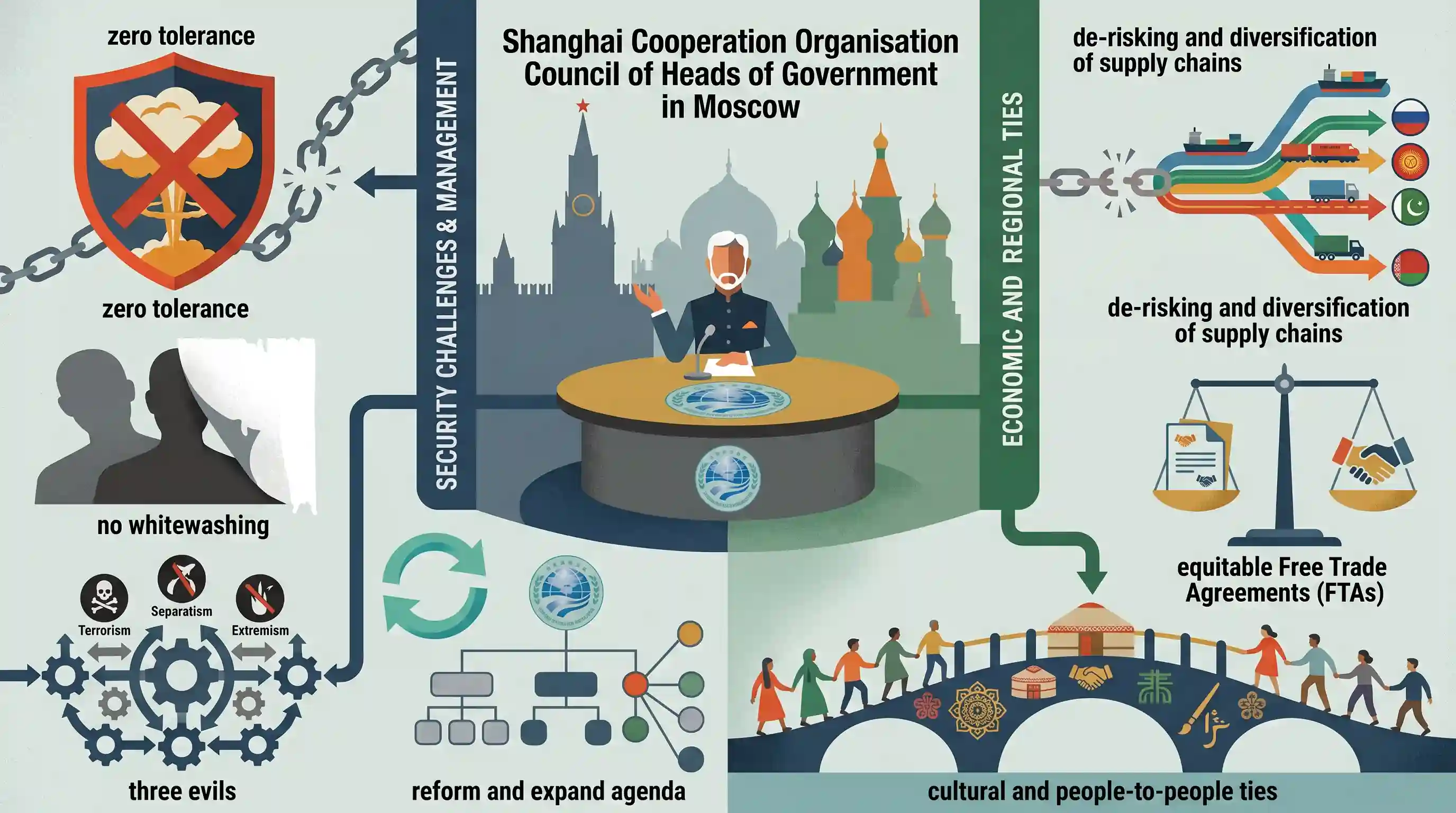
Highlights India's strategic posturing within the SCO, balancing robust anti-terrorism advocacy with economic pragmatism (supply chain diversification and FTAs) amid shifting global geopolitical dynamics.
Summary
At the Shanghai Cooperation Organisation (SCO) Council of Heads of Government meeting in Moscow, External Affairs Minister S. Jaishankar underscored the necessity of a "zero-tolerance" policy toward terrorism, rejecting any justification or "whitewashing." He urged the SCO to reform, expand its agenda, and stay true to its foundational goals of combatting terrorism, separatism, and extremism. Furthermore, addressing the current volatile global economic landscape, Jaishankar advocated for the de-risking and diversification of supply chains, the establishment of equitable Free Trade Agreements (FTAs), and the enhancement of cultural and people-to-people ties across the member states.
Key Points
- India asserted its right to defend against terrorism, urging the international community to adopt a strict "zero-tolerance" approach with "no whitewashing."
- External Affairs Minister S. Jaishankar emphasized that the SCO, originally formed to combat terrorism, separatism, and extremism, must reform its working methods and adapt to the changing global landscape.
- Highlighting global economic volatility, India called for the urgent de-risking and diversification of global supply chains through fair, transparent, and equitable economic links, including Free Trade Agreements (FTAs).
- India stressed the importance of fostering deeper cultural ties and people-to-people exchanges among intellectuals, artists, and sports personnel within the SCO.
Important Terms
Shanghai Cooperation Organisation (SCO)

A Eurasian political, economic, and security alliance founded in 2001. It currently comprises 10 member states, including India, China, and Russia, focusing on regional stability and cooperation.
UPSC context
GS Paper II: International Relations. Essential for understanding regional groupings and India's strategic engagement in Eurasia.
Free Trade Agreements (FTAs)
Treaties between two or more countries to reduce or eliminate trade barriers like tariffs and quotas. India uses them to enhance market access and integrate with global value chains.
UPSC context
GS Paper II & III: International Relations and Economy. Tests knowledge of trade policy and economic diplomacy.
Three Evils (Terrorism, Separatism, Extremism)
A foundational SCO concept targeting three major threats to regional security. India frequently highlights these to hold member states accountable for cross-border activities.
UPSC context
GS Paper II & III: Security and International Relations. Relates to regional security frameworks and counter-terrorism.
Regional Anti-Terrorist Structure (RATS)
A permanent SCO body based in Tashkent, Uzbekistan. It facilitates coordination among member states to combat terrorism, separatism, and extremism through intelligence sharing and joint exercises.
UPSC context
GS Paper II: Important International Institutions. Specific mechanism for multilateral security cooperation.
Supply Chain Resilience (De-risking)
A strategic shift from "just-in-time" efficiency to "just-in-case" resilience. It involves reducing over-dependence on single-source suppliers (like China) to minimize geopolitical and economic vulnerabilities.
UPSC context
GS Paper III: Indian Economy. Key to post-pandemic economic strategy and global trade shifts.
Zero Tolerance Policy
An absolute refusal to accept or justify any form of terrorism. In diplomacy, it demands accountability and rejects "whitewashing" or political excuses for terror activities.
UPSC context
GS Paper II & III: International Relations and Internal Security. Central to India's foreign policy and counter-terrorism stance.
Prelims Trap
The SCO Council of Heads of Government is the supreme decision-making body of the SCO.
Aspirants confuse Heads of Government with Heads of State. The Council of Heads of State is the supreme body; CHG handles trade/budget.
Static Concepts Connected
What is the mandate of the SCO's Regional Anti-Terrorist Structure (RATS)?
- Permanent body: It is a permanent organ of the SCO, headquartered in Tashkent, Uzbekistan (not Beijing).
- Core mandate: Explicitly focused on combating the "three evils" in the Eurasian region: terrorism, separatism, and extremism.
- Key functions: Coordinates intelligence-sharing, maintains databases of terrorist organizations, and conducts joint counter-terrorism drills among member states.
What distinguishes supply chain 'de-risking' from 'decoupling'?
- De-risking: Diversifying supply chains to reduce heavy reliance on a single supplier (e.g., China) without ending all trade.
- Decoupling: Completely untangling and severing bilateral economic integration, technology sharing, and dependencies with a specific target nation.
Cross-Topic Patterns
SCO continental vs Quad maritime focus
India uniquely balances its continental Eurasian engagement and security concerns through the SCO with its maritime Indo-Pacific strategy via the Quad, managing contradictory geopolitical alignments.
Supply Chain Resilience Initiative (SCRI)
Jaishankar's de-risking appeal directly aligns with the India-Japan-Australia Supply Chain Resilience Initiative (SCRI), designed to counter over-dependence on China-centric global manufacturing.

Expect a 2026 prelims question contrasting the roles of SCO's Council of Heads of State vs. Heads of Government, combined with RATS.
Linked PYQs · 4
Linked PYQs · 4
- 2021MainsGS2
Critically examine the aims and objectives of SCO. What importance does it hold for India?
- 2023MainsGS2
‘Virus of Conflict is affecting the functioning of the SCO’ In the light of the above statement point out the role of India in mitigating the problems.
- 2021MainsGS3
Analyse the complexity and intensity of terrorism, its causes, linkages and obnoxious nexus. Also suggest measures required to be taken to eradicate the menace of terrorism.
- 2024MainsGS2
‘The West is fostering India as an alternative to reduce dependence on China's supply chain and as a strategic ally to counter China's political and economic dominance.’ Explain this statement with examples.
