AIIMS proposal on tax exemption for cancer drugs and tobacco levies
Source:Indian Express ↗
Why It Matters
This article demonstrates the intersection of fiscal policy (taxation) and public health, offering a practical solution (taxing sin goods to subsidize life-saving care) to address the severe problem of healthcare affordability and the growing burden of non-communicable diseases in India.
Summary
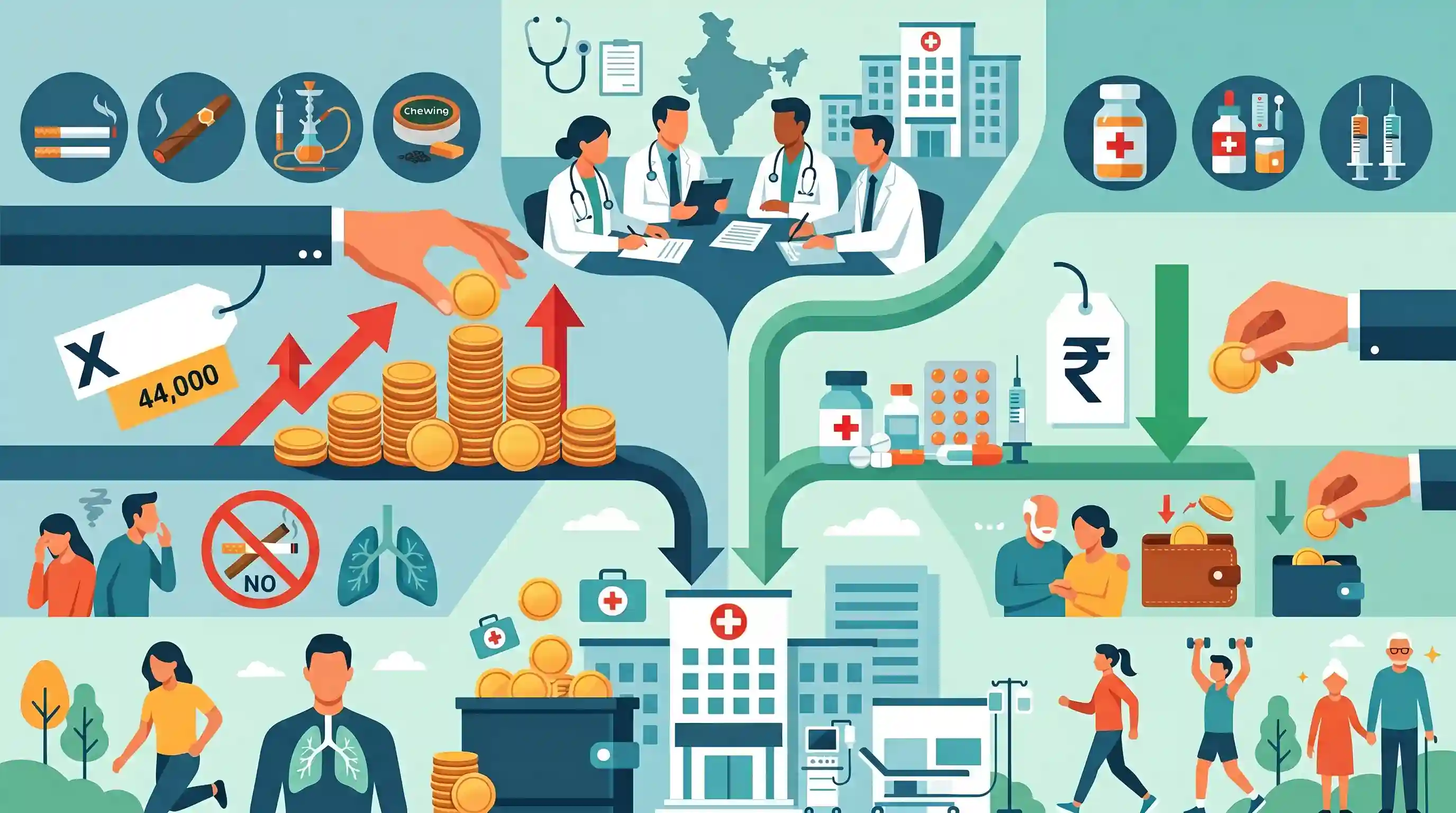
Medical experts at AIIMS are proposing a dual fiscal strategy to alleviate the financial burden of cancer treatment in India: completely exempting life-saving cancer drugs from taxes (such as GST) while significantly increasing levies on tobacco products. This approach aims to directly reduce out-of-pocket expenditures for patients fighting cancer, whilst utilizing higher 'sin taxes' on tobacco to discourage its use—a leading cause of cancer—and potentially generating funds to strengthen the public healthcare system.
Key Points
- AIIMS doctors are advocating for the removal of taxes, including GST and import duties, on life-saving cancer drugs to make oncology treatment more affordable.
- Cancer treatment currently imposes a massive out-of-pocket expenditure (OOPE) on Indian households, often pushing families into medical impoverishment.
- To counterbalance the revenue loss from tax exemptions on cancer drugs, experts propose increasing levies or 'sin taxes' on tobacco products.
- Higher tobacco taxes serve a dual purpose: deterring the consumption of a primary cancer-causing agent and generating revenue that could be used to cross-subsidize public healthcare infrastructure.
Important Terms
GST Council

A constitutional body (Article 279A) chaired by the Union Finance Minister. It recommends GST rates, exemptions, and thresholds, serving as the central forum for cooperative federalism in India's indirect tax regime.
UPSC context
GS II/III: Constitutional Bodies & Fiscal Policy. Tests understanding of federal tax administration and center-state financial relations.
Sin Tax
An excise tax on goods deemed harmful to society, like tobacco or alcohol. It aims to reduce consumption by increasing prices while generating revenue to fund public health initiatives.
UPSC context
GS III: Indian Economy. Tests knowledge of taxation tools used to address negative externalities and resource mobilization.
Out-of-Pocket Expenditure (OOPE)
Direct payments by households for healthcare services at the point of care, excluding reimbursements. High OOPE in India is a critical driver of "medical impoverishment" and poverty traps.
UPSC context
GS II: Social Justice & Health. Evaluates understanding of healthcare accessibility, financing gaps, and progress toward Universal Health Coverage.
Non-Communicable Diseases (NCDs)
Chronic, non-transmissible conditions like cancer, diabetes, and cardiovascular diseases. They currently account for over 60% of deaths in India, requiring a strategic shift in public health governance.
UPSC context
GS II: Public Health. Tests awareness of India's epidemiological transition and the socio-economic burden of chronic diseases.
AIIMS (All India Institute of Medical Sciences)
A group of autonomous public medical universities established as "Institutes of National Importance" under the AIIMS Act, 1956. They provide premier medical education, research, and affordable tertiary healthcare.
UPSC context
GS II: Statutory Bodies. Tests knowledge of premier institutions shaping national health standards and specialized medical infrastructure.
Prelims Trap
"Out-of-Pocket Expenditure (OOPE) in India has steadily increased over the last decade due to rising NCD treatment costs."
Aspirants often assume OOPE is rising due to expensive treatments. It has actually declined significantly from 62.6% (2014-15) to 39.4% (2021-22).
Static Concepts Connected
How are 'Sin Goods' and demerit goods taxed under the current GST regime?
- Highest Slab: Demerit goods are placed in the peak 28% GST bracket to actively disincentivize the consumption of socially harmful items like tobacco.
- Compensation Cess: An additional cess is levied on top of the 28% rate. Historically used to compensate states, its post-2026 restructuring is crucial for federal revenue.
- Pigouvian Tax: It acts as a Pigouvian tax, internalizing the negative externalities (such as public healthcare burdens) that consumers of these goods impose on society.
What are the major structural trends in Indian healthcare financing?
- Declining OOPE: Out-of-Pocket Expenditure (OOPE) has structurally dropped to roughly 39.4% of total health expenditure, though it still causes significant medical impoverishment.
- Rising State Share: Government Health Expenditure (GHE) has progressively increased both as a percentage of overall GDP and as a share of total health expenditure.
- Social Security Net: The expansion of schemes like Ayushman Bharat (PM-JAY) has broadened the financial protection net for the bottom 40% of the population.
Cross-Topic Patterns
Pigouvian Taxes + Public Health Funding
Using sin taxes to cross-subsidize healthcare connects GS-II health schemes with GS-III public finance, actively testing the economic principle of negative externalities (Pigouvian taxes).
NCDs + Demographic Dividend
The escalating burden of NCDs like cancer directly threatens India's working-age productivity, transforming a clinical health crisis into a macroeconomic headwind against the demographic dividend.

Expect a mixed GS-III question linking Pigouvian taxes (sin goods) to healthcare financing and National Health Accounts OOPE trends.
Linked PYQs · 2
Linked PYQs · 2
- 2024MainsGS2
In a crucial domain like the public healthcare system the Indian State should play a vital role to contain the adverse impact of marketisation of the system. Suggest some measures through which the State can enhance the reach of public healthcare at the grassroots level.
- 2019MainsGS3
Enumerate the indirect taxes which have been subsumed in the Goods and Services Tax (GST) in India. Also, comment on the revenue implications of the GST introduced in India since July 2017.
