Sanchar Saathi app mandate raises privacy and proportionality concerns
Source:The Hindu ↗
Why It Matters
The article highlights the critical tension between tackling sophisticated cybercrimes and protecting citizens\' fundamental right to privacy. It offers a crucial analysis of the proportionality and necessity of state mandates (like the Sanchar Saathi app) in the context of the landmark Puttaswamy judgment, which is highly relevant for GS2 (Polity/Governance) and GS3 (Internal Security).
Summary
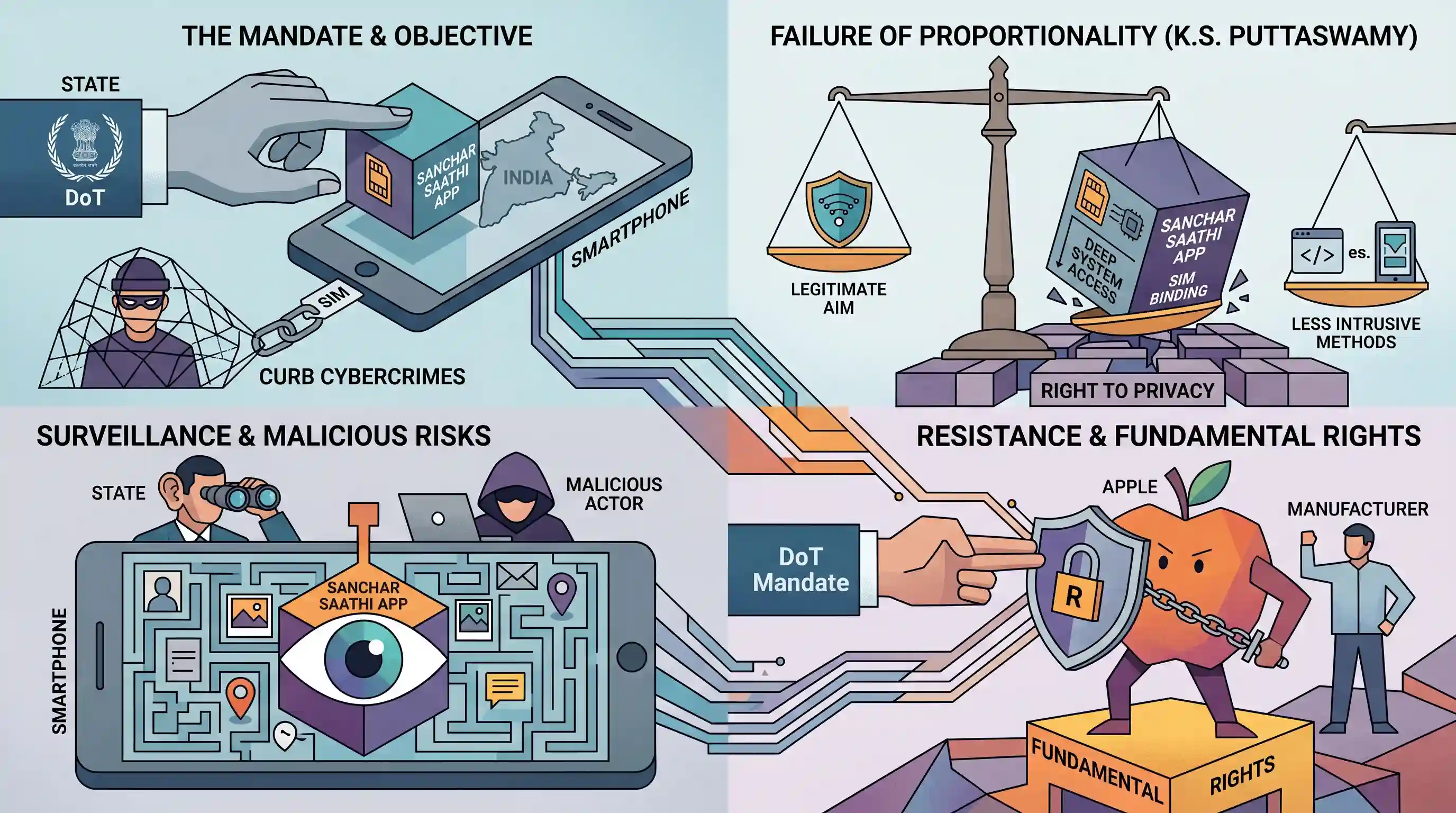
The Department of Telecommunications\' mandate to pre-install the Sanchar Saathi app and enforce "SIM binding" to curb cybercrimes has raised serious privacy concerns. The app\'s requirement for deep system access poses risks of state surveillance and malicious exploitation. The editorial argues that the mandate fails the proportionality test established in the K.S. Puttaswamy judgment, as less intrusive verification methods exist, prompting resistance from privacy-conscious manufacturers like Apple.
Key Points
- The Department of Telecommunications has mandated "SIM binding" and the pre-installation of the Sanchar Saathi app by smartphone makers by March 2026 to combat cybercrimes like digital arrests and IMEI spoofing.
- The mandate is criticized for requiring intrusive access to device features such as the camera and SMS, raising fears of state surveillance and potential misuse by malicious entities.
- The directive fails the proportionality test established in the Supreme Court\'s K.S. Puttaswamy judgment (2017), as less invasive verification alternatives like web portals and USSD codes are already available.
- Due to these privacy and surveillance concerns, privacy-conscious smartphone manufacturers such as Apple have reportedly refused to comply with the government order.
Important Terms
Sanchar Saathi

A citizen-centric portal and mobile application developed by the Department of Telecommunications (DoT) to enhance mobile security, allowing users to block stolen devices, verify SIM registrations, and report fraud.
UPSC context
GS Paper III (Cyber Security) and GS Paper II (Government Policies); examines digital governance and citizen-centric security initiatives.
K.S. Puttaswamy Judgment
A landmark 2017 Supreme Court ruling that declared the Right to Privacy a Fundamental Right under Article 21, establishing a triple test (legality, necessity, and proportionality) for state interference.
UPSC context
GS Paper II (Polity and Constitution); fundamental for questions on civil liberties, judicial review, and data protection.
Proportionality Test
A legal doctrine requiring that state measures restricting fundamental rights must have a legitimate aim, a rational connection to the objective, and be the least intrusive means possible.
UPSC context
GS Paper II (Judiciary and Constitution); tests the validity of executive and legislative actions against Fundamental Rights.
SIM Binding
A regulatory requirement where messaging apps (OTT) must be continuously linked to an active, physical SIM card in the device to prevent account misuse from unverified or remote locations.
UPSC context
GS Paper III (Cyber Security/Internal Security); relevant for debates on balancing national security with digital privacy.
Telecom Cyber Security Rules, 2024
Subordinate legislation under the Telecommunications Act 2023 that empowers the government to mandate security standards, device pre-installations, and identification protocols to safeguard the telecom ecosystem.
UPSC context
GS Paper II (Statutory Bodies/Laws) and Paper III (Internal Security); critical for understanding the evolving legal framework for digital regulation.
Department of Telecommunications (DoT)
The nodal department under the Ministry of Communications responsible for formulating policies and regulating India's telecommunications sector, including mobile security and spectrum management.
UPSC context
GS Paper II (Executive Agencies) and GS Paper III (Infrastructure/Communication); manages the regulatory environment for digital services.
Prelims Trap
"Sanchar Saathi is an initiative of MeitY and CERT-In to combat cyber frauds."
Sanchar Saathi is operated by the Department of Telecommunications (DoT), not MeitY, as it leverages telecom infrastructure like the Central Equipment Identity Register (CEIR).
Static Concepts Connected
What is the Proportionality Test under the K.S. Puttaswamy judgment?
- Legality: The state action restricting privacy must be expressly backed by a valid legislative law.
- Legitimate Aim: The action must serve a legitimate state interest, such as national security, public order, or combating cybercrime.
- Necessity: The measure must be the least restrictive alternative available to achieve the government's stated goal (often where app mandates fail).
- Procedural Safeguards: There must be adequate procedural checks and balances against the abuse of state interference.
What is SIM binding and how does it prevent cyber fraud?
- Mechanism: It structurally tethers an app-based service's digital identity (like WhatsApp or banking apps) to a physical, active SIM card in real-time.
- Spoofing Prevention: It prevents attackers from cloning accounts, operating 'Digital Arrest' scams from virtual numbers, or using spoofed IMEIs, as physical SIM presence is continuously verified.
Cross-Topic Patterns
Surveillance vs Proportionality Doctrine
The Sanchar Saathi mandate mirrors past controversies over mandatory Aarogya Setu and DigiYatra, highlighting a recurring GS2 theme: state security measures failing the 'least restrictive alternative' test of privacy.
Telecom Rules absorbing IT Act domains
By forcing OTT messaging apps to adopt SIM binding, the government structurally shifts internet intermediaries (traditionally under the IT Act) into the realm of telecom infrastructure regulation.

Expect a 2026 Prelims question testing the nodal ministry of Sanchar Saathi (DoT, not MeitY) alongside the Puttaswamy proportionality test.
Linked PYQs · 5
Linked PYQs · 5
- 2017MainsGS2
Examine the scope of Fundamental Rights in the light of the latest judgement of the Supreme Court on Right to Privacy.
- 2024MainsGS2
Right to privacy is intrinsic to life and personal liberty and is inherently protected under Article 21 of the constitution. Explain. In this reference discuss the law relating to D.N.A. testing of child in the womb to establish its paternity.
- 2020MainsGS3
Discuss different types of cyber crimes and measures required to be taken to fight the menace.
- 2017MainsGS3
Discuss the potential threats of Cyber attack and the security framework to prevent it.
- 2024MainsGS3
Social media and encrypting messaging services pose a serious security challenge. What measures have been adopted at various levels to address the security implications of social media? Also suggest any other remedies to address the problem.
