Zero Shadow Day Phenomenon and Physical Geography Concepts
Source:Indian Express ↗
Why It Matters
The apparent movement of the sun, Earth's axial tilt, solstices, and variations in insolation are foundational concepts in UPSC GS1 (Physical Geography). Past Prelims have repeatedly tested candidates on solar overhead positions, length of day, and latitudinal limits of these phenomena.
Summary
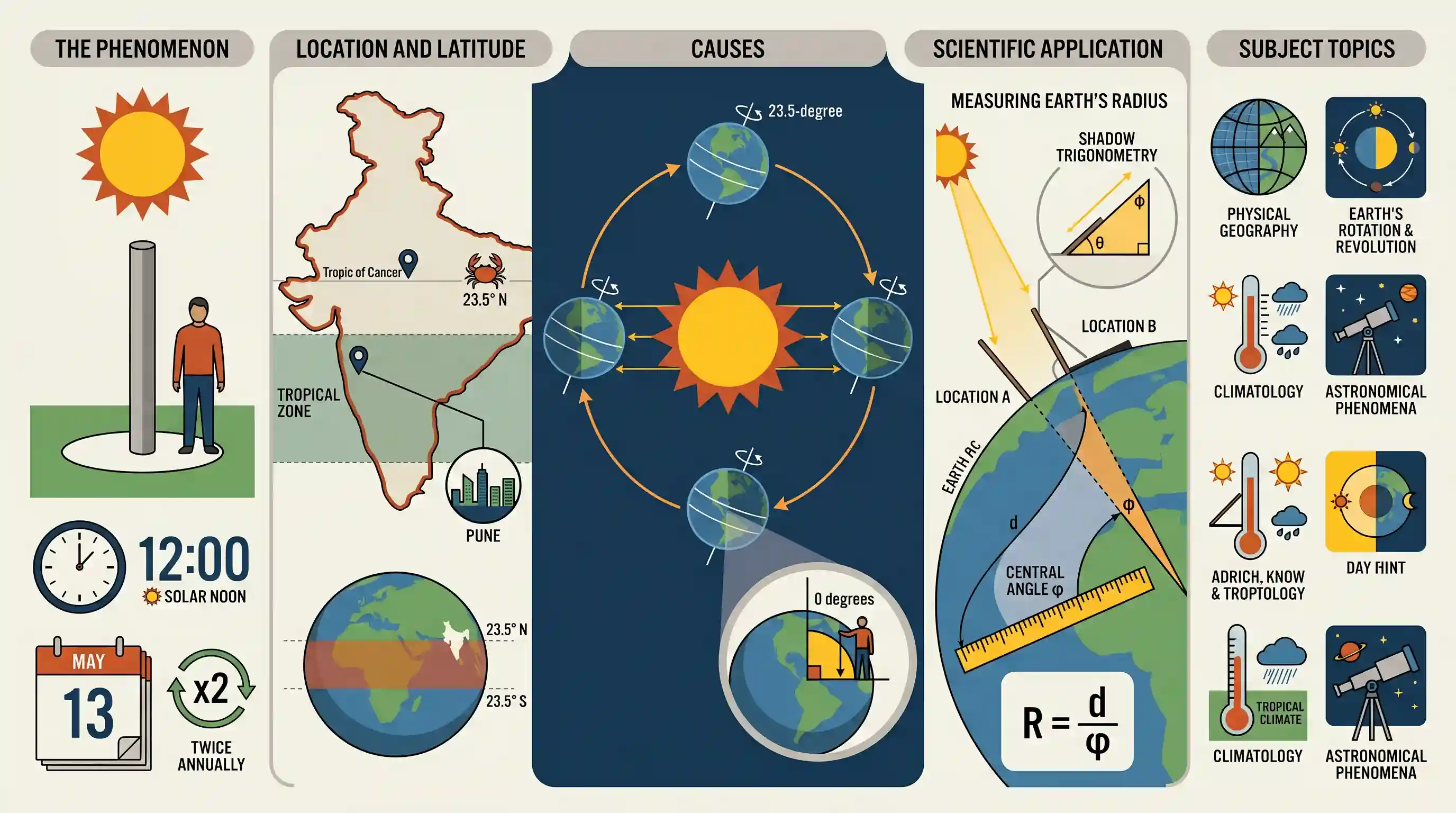
Pune witnessed 'Zero Shadow Day' on May 13, an astronomical phenomenon where the sun is exactly overhead at solar noon, eliminating shadows for vertical objects. This event occurs twice annually for places between the Tropics of Cancer and Capricorn due to the Earth's 23.5-degree axial tilt and its revolution around the sun. In India, states south of Bhopal fall into this latitudinal zone. Aside from public curiosity, the event holds scientific significance, offering a simple way to demonstrate Earth's geometry and measure its radius using shadow trigonometry.
Key Points
- Zero Shadow Day occurs when the sun is exactly overhead at local noon, causing vertical objects to cast no visible shadow for a brief period.
- The phenomenon is visible twice a year for any given location between the Tropic of Cancer (+23.5 degrees) and the Tropic of Capricorn (-23.5 degrees).
- It is caused by the Earth's 23.5-degree axial tilt and its revolution around the sun, which results in the apparent northward and southward movement of the sun across the equator.
- In India, regions located south of Bhopal experience this event, while locations north of the Tropic of Cancer never see the sun directly overhead.
- Pune experienced its first Zero Shadow Day of the year on May 13, with a second occurrence expected during the sun's southward journey later in the year.
- The phenomenon holds practical scientific value; for example, measuring shadow differences simultaneously at two latitudes (like Pune and Indore) allows one to calculate the radius of the Earth using basic trigonometry.
Important Terms
Zero Shadow Day

A biannual astronomical phenomenon where the Sun is exactly at the zenith, causing vertical objects to cast no shadow at solar noon. It occurs only for regions between the Tropics.
UPSC context
Relevant for GS Paper I (Physical Geography) and Prelims, testing understanding of Earth-Sun relationships and latitudinal phenomena.
Solar Noon
The specific moment when the Sun crosses the local meridian and reaches its highest point in the sky for the day, marking the middle of solar time.
UPSC context
Tests GS Paper I concepts of time reckoning, longitude, and the difference between solar time and standard clock time.
Axial Tilt
The 23.5-degree angle of Earth's rotational axis relative to its orbital plane around the Sun, responsible for seasons and varying solar intensity.
UPSC context
A fundamental GS Paper I (Geography) concept explaining seasonal changes, heat zones, and the limits of the tropics.
Inter-University Centre for Astronomy and Astrophysics (IUCAA)
An autonomous UGC-established institution in Pune focused on promoting research and nucleation of astronomy and astrophysics groups across Indian universities.
UPSC context
Important for GS Paper III (Science & Technology) regarding India's premier scientific institutions and space research infrastructure.
Jyotirvidya Parisanstha (JVP)
India's oldest amateur astronomers' association, founded in Pune in 1944, dedicated to astronomical outreach, research data sharing, and scientific temper.
UPSC context
Relevant for GS Paper I (Social Issues/History) or III, representing non-governmental contributions to scientific outreach and institutional history.
Zenith
The point on the celestial sphere directly above an observer (90 degrees altitude). During Zero Shadow Day, the Sun reaches this point.
UPSC context
A standard term in Geography and Astronomy (Prelims) used to describe solar position and celestial coordinates.
Prelims Trap
"Places situated exactly on the Tropic of Cancer experience Zero Shadow Day twice a year."
At the exact latitudes of the Tropics, the sun is overhead only once a year (solstices). It occurs twice a year strictly BETWEEN the tropics.
Static Concepts Connected
How does Earth's axial tilt dictate the 'Zero Shadow' latitudinal zone?
- Axial tilt limit: The 23.5-degree tilt restricts the sun's zenith (directly overhead) position strictly to the Torrid Zone, bounded by the Tropics of Cancer and Capricorn.
- Twice-a-year phenomenon: The apparent northward and southward journey of the sun ensures latitudes within the Torrid Zone see the sun directly overhead twice annually.
- Solstice extremes: On the exact lines of the Tropics of Cancer and Capricorn, the sun is exactly overhead only once a year during their respective solstices.
How does the Tropic of Cancer divide India's insolation zones?
- Geographical divide: The 23.5°N latitude serves as the northernmost limit for the subsolar point. It passes through eight states: Gujarat, Rajasthan, MP, Chhattisgarh, Jharkhand, WB, Tripura, and Mizoram.
- Tropical South: Places south of this line (e.g., Pune, Bengaluru) receive vertical sun rays and experience Zero Shadow Days.
- Sub-tropical North: Cities north of this line (e.g., New Delhi, Srinagar) only receive slanted rays and never experience a Zero Shadow Day.
Cross-Topic Patterns
Insolation zones and Solstices
Zero Shadow dynamics directly map to UPSC's recurring questions on the Torrid Zone's maximum insolation and the varying lengths of day/night during solstices across different latitudes.
Ancient Astronomy and Observatories
Using shadow trigonometry to measure Earth's radius recalls ancient scientific methods. This links to India's historical observatories (Jantar Mantar) built by Jai Singh II to track astronomical shadows.

Expect a geography question mapping specific Indian cities (e.g., Delhi vs. Chennai) to their ability to experience a Zero Shadow Day.
Linked PYQs · 3
Linked PYQs · 3
- 2019PrelimsGS1
On 21st June, the Sun
- 2024PrelimsGS1
On June 21 every year, which of the following latitude(s) experience(s) a sunlight of more than 12 hours? 1. Equator 2. Tropic of Cancer 3. Tropic of Capricorn 4. Arctic Circle Select the correct answer using the code given below:
- 2022PrelimsGS1
In the northern hemisphere, the longest day of the year normally occurs in the :
