US Russia Summit and Geopolitical Implications for Ukraine
Source:The Hindu ↗
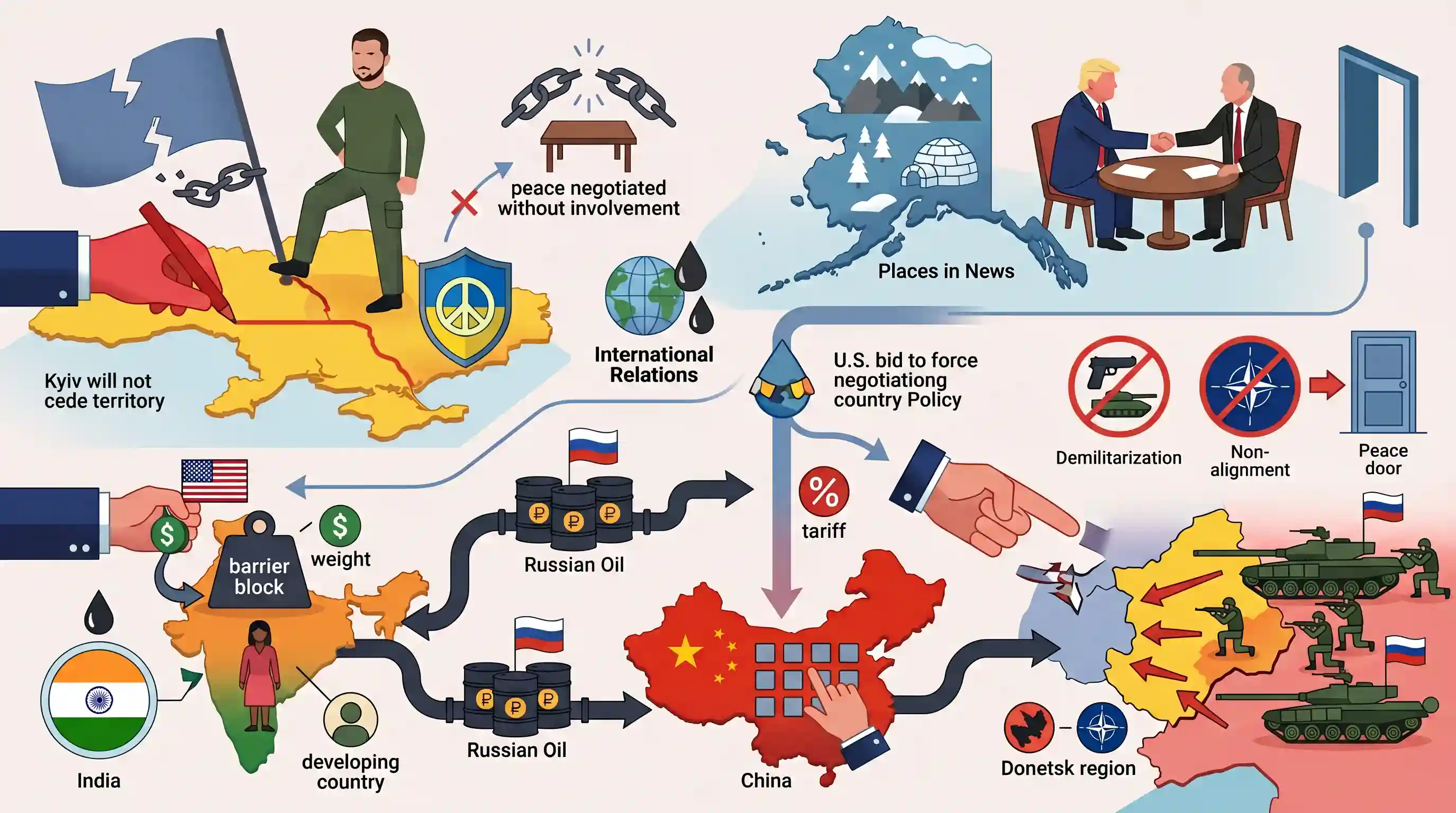
Why It Matters
The article highlights shifting global geopolitics under the new U.S. administration, the complexities of the Russia-Ukraine conflict, and direct economic implications for India via punitive tariffs tied to its energy security choices.
Summary
Ukrainian President Volodymyr Zelenskyy has warned against any peace agreements negotiated without Ukraine's involvement, firmly stating that Kyiv will not surrender territory to Russia. This comes ahead of a scheduled summit between U.S. President Donald Trump and Russian President Vladimir Putin in Alaska. In a bid to force Russia into negotiations, the U.S. has imposed tariffs on India and threatened China to curb their purchases of Russian oil. Meanwhile, Russian forces continue to advance in the Donetsk region, with Moscow demanding Ukraine's demilitarization and non-alignment with NATO as preconditions for peace.
Key Points
- Ukrainian President Zelenskyy rejected the idea of ceding land for peace and warned against decisions being made about Ukraine without its participation.
- U.S. President Donald Trump and Russian President Vladimir Putin are scheduled to hold a summit in Alaska to discuss the ongoing conflict.
- The U.S. imposed tariffs on India and threatened China over their purchases of Russian oil, aiming to financially pressure Moscow into negotiations.
- Russia captured Yablonovka in Donetsk and maintains its demands for Ukraine to withdraw from annexed regions, adopt neutrality, and abandon NATO aspirations.
Important Terms
NATO

A military alliance of 32 North American and European countries founded in 1949. Russia demands Ukraine's permanent neutrality and non-alignment with this alliance as a precondition for ending the ongoing conflict.
UPSC context
GS II: International Relations; crucial for understanding European security architecture and the geopolitical roots of the Russia-Ukraine war.
Donetsk
An industrial region in eastern Ukraine containing the 'fortress belt.' It is currently a focal point of Russian military advances and a major sticking point in peace negotiations regarding territorial concessions.
UPSC context
GS I: Geography/Places in News; relevant for mapping conflict zones and understanding regional geopolitical significance.
Tariffs
Taxes on imported goods. In 2025-2026, the U.S. used reciprocal and 'penalty' tariffs on Indian exports to pressure New Delhi into reducing its purchases of Russian crude oil.
UPSC context
GS III: Economy/Trade; illustrates the linkage between trade policy and foreign policy objectives (economic statecraft).
Strategic Autonomy
The ability of a state to pursue its national interests and foreign policy independently. For India, this involves balancing its energy needs from Russia with its strategic partnership with the U.S.
UPSC context
GS II: Indian Foreign Policy; tests knowledge of India's non-aligned approach in a polarized global order.
Energy Security
The uninterrupted availability of energy sources at an affordable price. India's reliance on Russian oil highlights the conflict between national resource needs and international diplomatic pressure.
UPSC context
GS III: Infrastructure/Energy; essential for understanding India’s import dependency and strategic reserves during global volatility.
Prelims Trap
"Russia currently claims only Donetsk and Luhansk as its annexed territories in Ukraine."
Aspirants often forget that Russia officially annexed four Ukrainian regions in late 2022 (Donetsk, Luhansk, Zaporizhzhia, and Kherson), not just the Donbas regions.
Static Concepts Connected
What is the geographical significance of the Bering Strait?
- Landmasses: Separates the Chukchi Peninsula of the Russian Far East from the Seward Peninsula of Alaska.
- Water bodies: Connects the Bering Sea (Pacific Ocean) in the south to the Chukchi Sea (Arctic Ocean) in the north.
- International Date Line: The International Date Line passes directly through the strait, lying exactly between the Russian Big Diomede and US Little Diomede islands.
How do Secondary Sanctions differ from Primary Sanctions?
- Primary Sanctions: Prohibit citizens and companies of the sanctioning country from doing business with the targeted nation.
- Secondary Sanctions: Penalize third-party countries (like India) or their entities for trading with the sanctioned target (Russia).
- Strategic Impact: Secondary sanctions represent extraterritorial application of domestic law, often threatening a nation's strategic autonomy.
Cross-Topic Patterns
Energy Security vs. Trade Tariffs
The US using tariffs to punish India for Russian oil purchases links GS2 (policies of developed nations) directly to GS3 (energy security and macroeconomic stability).
Arctic Geopolitics & Great Power Rivalry
Hosting the summit in Alaska highlights the Bering Strait's strategic role, connecting US-Russia relations to Arctic shipping routes and Prelims mapping questions.

US secondary sanctions impacting India's energy security is highly likely to feature as a GS2 Mains question on strategic autonomy in 2026.
Linked PYQs · 5
Linked PYQs · 5
- 2023PrelimsGS1
Consider the following pairs: Regions often mentioned in news Reason for being in news 1. North Kivu and Ituri : War between Armenia and Azerbaijan 2. Nagorno-Karabakh : Insurgency in Mozambique 3. Kherson and Zaporizhzhia : Dispute between Israel and Lebanon How many of the above pairs are correctly matched?
- 2023PrelimsGS1
Consider the following pairs: Area of conflict mentioned in news Country where it is located 1. Donbas : Syria 2. Kachin : Ethiopia 3. Tigray : North Yemen How many of the above pairs are correctly matched?
- 2025MainsGS2
"Energy security constitutes the dominant kingpin of India's foreign policy, and is linked with India's overarching influence in Middle Eastern countries.” How would you integrate energy security with India's foreign policy trajectories in the coming years?
- 2023MainsGS2
‘The expansion and strengthening of NATO and a stronger US-Europe strategic partnership works well for India.’ What is your opinion about this statement ? Give reasons and examples to support your answer.
- 2020MainsGS2
What is the significance of Indo-US defence deals over Indo-Russian defence deals? Discuss with reference to stability in the Indo-Pacific region.
