European allies pledge urgent military and energy aid to Ukraine
Source:The Hindu ↗
Why It Matters
The sustained Russia-Ukraine conflict highlights the evolving nature of global alliances, the profound impact of modern warfare technologies like drones on civilian infrastructure, and the resulting geopolitical ripple effects on global energy and security dynamics.
Summary
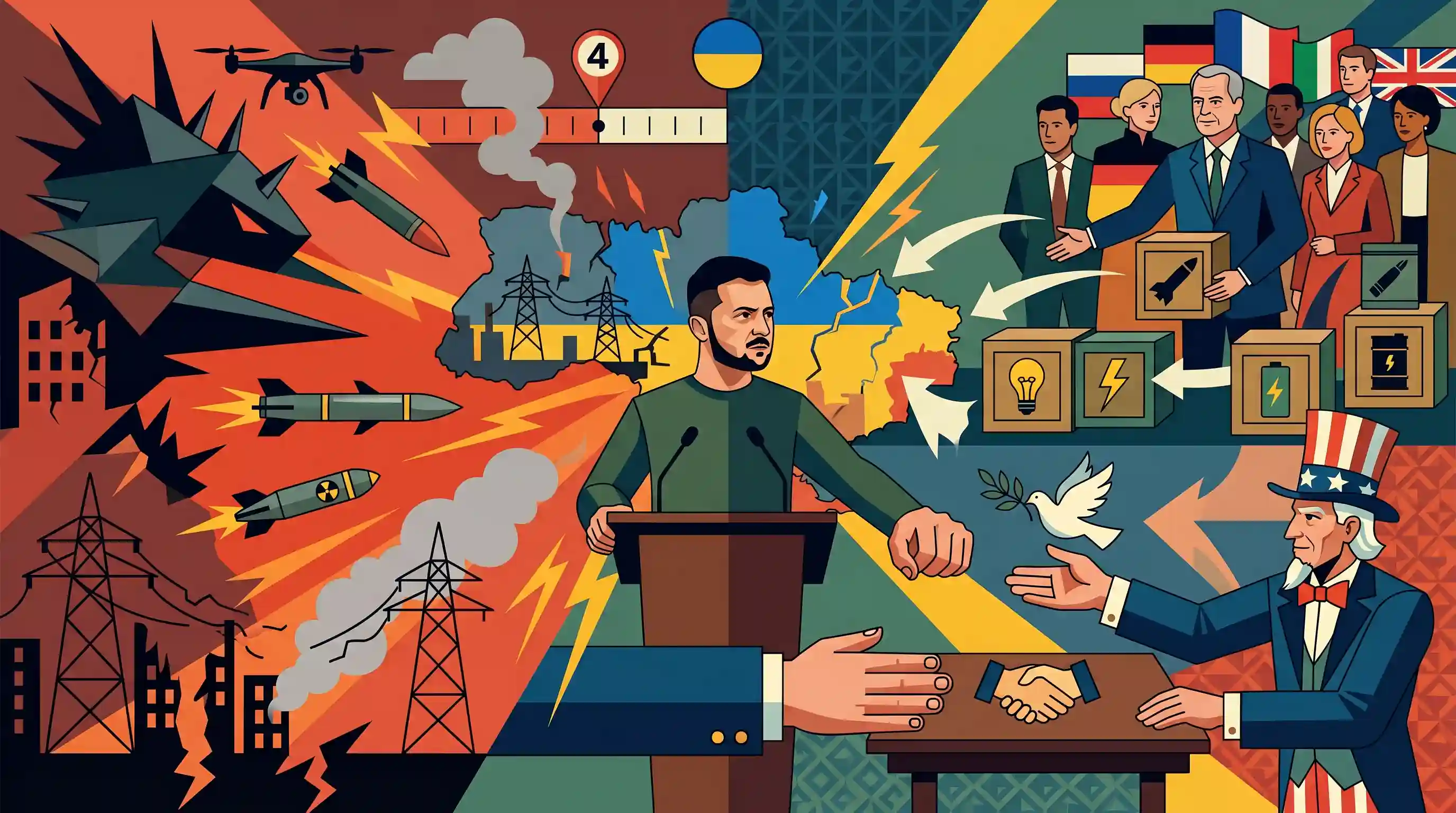
Ukrainian President Volodymyr Zelenskyy announced that European allies, under the 'Berlin Format', have agreed to provide new packages of energy and military aid to Ukraine ahead of the fourth anniversary of Russia's full-scale invasion on February 24. This support comes as Ukraine faces devastating Russian attacks—including thousands of drones, guided bombs, and missiles—on its cities and critical energy infrastructure. Concurrently, Kyiv is striving to rally European partners while managing U.S. pressure to enter peace negotiations.
Key Points
- European leaders in the 'Berlin Format' agreed in Munich to provide specific energy and military aid packages to Ukraine by February 24.
- The aid arrives ahead of the fourth anniversary of Russia's full-scale invasion.
- Ukraine has faced relentless Russian attacks on its energy infrastructure, resulting in widespread power outages in freezing weather.
- Russia recently launched around 1,300 attack drones, 1,200 guided aerial bombs, and numerous ballistic missiles within a single week.
- Kyiv is currently balancing the need to fend off Russian advances with growing U.S. pressure to negotiate a peace settlement.
Important Terms
Berlin Format

An ad-hoc diplomatic grouping of Ukraine and key European allies (including EU and NATO leadership) formed to coordinate urgent energy and military assistance packages.
UPSC context
GS Paper II: International Relations. Relevant for understanding regional groupings and ad-hoc diplomacy in the European security architecture.
Critical Energy Infrastructure
Physical assets like power grids and thermal plants essential for a state's functioning; their protection is vital for national resilience during modern warfare.
UPSC context
GS Paper III: Security/Infrastructure. Tests knowledge of asymmetric warfare and the targeting of civilian assets to degrade national morale.
Trilateral Format
A diplomatic framework involving three parties—the US, Russia, and Ukraine—focused on brokering a ceasefire and negotiating territorial disputes.
UPSC context
GS Paper II: International Relations. Important for studying global mediation efforts and the dynamics of major power diplomacy in conflict resolution.
Security Guarantees
Formal, legally binding commitments by external powers to defend a state’s sovereignty and territorial integrity against future aggression.
UPSC context
GS Paper II: IR. Key concept in post-conflict stability and the evolution of collective security mechanisms.
Hybrid Warfare
A conflict strategy blending conventional military force with unconventional methods, such as infrastructure sabotage, cyberattacks, and economic pressure.
UPSC context
GS Paper III: Security. Essential for analyzing modern threats that blur the line between civilian and military targets.
Ramstein Format
Also known as the Ukraine Defense Contact Group, this US-led coalition of 50+ nations coordinates the long-term delivery of military equipment to Ukraine.
UPSC context
GS Paper II: IR. Significant for understanding global military cooperation and the logistics of international defense aid.
Prelims Trap
"The 'Berlin Format' is a UN-mandated peace negotiation framework between Russia and Ukraine."
The 'Berlin Format' mentioned here is a European coordination mechanism for aid to Ukraine, distinct from the defunct Normandy Format or UN peace missions.
Static Concepts Connected
What is the Munich Security Conference (MSC)?
- Independent forum: An annual conference on international security policy held since 1963 in Munich, Germany.
- Not an IGO: It is not an intergovernmental organization or treaty body, but an independent platform for diplomatic initiatives.
- Davos of Defense: Often called the 'Davos of Defense', it gathers heads of state, military leaders, and intelligence chiefs globally.
How does International Law protect civilian infrastructure during war?
- Geneva Conventions: Additional Protocol I (1977) explicitly prohibits attacks on objects indispensable to the survival of the civilian population.
- Rome Statute: Systematic targeting of power plants to freeze civilian populations is generally considered a war crime under the Rome Statute.
- Proportionality principle: Military necessity must be weighed against civilian harm; indiscriminate attacks and weaponization of weather are forbidden.
Cross-Topic Patterns
Asymmetric Warfare & Border Security
The shift to low-cost 'kamikaze' drone swarms in Ukraine mirrors India's emerging internal security challenges with cross-border drone deployments in Punjab and J&K for arms and narcotics smuggling.
Transatlantic Divide & Strategic Autonomy
Europe's push to independently aid Ukraine (Berlin Format) amid US peace-negotiation pressures parallels India's own advocacy for multipolarity, strategic autonomy, and reducing reliance on singular defense/security umbrellas.

Expect a 2026 prelims match-the-following on global security frameworks (Berlin Format, Normandy, Munich Conference) or UAV swarm tech.
Linked PYQs · 3
Linked PYQs · 3
- 2023MainsGS2
‘The expansion and strengthening of NATO and a stronger US-Europe strategic partnership works well for India.’ What is your opinion about this statement ? Give reasons and examples to support your answer.
- 2023MainsGS3
The use of unmanned aerial vehicles (UAVs) by our adversaries across the borders to ferry arms/ammunitions, drugs, etc., is a serious threat to the internal security. Comment on the measures being taken to tackle this threat.
- 2025MainsGS2
"The reform process in the United Nations remains unresolved, because of the delicate imbalance of East and West and entanglement of the USA vs. Russo-Chinese alliance.” Examine and critically evaluate the East-West policy confrontations in this regard.
