India and Ukraine Discuss Enhanced Security Cooperation Agreement
Source:Indian Express ↗
Why It Matters
This development is crucial for UPSC aspirants as it illustrates India's exercise of strategic autonomy and multi-alignment—upgrading security ties with a Western-backed Ukraine without abandoning its foundational defence partnership with Russia. Additionally, the NIA's involvement in arresting foreign nationals highlights the intersection of internal security mandates with international diplomacy, a critical theme in GS2 and GS3.
Summary
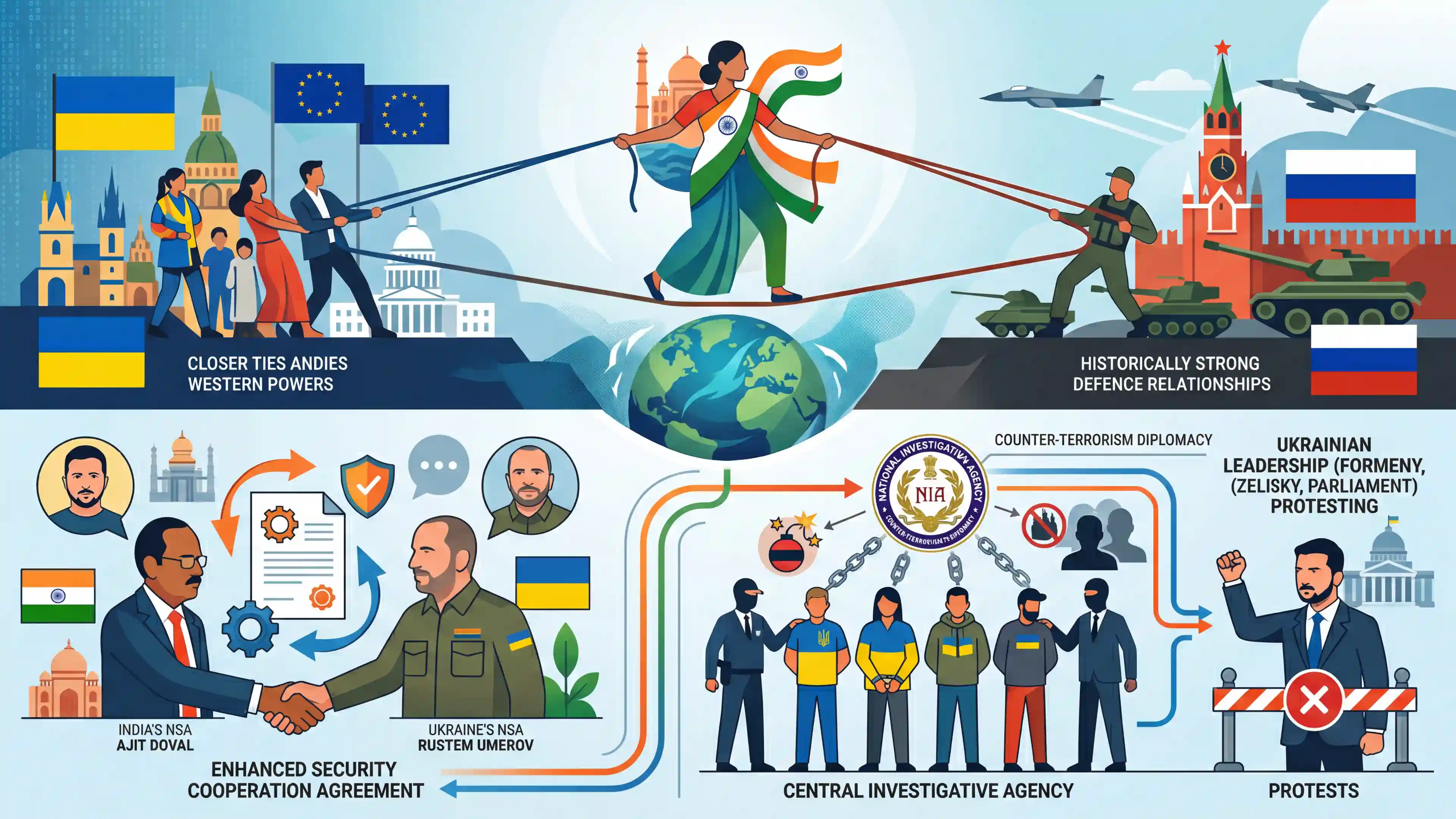
Ukrainian President Volodymyr Zelenskyy has announced that India and Ukraine are finalising an enhanced security cooperation agreement, following discussions between Ukraine's NSA Rustem Umerov and India's NSA Ajit Doval in New Delhi. This development underscores India's delicate diplomatic tightrope walk—forging closer security ties with Kyiv while sustaining its historically strong defence relationship with Russia. Concurrently, bilateral ties face friction due to the National Investigation Agency's (NIA) recent arrest of six Ukrainian nationals on terror conspiracy charges, an action that Ukraine formally protested as politically motivated.
Key Points
- Ukraine's President Zelenskyy announced that India and Ukraine are finalising an enhanced security cooperation agreement following NSA Rustem Umerov's visit to New Delhi.
- The upgraded security arrangement highlights India's strategic balancing act, deepening ties with Kyiv while maintaining robust historical defence relations with Moscow.
- During the talks, India reiterated its longstanding position advocating for a peaceful settlement of the Russia-Ukraine war through dialogue and diplomacy.
- The article also highlighted recent diplomatic friction after India's NIA arrested six Ukrainian nationals on terrorism conspiracy charges, prompting an official protest from Ukraine alleging political motivation.
Important Terms
Strategic Autonomy

India's policy of making independent foreign policy and security decisions based on national interest, avoiding permanent alignment with any major power bloc while engaging in issue-based partnerships.
UPSC context
GS2 International Relations; tests India’s balancing act between global powers and its shift from non-alignment to multi-alignment.
Joint Statement of the President of Ukraine and the Prime Minister of India (August 2024)
A landmark document from PM Modi's historic 2024 Kyiv visit, outlining cooperation in defense manufacturing, technology, and trade, while emphasizing peaceful resolution and territorial integrity.
UPSC context
GS2 Bilateral Relations; essential for understanding the recent pivot in India-Ukraine ties and peace diplomacy.
National Investigation Agency (NIA)
India's premier federal counter-terrorism agency established post-26/11. It has statutory powers to investigate terror-related crimes across states without requiring specific state-level consent.
UPSC context
GS3 Internal Security; tests knowledge of specialized agencies and the legal framework for combating terrorism.
National Security and Defense Council of Ukraine (NSDC)
The top-level state body responsible for coordinating national security, defense, and sanctions policy in Ukraine, advising the President on strategic and military affairs.
UPSC context
GS2 International Relations; relevant for understanding the institutional counterparts India engages for security cooperation.
Ministry of External Affairs (MEA)
The Government of India department responsible for managing foreign relations, formulating diplomatic policies, and representing India’s interests in international forums and bilateral dialogues.
UPSC context
GS2 Governance/IR; fundamental for understanding the execution of foreign policy and diplomatic protocol.
Prelims Trap
The UAPA and NIA Act are applicable only to Indian citizens committing offenses within India's territorial limits.
UAPA explicitly applies to foreign nationals. Furthermore, the 2019 NIA amendment granted the agency extraterritorial jurisdiction to investigate offenses targeting India, irrespective of nationality.
Static Concepts Connected
How do the UAPA and NIA Act apply to foreign nationals?
- Universal Applicability: The Unlawful Activities (Prevention) Act applies equally to any person, including foreign nationals, charged with terror conspiracies or acts against India.
- Extraterritorial Jurisdiction: The 2019 NIA Amendment empowers the agency to investigate terror crimes committed against Indians or Indian interests abroad, subject to international treaties.
- Special Courts: Cases involving foreign nationals investigated by the NIA are tried in specialized NIA Special Courts to ensure expedited processing.
What distinguishes India's multi-alignment from traditional Non-Alignment (NAM)?
- Issue-Based Partnerships: Engaging concurrently with opposing global actors (e.g., Russia and Ukraine/West) to maximize national interests, rather than maintaining passive equidistance.
- Security Integration: Unlike NAM's historical avoidance of military blocs, multi-alignment involves actively forging defense and security agreements with competing geopolitical poles.
Cross-Topic Patterns
Domestic Security Law vs. Diplomacy
The NIA's arrest of Ukrainian nationals illustrates how sovereign counter-terrorism actions under domestic law (UAPA) can create diplomatic friction, requiring tight MEA-MHA coordination.
Strategic Autonomy in Eastern Europe
Upgrading security ties with Kyiv signals India moving beyond its exclusive Moscow dependency, demonstrating true strategic autonomy and independent agency in Eastern Europe.

A multi-statement Prelims question testing NIA's extraterritorial jurisdiction and UAPA's applicability to foreign nationals is highly likely.
Linked PYQs · 4
Linked PYQs · 4
- 2020MainsGS2
What is the significance of Indo-US defence deals over Indo-Russian defence deals? Discuss with reference to stability in the Indo-Pacific region.
- 2023MainsGS3
What are the internal security challenges being faced by India? Give out the role of Central Intelligence and Investigative Agencies tasked to counter such threats.
- 2019MainsGS3
Indian Government has recently strengthened the anti-terrorism laws by amending the Unlawful Activities (Prevention) Act (UAPA), 1967 and the NIA Act. Analyze the changes in the context of prevailing security environment while discussing the scope and reasons for opposing the UAPA by human rights organizations.
- 2024MainsGS2
‘The West is fostering India as an alternative to reduce dependence on China's supply chain and as a strategic ally to counter China's political and economic dominance.’ Explain this statement with examples.
