Political Leadership Changes and Ethnic Conflict Management in Manipur
Source:Indian Express ↗
Why It Matters
The political stability and governance of North-Eastern states like Manipur are critical for India's internal security. The region faces unique challenges such as ethnic violence, cross-border insurgency (via the porous India-Myanmar border), and historical deficits in peace-building. Understanding political leadership changes in this context helps evaluate state responses to internal security crises and the mechanisms of peace processes.
Summary
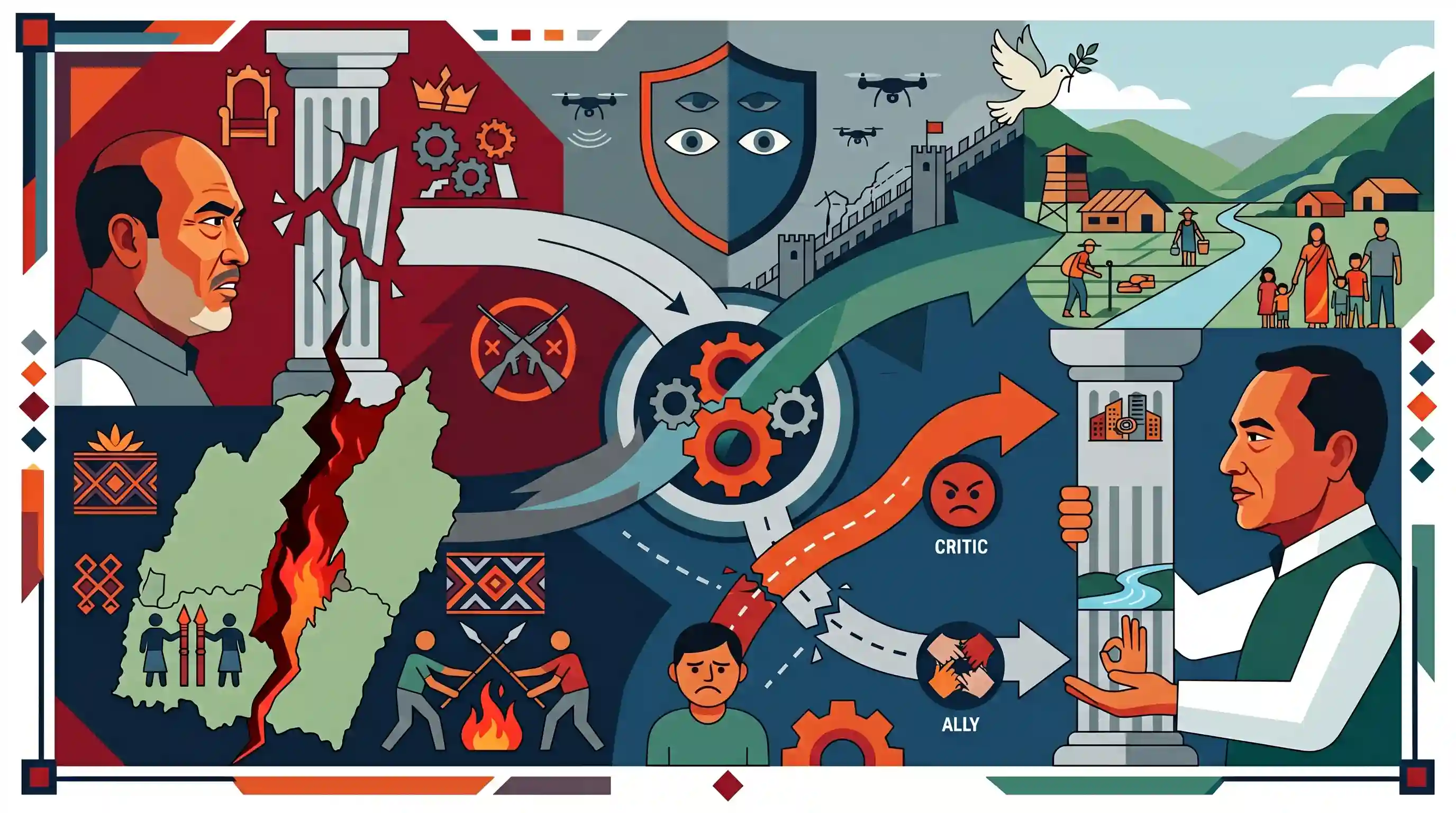
The article discusses the anticipated transition of the Chief Ministerial post in Manipur from N Biren Singh to Yumnam Khemchand Singh. Khemchand Singh, once a trusted ally, emerged as a prominent critic of Biren Singh's handling of the prolonged ethnic conflict between the Meitei and Kuki communities. This leadership change reflects the ruling party's strategy to address the severe governance deficit, restore peace, and manage internal security challenges in the border state of Manipur.
Key Points
- Yumnam Khemchand Singh is poised to replace N Biren Singh as the Chief Minister of Manipur.
- Khemchand Singh transitioned from being a trusted ally to a key critic of Biren Singh's administration, particularly concerning the handling of the ongoing state crisis.
- The leadership change is a strategic political move aimed at restoring governance and managing the prolonged ethnic conflict and internal security challenges in Manipur.
- This development highlights the complexities of state governance in border regions dealing with insurgency and ethnic strife.
Important Terms
Yumnam Khemchand Singh

The 13th Chief Minister of Manipur and former Assembly Speaker, chosen by the BJP in 2026 to lead reconciliation efforts following a year of President’s Rule.
UPSC context
Relevant for GS Paper II (Polity) regarding state executive leadership changes and conflict-resolution strategies in sensitive border states.
Manipur State Legislative Assembly
The state's unicameral 60-member legislature, characterized by a 40-20 seat split between the Meitei-dominated Imphal Valley and the tribal-majority Hill districts.
UPSC context
Tests understanding of GS Paper II (Polity) regarding legislative composition, representation of diverse communities, and state-level governance structures.
Meitei-Kuki Ethnic Conflict
A violent 2023-2024 conflict triggered by Meitei demands for ST status, exposing deep demographic anxieties and territorial disputes over land and resources.
UPSC context
Crucial for GS Paper III (Internal Security) and GS Paper I (Social Issues) regarding ethnic mobilization and communal harmony.
President’s Rule (Article 356)
Constitutional provision (Article 356) allowing the Union to take direct control when a state's government cannot function; imposed in Manipur for a year in 2025.
UPSC context
A core GS Paper II (Polity) topic testing federalism, emergency provisions, and the role of the Governor/Centre.
Suspension of Operations (SoO) Agreement
A tripartite ceasefire agreement between the Centre, State, and insurgent groups to stop hostilities and confine militants to designated camps while peace talks progress.
UPSC context
Important for GS Paper III (Internal Security) regarding insurgency management and peace negotiations in Northeast India.
Hill-Valley Divide
Manipur's socio-political fault line between the central plain (Meiteis) and the surrounding hills (Tribal groups), defined by differing land laws and resource access.
UPSC context
Relevant for GS Paper I (Geography) and Paper II (Governance) regarding regional imbalances and identity politics.
Prelims Trap
"Under Article 371C, the Governor administers Manipur's Hill Areas directly, overriding the State Legislature."
The Governor has a special reporting duty to the President, but executive power remains with the State Government subject to Union directions. They do not administer it directly.
Static Concepts Connected
What are the constitutional safeguards under Article 371C for Manipur?
- Hill Areas Committee: It provides for the creation of a committee consisting of MLAs elected from the Hill Areas of the state.
- Governor's Duty: The Governor must submit an annual report (or when required) to the President regarding the administration of the Hill Areas.
- Union Executive Power: The executive power of the Union extends to giving directions to the State Government concerning the administration of these specific areas.
What is the Suspension of Operations (SoO) agreement?
- Tripartite Pact: A 2008 tripartite ceasefire pact signed between the Central Government, the Manipur State Government, and Kuki-Zo insurgent groups.
- Core Objective: Designed to initiate political dialogue, halt violence, and confine armed insurgent cadres to designated camps under state monitoring.
Cross-Topic Patterns
Border Management + Demographic Faultlines
Manipur's crisis links internal demographic divides (Valley vs. Hills) with external security threats, specifically cross-border insurgent movement from Myanmar and the debate over scrapping the Free Movement Regime (FMR).
Article 355 vs. Article 356 mechanisms
The prolonged unrest constantly tests the application of Article 355 (duty to protect against internal disturbance) as a constitutional alternative to invoking Article 356 (President's Rule) in distressed states.

Expect a multi-statement Prelims question testing Article 371C, the Hill Areas Committee, and the Governor's reporting powers.
Linked PYQs · 4
Linked PYQs · 4
- 2017MainsGS3
The North-East region of India has been infested with insurgency for a very long time. Analyze the major reasons for the survival of armed insurgency in this region.
- 2019MainsGS3
Cross-border movement of insurgents is only one of the several security challenges facing the policing of the border in North-East India. Examine the various challenges currently emanating across the India-Myanmar border. Also, discuss the steps to counter the challenges.
- 2025MainsGS3
What are the major challenges to internal security and peace process in the North-Eastern States? Map the various peace accords and agreements initiated by the government in the past decade.
- 2024PrelimsGS1
The North Eastern Council (NEC) was established by the North Eastern Council Act, 1971. Subsequent to the amendment of NEC Act in 2002, the Council comprises which of the following members? 1. Governor of the Constituent State 2. Chief Minister of the Constituent State 3. Three Members to be nominated by the President of India 4. The Home Minister of India Select the correct answer using the code given below:
