SIM swap cyber fraud and digital financial security vulnerabilities
Source:Indian Express ↗
Why It Matters
As digital banking adoption grows, the reliance on SMS-based OTPs for financial authentication presents a major vulnerability. Understanding evolving cyber threats like SIM swapping is crucial for policymakers and law enforcement to develop robust data protection frameworks, mandate stronger multi-factor authentication, and improve digital literacy among citizens.
Summary
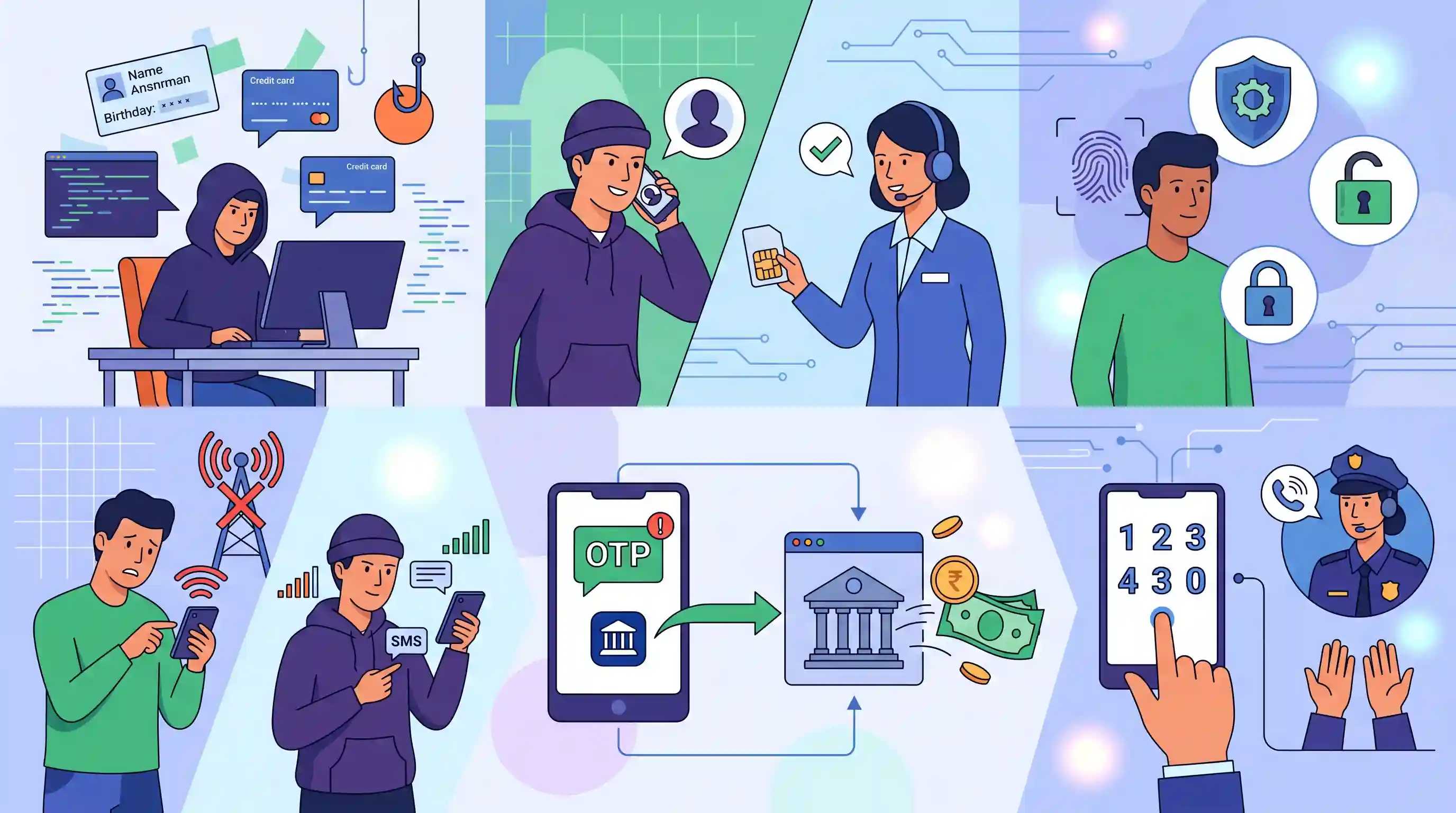
A rising cybercrime tactic known as "SIM swap fraud" is allowing criminals to drain bank accounts through a "silent takeover" of victims' mobile numbers. By gathering personal details via phishing or data leaks, fraudsters trick telecom providers into issuing duplicate SIM cards. This deactivates the victim's SIM—causing a sudden loss of network—while granting the attacker access to calls, SMS, and crucial banking OTPs. Law enforcement officials urge the public to be vigilant about unexpected network drops, adopt two-factor authentication (2FA), and immediately report incidents to the national cybercrime helpline (1930).
Key Points
- SIM swap fraud is an identity theft tactic where criminals use stolen personal data to obtain a duplicate SIM card, giving them control over a victim's mobile number.
- This 'silent takeover' enables fraudsters to intercept banking OTPs and siphon funds without requiring the victim to inadvertently share passwords or PINs.
- A primary warning sign is a sudden and prolonged loss of mobile network signal, as the original SIM is deactivated when the duplicate is issued.
- Victims are advised to report the fraud immediately to the national cybercrime helpline (1930) and their bank to block unauthorized transactions.
- Preventive steps include enabling two-factor authentication (2FA) via apps, avoiding suspicious links, and never sharing personal information with unverified callers.
Important Terms
SIM Swap Fraud

A cybercrime where fraudsters deceive telecom providers into transferring a victim's mobile number to a new SIM card under their control, enabling interception of OTPs and financial alerts.
UPSC context
GS III: Internal Security (Cyber Security). Tests understanding of digital financial threats and evolving modus operandi of organized cybercrime.
National Cybercrime Helpline (1930)
A national 24/7 toll-free helpline managed by the Indian Cyber Crime Coordination Centre (I4C) for immediate reporting and mitigation of financial cyber frauds.
UPSC context
GS III: Internal Security. Relevant for government initiatives to combat cybercrime and protect the digital economy.
Indian Cyber Crime Coordination Centre (I4C)
A nodal agency under the Ministry of Home Affairs that provides a framework for law enforcement agencies to deal with cybercrime in a coordinated manner across India.
UPSC context
GS III: Internal Security (Institutional Framework). Tests knowledge of India's central architecture for cybercrime management.
Two-Factor Authentication (2FA)
A security process requiring two distinct forms of identification (e.g., a password and a time-sensitive OTP) to grant access to an account or transaction.
UPSC context
GS III: Science & Technology (IT/Cybersecurity). Important for questions on digital safety standards and data protection.
Phishing
A form of social engineering where attackers use deceptive emails, messages, or calls to trick individuals into revealing sensitive personal or financial information.
UPSC context
GS III: Internal Security (Cyber Security). A basic yet critical concept regarding threat vectors in digital infrastructure.
Centre for Cyber Operations and Security (CenCOPS)
India's first state-of-the-art cyber centre established in Chandigarh to handle data analytics, predictive policing, and evidence collection for cybercrimes nationwide.
UPSC context
GS III: Internal Security (Police Modernization). A model for modernizing law enforcement to tackle high-tech crimes.
Prelims Trap
"SIM swap fraud requires the victim to inadvertently share an OTP for the transaction to succeed."
In a 'silent takeover', fraudsters clone the SIM at the telecom level. They receive OTPs directly; the victim merely experiences network loss and never actually shares the OTP.
Static Concepts Connected
What are the key citizen-centric modules of the DoT's Sanchar Saathi portal?
- TAFCOP module: Allows citizens to check the number of active mobile connections issued in their name and report/disconnect unauthorized ones.
- CEIR module: Central Equipment Identity Register enables users to block lost or stolen mobile devices across all Indian networks using the 15-digit IMEI number.
- Chakshu facility: Allows citizens to proactively report suspected fraudulent communications received via calls, SMS, or WhatsApp (e.g., fake KYC updates).
What is India's institutional framework for cybercrime reporting and response?
- I4C (MHA): The Indian Cyber Crime Coordination Centre operates under the Home Ministry (MHA), managing the National Cybercrime Reporting Portal and the 1930 helpline.
- CERT-In (MeitY): Operating under MeitY, it is the national nodal agency for responding to computer security incidents and tracking major malware/infrastructure threats.
- Defence Cyber Agency: A specialized agency under the Ministry of Defence established to handle cyber security challenges specifically for the Indian Armed Forces.
Cross-Topic Patterns
Inter-ministerial cyber security frameworks
Combating SIM swap fraud requires coordination between DoT (telecom node security), MHA (I4C financial fraud tracking), and RBI (banking authentication protocols).
Identity theft vs. Device compromise
Unlike spyware (Pegasus) that compromises device hardware, SIM swapping is an identity theft tactic that exploits human vulnerabilities at the telecom operator level to hijack the network connection.

Expect a 2026 Prelims question testing the distinct mandates of Sanchar Saathi (DoT), I4C (MHA), and CERT-In (MeitY) in cyber frauds.
Linked PYQs · 2
Linked PYQs · 2
- 2020MainsGS3
Discuss different types of cyber crimes and measures required to be taken to fight the menace.
- 2017MainsGS3
Discuss the potential threats of Cyber attack and the security framework to prevent it.
