Supreme Court Criticizes Election Commission on Voter Roll Revision
Source:The Hindu ↗
Why It Matters
This article is crucial for understanding the practical hurdles in India's electoral process, specifically concerning internal migrants and the grassroots administrative machinery (BLOs). It highlights the Supreme Court's proactive role in holding a constitutional body (ECI) accountable, making it highly relevant for questions on electoral reforms, the functioning of the ECI, and judicial oversight in GS Paper 2.
Summary
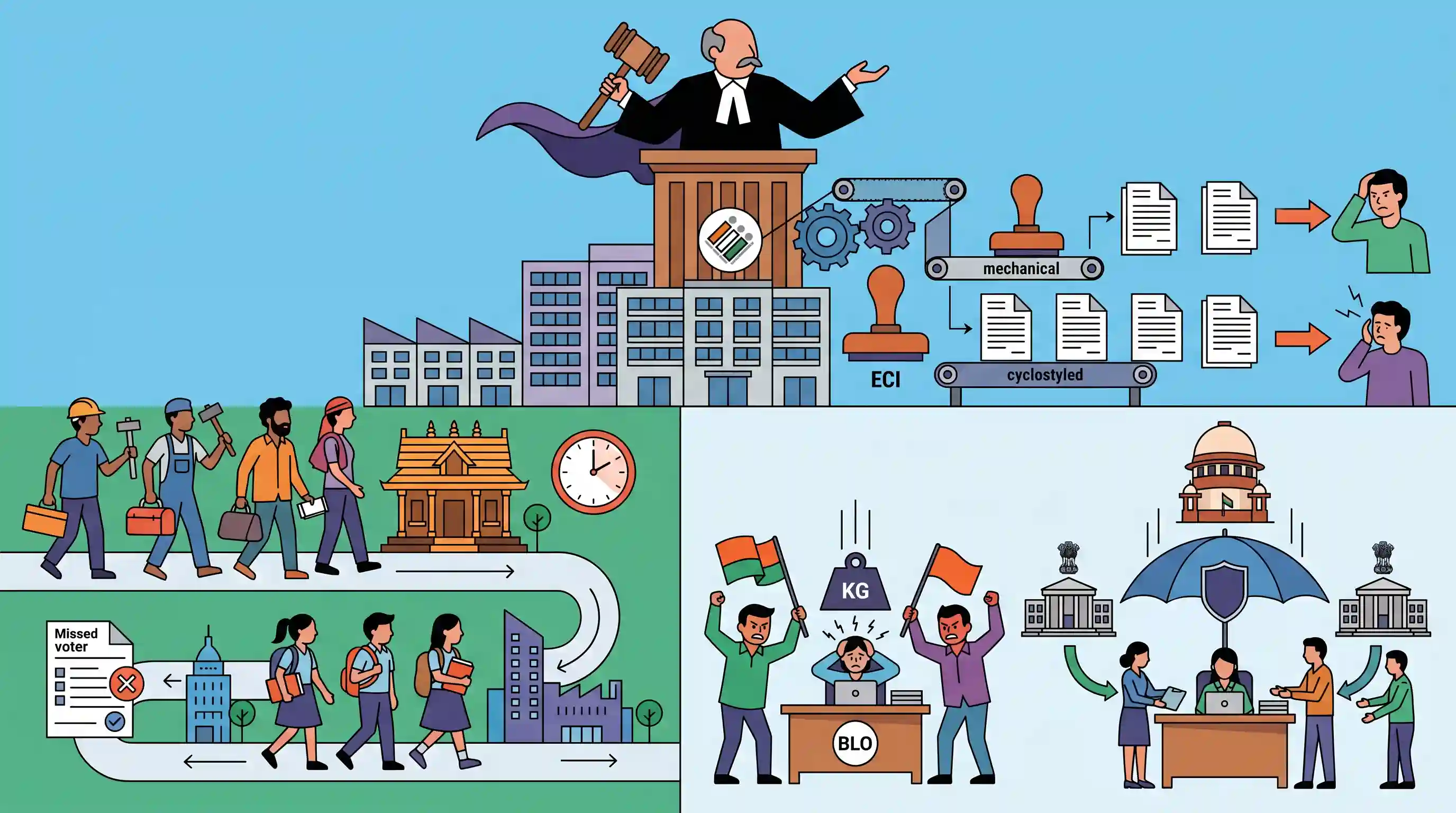
The Supreme Court strongly criticized the Election Commission of India (ECI) for providing "mechanical" and "cyclostyled" responses to the practical difficulties voters face during the Special Intensive Revision of electoral rolls. The Court emphasized the real-world problems of internal migrants, citing examples of Tamil Nadu workers traveling to Sabarimala and students in Kerala, who struggled to meet deadlines for voter enumeration forms. Additionally, the Supreme Court expressed concern over the plight of Booth Level Officers (BLOs), who face extreme pressure and hostility from local political parties. Recognizing their statutory duty, the Court mandated pan-India protection for BLOs and directed state governments to provide additional personnel or substitutes to manage the workload and protect grassroots election officials.
Key Points
- The Supreme Court criticized the Election Commission of India (ECI) for its bureaucratic and mechanical responses to practical challenges faced by voters during the Special Intensive Revision of electoral rolls.
- The Court highlighted the voting enfranchisement struggles of internal migrants, such as workers going on the Sabarimala pilgrimage and students studying in other states.
- The SC mandated that states and the ECI must protect Booth Level Officers (BLOs), who are allegedly facing hostility and intimidation from political parties in states like West Bengal and Kerala.
- A pan-India directive was issued requiring states to provide substitutes for sick BLOs and depute additional personnel to alleviate the immense workload and stress on the grassroots election machinery.
Important Terms
Special Intensive Revision (SIR)

A large-scale, door-to-door verification drive by the Election Commission to comprehensively update electoral rolls. It involves fresh enumeration and physical verification to remove duplicates and include new voters, typically triggered before major elections.
UPSC context
GS Paper II (Electoral Reforms); tests understanding of election management and voter list purification processes.
Booth Level Officers (BLO)
Grassroots election officials, usually government employees, appointed under Section 13B of the RPA 1950. They act as the ECI's field-level representatives responsible for house-to-house verification and ensuring voter roll accuracy.
UPSC context
GS Paper II (Governance); relevant for understanding the administrative machinery and challenges at the booth level.
Representation of the People Act, 1950
A parliamentary act governing the preparatory stages of elections, including seat allocation, delimitation of constituencies, and the preparation of electoral rolls. It provides the legal basis for voter registration and roll revision.
UPSC context
GS Paper II (Salient Features of RPA); a core legislative topic for understanding India’s democratic framework.
Election Commission of India (ECI)
An autonomous constitutional body mandated to conduct elections to India's Parliament, State Legislatures, and the offices of President and Vice-President. It ensures the integrity of the electoral process and voter enrollment.
UPSC context
GS Paper II (Constitutional Bodies); frequently tested regarding its powers, independence, and role in electoral reforms.
Article 324
A constitutional provision vesting the superintendence, direction, and control of Union and State elections in the Election Commission. It provides the plenary power required to ensure the conduct of free and fair elections.
UPSC context
GS Paper II (Constitutional Bodies); fundamental for understanding the autonomy and functional scope of the ECI.
Internal Migrants
Citizens who move within their country for work or education. In an electoral context, they often face disenfranchisement due to practical difficulties in updating voter registration at their new residence.
UPSC context
GS Paper II (Social Justice/Vulnerable Sections); tests sensitivity to practical barriers in exercising the right to vote.
Prelims Trap
"Booth Level Officers are permanent staff directly employed by the Election Commission of India."
BLOs are not ECI employees. They are local State Government or local authority employees (e.g., teachers, Anganwadi workers) temporarily deputed for election duties under RPA 1950.
Static Concepts Connected
What are the core voter registration conditions under the Representation of the People Act, 1950?
- Age & Citizenship: Must be a citizen of India and not less than 18 years of age on the stipulated qualifying date.
- Ordinarily Resident: Must be an "ordinarily resident" in the constituency, which denotes habitual living rather than mere property ownership.
- Disqualifications: Individuals can be disqualified from registration due to unsoundness of mind, corrupt electoral practices, or specific criminal offenses.
What is the constitutional framework governing electoral rolls and voting rights?
- Article 325: Mandates a single, general electoral roll for every territorial constituency, strictly prohibiting exclusion based on religion, race, caste, or sex.
- Article 326: Establishes universal adult suffrage as the baseline for elections to the Lok Sabha and State Legislative Assemblies, guaranteeing the right to vote.
- Article 324: Vests the superintendence, direction, and control of the preparation of electoral rolls entirely in the Election Commission of India.
Cross-Topic Patterns
Internal Migration & Voting Rights
The disenfranchisement of circular migrants links demographic shifts in economic geography to the constitutional guarantee of Article 326 and the ECI's proposed technological fix via Remote EVMs (RVMs).
Judicial Scrutiny of ECI Machinery
Mandating BLO protection extends the Supreme Court's recent trend of deeply reviewing the ECI's administrative machinery, echoing the scrutiny seen in the Anoop Baranwal (CEC appointment) judgment.

Expect a multi-statement Prelims question testing the strict legal differences between RPA 1950 (electoral rolls/BLOs) and RPA 1951 in 2026.
Linked PYQs · 3
Linked PYQs · 3
- 2022MainsGS2
Discuss the role of the Election Commission of India in the light of the evolution of the Model Code of Conduct.
- 2004PrelimsGS1
Consider the following tasks: 1. Superintendence, direction and conduct of free and fair elections. 2. Preparation of electoral rolls for all elections to the Parliament, State Legislatures and the Office of the President and the Vice-president. 3. Giving recognition to political parties and allotting election symbols to political parties and individuals contesting the election. 4. Proclamation of final verdict in the case of election disputes. Which of the above are the functions of the Election Commission of India?
- 2017MainsGS2
To enhance the quality of democracy in India the Election Commission of India has proposed electoral reforms in 2016. What are the suggested reforms and how far are they significant to make democracy successful?
