Senior leader criticises police action on student protests
Source:Indian Express ↗
ఇది ఎందుకు ముఖ్యం
This development addresses the critical balance between maintaining public order and protecting the democratic right to protest. It raises significant questions regarding the integrity of high-stakes national examinations like NEET, the application of legislative tools like the Public Examinations Act, and the ethical requirement for empathy and compassion in public administration and civil services.
సారాంశం
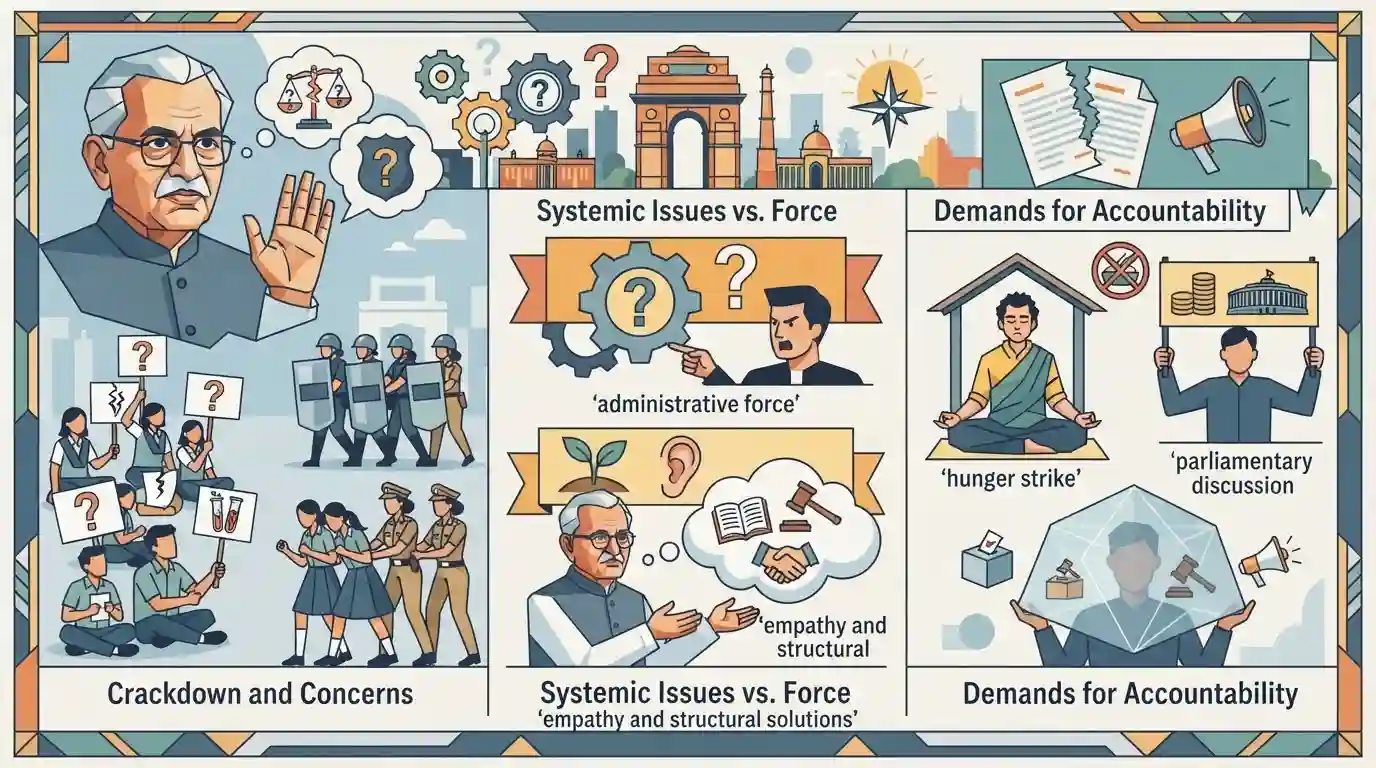
BJP veteran Dr. Murli Manohar Joshi criticized the Delhi Police's forceful crackdown on student protestors agitating against the NEET examination paper leaks in New Delhi. Expressing deep concern over the mishandling of female protestors, Joshi argued that student anxieties are genuine systemic issues requiring empathy and structural solutions rather than administrative force. He warned that treating protests purely as law-and-order issues could alienate the youth from the national goal of 'Viksit Bharat'. The ongoing agitation, led by the Cockroach Janta Party (CJP) and supported by activist Sonam Wangchuk on a hunger strike, demands accountability, compensation, and parliamentary discussions over the exam integrity crisis.
ముఖ్య అంశాలు
- BJP veteran and former Union Minister Dr. Murli Manohar Joshi criticized the police's forceful crackdown on student protests in New Delhi, highlighting the 'brutal mishandling' of young female protestors.
- Joshi stated that the anxieties and concerns of students regarding the NEET examination system are genuine and must be addressed with administrative empathy and structural solutions, rather than being treated strictly as law-and-order issues.
- He warned that the disproportionate use of police force risks alienating the youth and large sections of society, which could hinder the national objective of achieving 'Viksit Bharat'.
- The protests, led by the Cockroach Janta Party (CJP) at Jantar Mantar, are centered on demands for the resignation of Union Education Minister Dharmendra Pradhan over the NEET paper leak, compensation for families of students who committed suicide, and a dedicated discussion in Parliament.
- Activist Sonam Wangchuk continues his hunger strike (hospitalized at Medanta Hospital in Gurugram) in support of the students, establishing specific conditions for ending the stir.
ముఖ్యమైన పదాలు
The Public Examination (Prevention of Unfair Means) Act, 2024

A national legislation enacted to curb paper leaks, organized cheating, and malpractices in central recruitment and entrance exams like NEET, JEE, and UPSC, prescribing strict criminal penalties.
UPSC context
GS Paper II (Governance) & GS III (Education). Tests statutory frameworks for exam integrity and administrative accountability.
Cockroach Janta Party (CJP)
A satirical, youth-led Indian protest movement founded in May 2026, reclaiming a controversial judicial remark to mobilize massive student demonstrations demanding educational reforms and exam system accountability.
UPSC context
GS Paper II (Pressure Groups and Civil Society). Tests roles of informal civic movements and digital public grievance forums in a democracy.
Delhi Police
The law enforcement agency for India's capital territory, operating directly under the Ministry of Home Affairs, responsible for maintaining public order, safety, and policing during protests.
UPSC context
GS Paper II (Police Reforms / Civil Services in a Democracy). Tests mechanisms of policing, law and order, and state accountability.
Medanta Hospital
A premier multi-specialty private hospital in Gurugram where activist Sonam Wangchuk was transferred for medical care under Delhi High Court orders during his indefinite hunger strike.
UPSC context
GS Paper II (Fundamental Rights). Relates to judicial intervention under Article 21, protecting health and choice of medical facility.
ప్రిలిమ్స్ ఉచ్చు
The Right to Protest is explicitly listed as an absolute and independent Fundamental Right under Article 19.
The Indian Constitution does not explicitly grant an independent 'Right to Protest.' Instead, this right is a derivative right inferred from the combination of Article 19(1)(a) and 19(1)(b), which are subject to reasonable restrictions.
అనుసంధానమైన స్థిర భావనలు
What is the constitutional framework and judicial stance on the Right to Protest in India?
- Constitutional Basis: Derived from Article 19(1)(a) (freedom of speech) and 19(1)(b) (peaceful assembly without arms).
- Reasonable Restrictions: Subject to Article 19(2) and 19(3) clauses, including public order, sovereignty, and integrity of India.
- Judicial Boundaries: The Supreme Court in Amit Sahni (2020) ruled that public spaces/roads cannot be occupied indefinitely, and protests must happen in designated areas.
What are the legal protections and procedures for arresting/handling female protestors in India?
- Sunset Provision: Prohibits arresting women between sunset and sunrise, except under exceptional circumstances and only with the prior written permission of a Judicial Magistrate.
- Gender-Specific Arrest: Any search, arrest, or physical handling of a woman must strictly be performed by a female police officer to maintain decency.
- Judicial Mandate: The Supreme Court in Sheela Barse v. State of Maharashtra (1983) mandated separate lockups for female lockups and female guard presence.
అంతర-అంశ నమూనాలు
Police Reforms + Internal Security: Democratic crowd control
Examines the shift from colonial-era policing tactics to human-rights-centric crowd management under modern police reform recommendations like the Padmanabhaiah and Soli Sorabjee committees.
E-Governance + Public Trust: Secure exam systems
Links systemic paper leaks and subsequent student unrest to the urgent need for secure, tamper-proof, and decentralized computer-based testing infrastructure in national-level examinations.

Expect a GS-II question assessing the balance between Section 163 of BNSS and derivative fundamental rights to peaceful assembly in 2026.
అనుసంధాన PYQలు · 2
అనుసంధాన PYQలు · 2
- 2024MainsGS2
What are the aims and objects of recently passed and enforced, The Public Examination (Prevention of Unfair Means) Act, 2024? Whether University/State Education Board examinations, too, are covered under the Act ?
- 2022MainsGS4
Apart from intellectual competency and moral qualities, empathy and compassion are some of the other vital attributes that facilitate the civil servants to be more competent in tackling the crucial issues or taking critical decisions. Explain with suitable illustrations.
