Judicial Review of Police Crackdowns on Student Protests
Source:Indian Express ↗
Why It Matters
This development highlights the delicate balance between the constitutional right to peaceful protest, state actions to maintain public order, and the role of the Supreme Court as a shield against potential executive and police overreach. It serves as a prime case study for civil liberties, police reforms, and judicial intervention under GS Paper II and GS Paper IV.
Summary
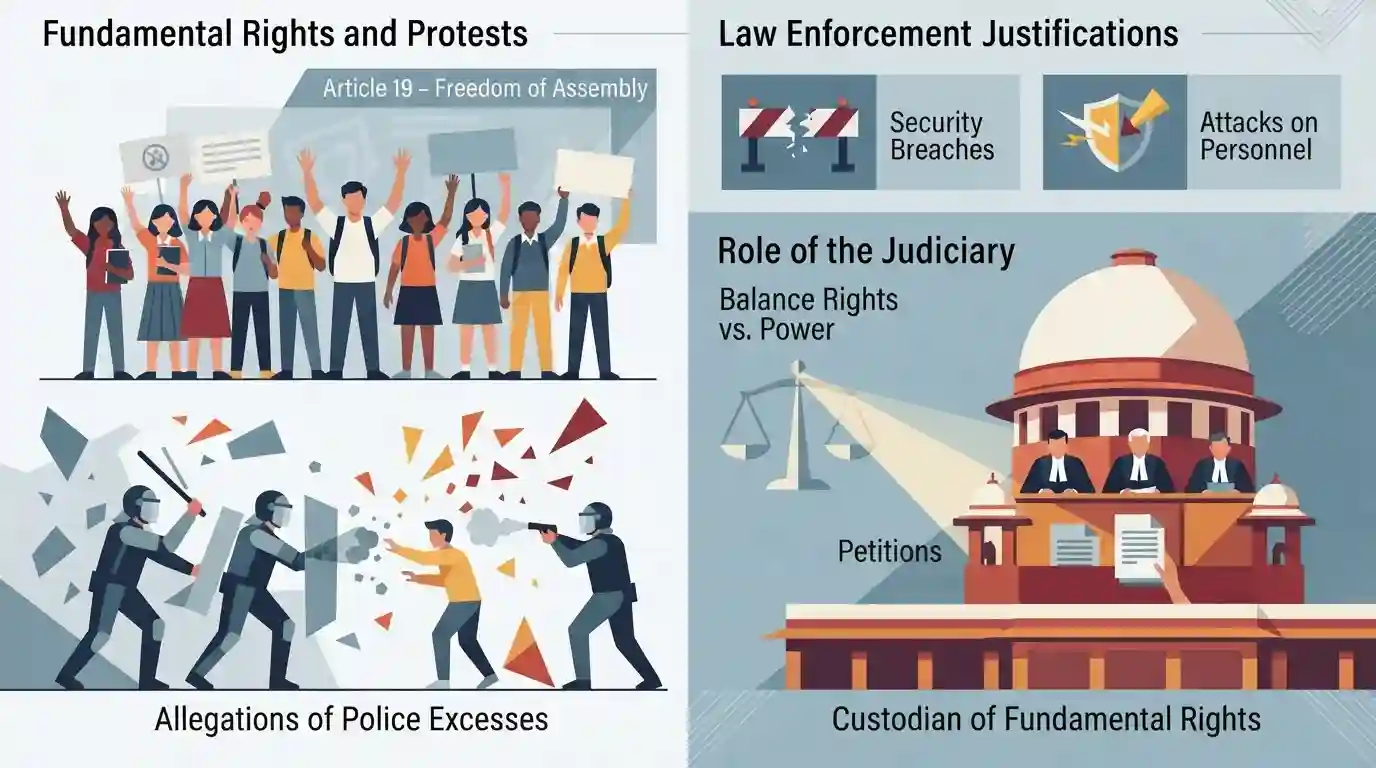
The Supreme Court of India has agreed to hear petitions alleging police excesses against students protesting across the country over the NEET paper leak. While students allege the use of excessive force like batons and tear gas, police cite security breaches and attacks on personnel as justifications for their actions. The bench, led by CJI Surya Kant, scheduled the hearing after clarifying that properly constituted petitions have now been submitted, highlighting the judiciary's essential role in balancing citizen rights against police and executive power.
Key Points
- The Supreme Court of India, led by a three-judge bench of Chief Justice Surya Kant and Justices Joymalya Bagchi and V Mohana, has agreed to hear petitions concerning alleged police excesses against students protesting across India against the NEET question paper leaks.
- Petitioners represented by Senior Advocate Gopal Sankaranarayanan allege that police have used excessive force, including batons and tear gas, against students, stating that 'the court stands between us and the police'.
- Law enforcement officials have defended their actions, citing attempts by protesters to breach security cordons and attacks on police personnel, leading to the registration of multiple FIRs and intensified security measures.
- Chief Justice Surya Kant clarified that the court had previously not refused to list the matter, explaining that the media had falsely reported a refusal based on an informal lawyer's representation, whereas properly filed petitions with diary numbers are now set to be heard.
Important Terms
Supreme Court of India

The highest judicial body in India, established under Article 124, serving as the final court of appeal and the ultimate custodian of citizens' fundamental rights.
UPSC context
GS Paper II (Judiciary); tests judicial review, writ jurisdictions (Article 32), and balancing public safety against fundamental rights.
Doctrine of Proportionality
A legal rule requiring that any state action restricting fundamental rights must pursue a legitimate aim, be necessary, and balance public interest with individual liberty.
UPSC context
GS Paper II (Polity & Judicial Review); tests executive accountability and the limits of reasonable restrictions on constitutional freedoms.
Constitution of India
The supreme law of India that outlines the framework for governance, establishes the structures and powers of state organs, and guarantees fundamental rights.
UPSC context
GS Paper II (Polity & Constitution); tests the basic structure, constitutionalism, and civil liberties.
National Eligibility-cum-Entrance Test (NEET)
A nationwide, single-window competitive examination conducted by the National Testing Agency (NTA) for admissions to undergraduate medical courses in India.
UPSC context
GS Paper II (Education & Governance); tests policies on centralized testing, federalism in education, and administrative transparency.
Article 19 of the Constitution of India
A constitutional provision guaranteeing six essential democratic freedoms, including peaceful assembly, subject to reasonable restrictions like public order and security.
UPSC context
GS Paper II (Fundamental Rights); tests the balance between civil liberties, administrative overreach, and state power.
Prelims Trap
The right to assemble peaceably under Article 19(1)(b) can be restricted on grounds of decency, morality, or security of the State.
Decency, morality, and security of the State are grounds under Article 19(2) (speech), not Article 19(3) (assembly), which only allows sovereignty/integrity and public order.
Static Concepts Connected
What are the constitutional boundaries of the Right to Protest in India?
- Constitutional Source: Derived implicitly from the intersection of Article 19(1)(a) (speech) and Article 19(1)(b) (peaceful assembly without arms).
- Permissible Restrictions: Article 19(3) permits restrictions only on two specific grounds: sovereignty and integrity of India, and public order.
- Amit Sahni Ruling: The Supreme Court ruled that protests cannot block public roads indefinitely; rights of commuters must coexist with dissent.
What is the legal standard for police force during protests?
- Proportionality Doctrine: Police force must be a last resort, using only the minimum necessary measure to restore public order.
- Anita Thakur Case: The Supreme Court ruled that excessive or disproportionate force by police violates Article 21, allowing public law compensation.
Cross-Topic Patterns
Seventh Schedule vs. Fundamental Rights
Maintaining public order (State List) often collides with Union-protected fundamental rights, forcing the Supreme Court to act as a federal balancing wheel during civil unrest.
Governance Failures and Protest Genesis
Institutional lapses in central testing bodies (like NTA) act as triggers for law-and-order crises, showing how bad administrative governance directly impacts civil stability.

Mains 2026 is likely to test the boundary between Article 19(1)(b) and 'public order' restrictions using recent protest precedents.
Linked PYQs · 2
Linked PYQs · 2
- 2024MainsGS2
Explain the reasons for the growth of public interest litigation in India. As a result of it, has the Indian Supreme Court emerged as the world's most powerful judiciary ?
- 2020MainsGS2
Judicial Legislation is antithetical to the doctrine of separation of powers as envisaged in the Indian Constitution. In this context justify the filing of large number of public interest petitions praying for issuing guidelines to executive authorities.
