Uttar Pradesh government orders probe into Meerut student murder
Source:timesofindia ↗
Why It Matters
The article underlines the practical challenges surrounding police accountability, the political sensitivity of atrocities against Dalits, and constitutional dimensions involving the right to peaceful assembly, use of force, and the protection of vulnerable groups—all vital themes for Polity and Governance.
Summary
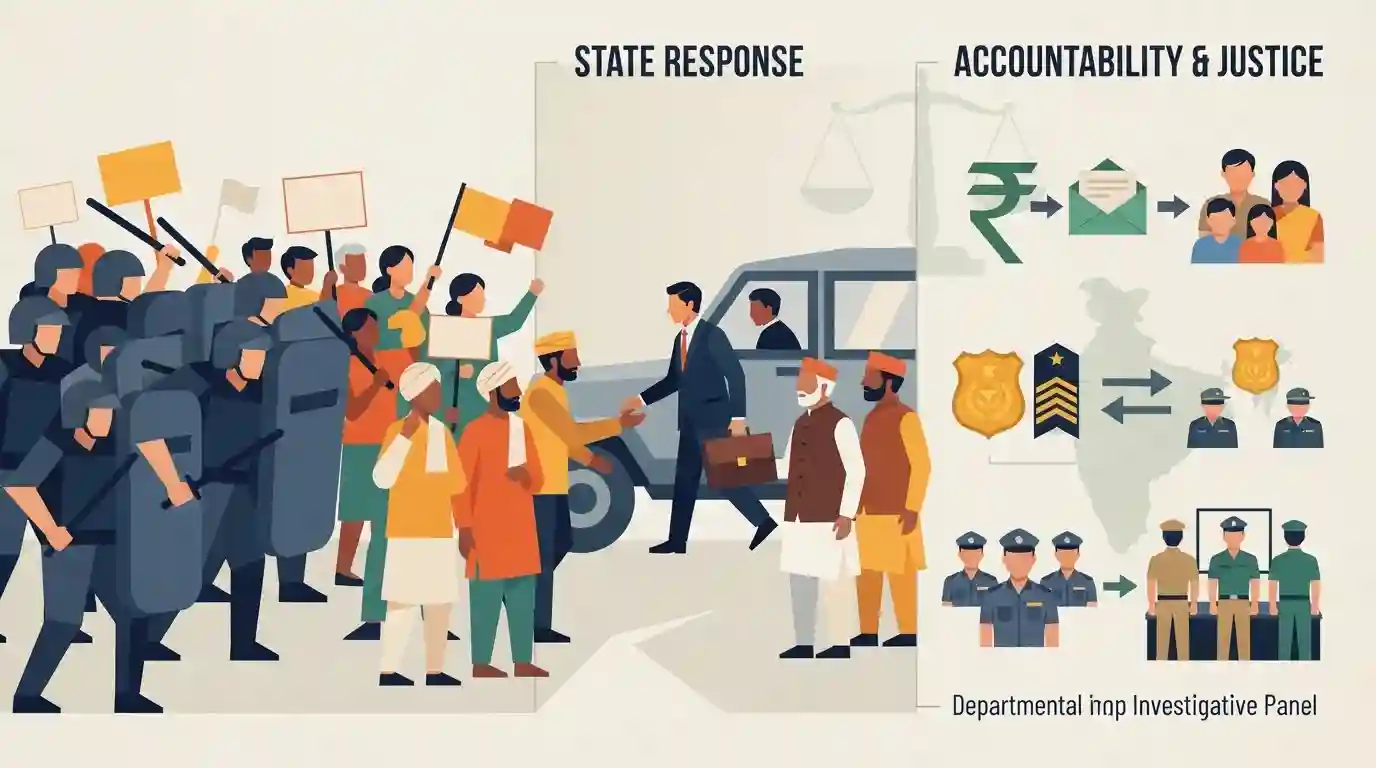
Following the murder of a Dalit student in Meerut and a subsequent police lathi-charge on protesting members of the Dalit community, the Uttar Pradesh government dispatched Social Welfare Minister Asim Arun to manage the escalating crisis. The incident drew intense criticism from opposition leaders regarding the state's law and order and its treatment of marginalized communities. In response, the state government announced financial compensation, transferred senior police officers, and instituted departmental inquiries into the alleged police brutality. The situation highlights critical governance issues related to police accountability, the protection of Dalit rights, and the constitutional right to peaceful assembly.
Key Points
- The UP government dispatched Social Welfare Minister Asim Arun to Meerut to defuse political tension following the murder of a Dalit student and subsequent police crackdown on protesters.
- High-level probes and departmental inquiries were ordered into the alleged police brutality (lathi-charge) against the Dalit demonstrators.
- Several police officials, including a circle officer, were transferred, and an involved PAC constable was arrested.
- The incident sparked intense political reactions from opposition leaders (Mayawati, Akhilesh Yadav, Chandrashekhar Azad), raising concerns over Dalit safety, law and order, and police accountability in the state.
Important Terms
Scheduled Castes and the Scheduled Tribes (Prevention of Atrocities) Act

A 1989 Indian law enacted to prevent crimes, discrimination, and hate crimes against Scheduled Castes and Scheduled Tribes, establishing special courts for speedy trials and rehabilitation of victims.
UPSC context
GS Paper II: Social Justice and Vulnerable Sections; tests understanding of legislative protections for marginalized groups.
Provincial Armed Constabulary (PAC)
An armed reserve wing of the Uttar Pradesh Police, trained on military lines, primarily deployed for riot control, maintaining law and order during emergencies, and protecting vital installations.
UPSC context
GS Paper III: Internal Security; tests knowledge of state-level specialized law enforcement agencies.
Bhim Army
An unregistered Dalit rights organization founded in 2015 in Uttar Pradesh, advocating for education, empowerment, and defense against caste-based discrimination and atrocities.
UPSC context
GS Paper II: Social Justice and Civil Society; tests understanding of grassroots social mobilization.
Bahujan Samaj Party (BSP)
A national political party in India, founded in 1984 by Kanshi Ram, representing marginalized communities like Scheduled Castes, Scheduled Tribes, and Other Backward Classes.
UPSC context
GS Paper II: Polity & Representation; tests knowledge of regional parties and caste-based political mobilization.
Samajwadi Party (SP)
A regional political party in Uttar Pradesh, founded in 1992, rooted in socialist ideology with a traditional base among Other Backward Classes and minority groups.
UPSC context
GS Paper II: Polity; tests understanding of regional party dynamics and social coalitions in elections.
UP Police
The primary law enforcement agency of Uttar Pradesh, established under the Police Act of 1861, responsible for maintaining law and order, crime prevention, and public safety.
UPSC context
GS Paper II & III: Police Reforms; tests knowledge of law enforcement administration and accountability.
Prelims Trap
Police Complaints Authorities (PCAs) are statutory bodies established under a central Act of Parliament to investigate police misconduct.
PCAs were mandated by the Supreme Court's landmark 2006 Prakash Singh judgment. Although some states amended their state Police Acts to include them, they are not established under a central parliamentary statute.
Static Concepts Connected
What is the constitutional status and powers of the National Commission for Scheduled Castes?
- Constitutional Mandate: Established under Article 338 to monitor safeguards for Scheduled Castes and investigate specific complaints of rights violations.
- Civil Court Powers: Possesses the powers of a civil court to summon persons, requisition public records, and receive evidence on affidavits.
- Advisory Nature: Its recommendations are advisory; it lacks direct punitive or prosecution powers, relying on state or central executive action.
What are the key directives of the Supreme Court in the Prakash Singh (2006) judgment?
- Structural Independence: Mandates State Security Commissions and secure tenures (minimum two years) for DGPs and key field officers to limit political interference.
- Functional Separation: Separation of investigation and law-and-order duties to ensure speedier, more professional, and independent criminal probes.
- Accountability Mechanism: Directs setting up Police Complaints Authorities (PCAs) at state/district levels to investigate serious complaints against police personnel.
Cross-Topic Patterns
Police reforms + Seventh Schedule friction
Since 'Police' is a State List subject, state legislatures routinely delay or dilute Supreme Court directives on accountability, illustrating executive-judicial tension in federal structures.
Right to assembly + Law and Order
Police lathi-charges test the threshold of Article 19(3) 'reasonable restrictions', requiring courts to balance public order with the fundamental right to peaceful protest.

Mains 2026 may evaluate police accountability mechanisms like PCAs and NCSC's efficacy in handling caste-based violence.
Linked PYQs · 4
Linked PYQs · 4
- 2024UPPSC_PRELIMSGS1
Which of the following are envisaged by the Right against Exploitation in the Constitution of India ? 1. Abolition of untouchability 2. Prohibition of human trafficking and forced labour 3. Prohibition of employment of children in factories and mines 4. Protection of interests of minorities Select the correct answer from the codes given below :
- 2021UPPSC_PRELIMSGS1
Which one of the following is NOT correctly matched? (Subject)
- 2016UPPSC_PRELIMSGS1
The constitutional authority, vested with the power of declaring castes and tribes as the scheduled Castes and Scheduled Tribes, is the
- 2024UPPSC_PRELIMSGS1
Which of the following freedoms is not guaranteed by the Indian Constitution under Article 19 ?
