Uttar Pradesh Proposes Revamped Startup Policy and Dedicated Mission
Source:indiatimes ↗
Why It Matters
UPPSC PCS Prelims regularly tests students on UP state-specific policies, economic rankings (like DPIIT rankings), regional development initiatives (e.g., Bundelkhand and Purvanchal), and emerging science & technology trends.
Summary
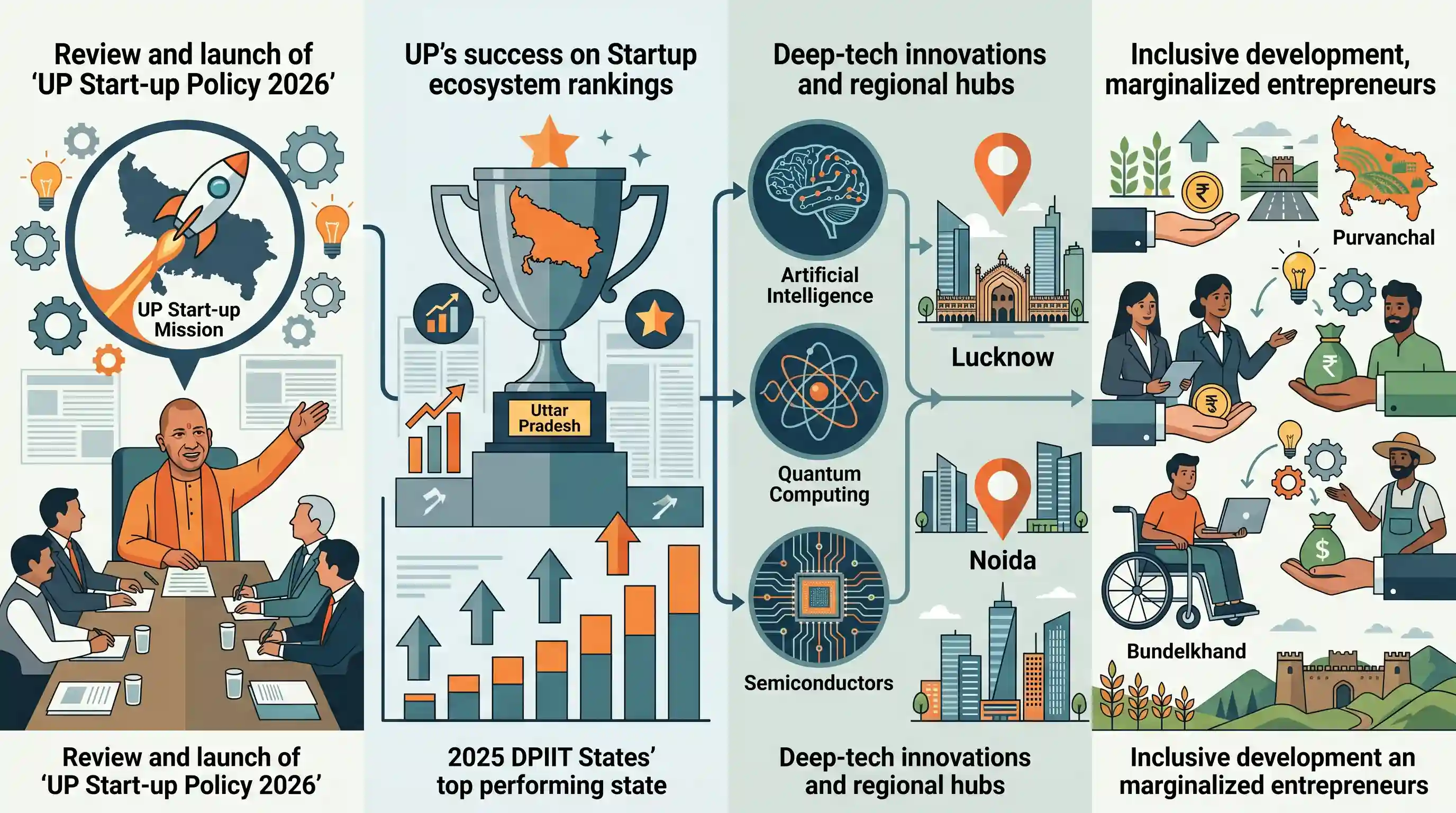
Chief Minister Yogi Adityanath reviewed UP's startup ecosystem and discussed the preliminary draft of the 'Uttar Pradesh Start-up Policy 2026'. The upcoming policy focuses on developing a dedicated 'UP Start-up Mission', promoting regional development in Purvanchal and Bundelkhand, and offering robust incentives to marginalized entrepreneurs. Additionally, the policy targets deep-tech innovations (AI, quantum, semiconductors) with Lucknow and Noida as major hubs, building on UP's success in being ranked among the 'top performing states' in the 2025 DPIIT States' Startup Ranking.
Key Points
- Draft Start-up Policy 2026: Uttar Pradesh is preparing to launch a revamped, industry-friendly startup policy aimed at making the state the country's leading startup hub.
- UP Start-up Mission: Chief Minister Yogi Adityanath directed the formation of a dedicated 'UP Start-up Mission' to ensure the professional, transparent, and structured implementation of the policy.
- Performance in Rankings: Uttar Pradesh secured a place among the 'top performing states' in the 2025 nationwide States' Startup Ranking conducted by the DPIIT.
- Inclusive Incentives: The policy features targeted incentives for women entrepreneurs, economically weaker sections (EWS), persons with disabilities (Divyangjan), transgender entrepreneurs, and startups based in the Purvanchal and Bundelkhand regions.
- Deep-Tech Focus: Lucknow and Noida are designated to be developed as major hubs for deep-tech innovation. Priority sectors include AI, machine learning, quantum technology, robotics, semiconductors, aerospace, space technology, and health-tech.
- Support Mechanisms: The policy aims to strengthen incubation support, prototype grants, seed capital assistance, patent support, and quality certification incentives.
Important Terms
Uttar Pradesh Start-up Policy 2026

A state policy aimed at positioning Uttar Pradesh as a research-driven innovation hub by promoting deep-tech sectors, inclusive entrepreneurship, and balanced regional development in Purvanchal and Bundelkhand.
UPSC context
GS Paper 3: Industrial policy and technology; GS Paper 2: State interventions for development.
States' Startup Ranking
An annual capacity-building framework launched by DPIIT in 2018 to evaluate and rank India's states and Union Territories on their policy initiatives and ecosystem support for early-stage entrepreneurs.
UPSC context
GS Paper 3: Mobilization of resources and growth; tests cooperative and competitive federalism in economic policy.
UP Start-up Mission
A proposed state-level nodal agency in Uttar Pradesh tasked with supervising startup promotion, financial administration, capacity building, and multi-stakeholder coordination to ensure structured implementation of the state's startup policy.
UPSC context
GS Paper 3: Economic growth and investment models; GS Paper 2: Institutional frameworks for development.
Department for Promotion of Industry and Internal Trade (DPIIT)
A central government department under the Ministry of Commerce and Industry responsible for coordinating the Startup India initiative, industrial policy formulation, and boosting foreign direct investments in the country.
UPSC context
GS Paper 3: Government policies for industrial growth and mobilization of resources; tests knowledge of key regulatory bodies.
Prelims Trap
Uttar Pradesh achieved the highest possible tier, 'Best Performer', in the DPIIT States' Startup Ranking Framework.
The highest tier in the DPIIT ranking is 'Best Performers'. Uttar Pradesh actually achieved the 'Top Performers' tier (the second-highest category) under Category A.
Static Concepts Connected
How does DPIIT evaluate and categorize states under the States' Startup Ranking Framework?
- Evaluation Tiers: Categorizes states into five bands: Best Performers, Top Performers, Leaders, Aspiring Leaders, and Emerging Startup Ecosystems.
- Population Categorization: Divides states into Category A (population over 1 crore) and Category B (under 1 crore) to ensure equitable evaluation.
What defines deep technology under India's draft National Deep Tech Startup Policy?
- Core Definition: Startups based on scientific breakthroughs or engineering innovations requiring intense R&D and long gestation periods, unlike purely digital business model innovations.
- Key Pillars: Focuses on funding via patient capital, protecting intellectual property rights, and providing access to high-end infrastructure.
Cross-Topic Patterns
Regional developmental imbalance & startup clustering
Standard startup ecosystems naturally cluster in tier-1 cities. Subsidizing startups in Purvanchal and Bundelkhand utilizes venture creation as a tool for regional economic convergence.
Inclusive entrepreneurship & social justice
Linking fiscal top-ups directly to marginalized founders shifts startup policy from standard market economics to targeted affirmative action under GS-2 social justice.

Multi-statement questions in 2026 may test DPIIT's five-tier state rankings alongside the strategic pillars of the National Deep Tech Policy.
Linked PYQs · 2
Linked PYQs · 2
- 2017UPPSC_PRELIMSGS1
The specific requirements of the 'start-ups' can be fulfilled through:
- 2024UPPSC_PRELIMSGS1
Match List-I with List-II and select the correct answer from the codes given below. List-I (State): (A) Maharashtra (B) Uttar Pradesh (C) Tamil Nadu (D) Karnataka List-II (Rank according to expenditure on infrastructure 2019 - 23): 1. First 2. Second 3. Third 4. Fourth
