CM Yogi blames Congress for 1947 Partition on Remembrance Day
Source:dailypioneer ↗
Why It Matters
The political discourse around the 1947 Partition, the role of leaders like Sardar Vallabhbhai Patel, and citizenship laws (CAA) frequently bridge modern history and polity. Understanding the historical context of Partition and Part II of the Constitution (Citizenship) is essential for the UPPSC Prelims.
Summary
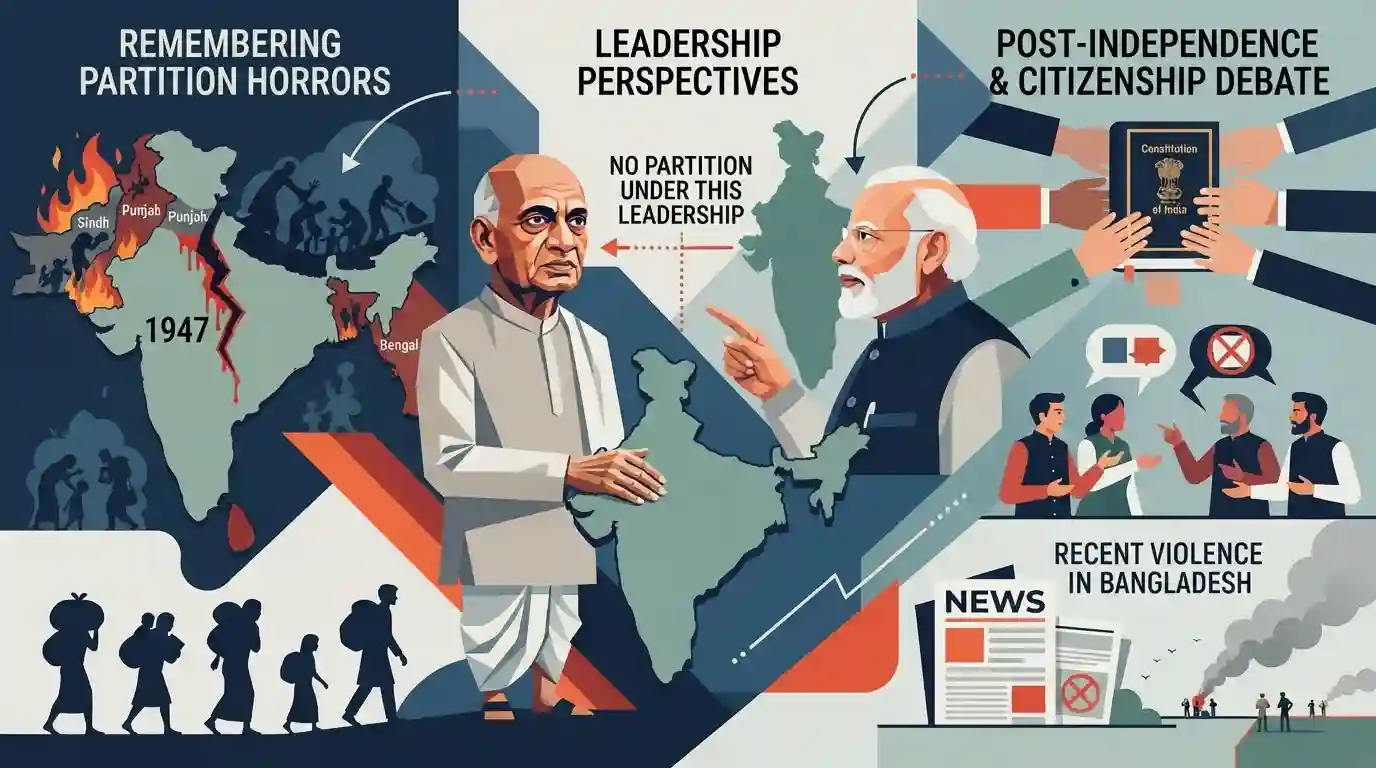
Uttar Pradesh Chief Minister Yogi Adityanath marked 'Partition Horrors Remembrance Day' by blaming the Congress for the 1947 Partition, alleging it betrayed the country for political power. Emphasizing the demographic changes and violence in Sindh, Punjab, and Bengal, he claimed Partition would not have occurred under the leadership of Sardar Vallabhbhai Patel or Narendra Modi. Furthermore, Adityanath criticized opposition parties for opposing the Citizenship Amendment Act (CAA) while remaining silent on recent violence against Hindus in Bangladesh.
Key Points
- UP Chief Minister Yogi Adityanath marked 'Partition Horrors Remembrance Day' by blaming the Congress for the 1947 Partition, alleging the nation was betrayed for political power.
- He highlighted the severe demographic changes and violence experienced in regions like Sindh, Punjab, and Bengal during the Partition.
- Adityanath claimed that if Sardar Vallabhbhai Patel or Prime Minister Narendra Modi had been in charge, India would not have been divided.
- He criticized the opposition for their past protests against the Citizenship Amendment Act (CAA) and their current silence on attacks against Hindus in Bangladesh.
Important Terms
Citizenship Amendment Act (CAA)

A 2019 law fast-tracking Indian citizenship for persecuted religious minorities (Hindus, Sikhs, Buddhists, Jains, Parsis, Christians) from Afghanistan, Bangladesh, and Pakistan who entered India before 2014, excluding Muslims.
UPSC context
GS Paper 2: Indian Constitution/Citizenship. Tests understanding of secularism, equality rights (Article 14), and India's refugee policies.
Indian Independence Act 1947
A 1947 UK Parliament act partitioning British India into the independent dominions of India and Pakistan, ending colonial rule and enabling the adoption of independent constitutions.
UPSC context
GS Paper 1: Modern Indian History. Crucial for understanding the legal mechanism of Partition, decolonization, and post-independence territorial consolidation.
Indian National Congress
Founded in 1885, it is India's oldest political party. It led the Indian independence movement under figures like Gandhi and dominated post-independence politics.
UPSC context
GS Paper 1: Modern Indian History. Central to tracing the nationalist movement, constitutional development, and post-independence political history.
Partition Horrors Remembrance Day
An annual observance in India on August 14th, instituted in 2021, to commemorate the victims, displacement, and suffering caused by the 1947 partition of India.
UPSC context
GS Paper 1: Post-Independence Consolidation. Relevant to discussions on Partition's legacy, historical memory, and communal harmony.
Prelims Trap
Partition Horrors Remembrance Day has been officially observed since 1947 to honor victims.
This is a trap. Partition Horrors Remembrance Day (August 14) was instituted recently in 2021 by the PM, not at the time of independence.
Static Concepts Connected
What were the key provisions of the Indian Independence Act 1947?
- Dominion Status: Created two independent Dominions, India and Pakistan, stripping the British monarch of the title 'Emperor of India'.
- Princely States: Lapsed British paramountcy over Indian princely states, granting them freedom to join either dominion or remain independent.
- Boundary Demarcation: Provided for the appointment of a Boundary Commission (Radcliffe Commission) to demarcate the borders of Punjab and Bengal.
Who is eligible for fast-tracked citizenship under the CAA 2019?
- Specific Minorities: Hindus, Sikhs, Buddhists, Jains, Parsis, and Christians facing religious persecution in Afghanistan, Bangladesh, and Pakistan.
- Cut-off Date: Eligible migrants must have entered India on or before December 31, 2014.
- Exempted Areas: Exempts Sixth Schedule tribal areas (Assam, Meghalaya, Mizoram, Tripura) and regions under the Inner Line Permit.
Cross-Topic Patterns
Partition History + CAA Polity
The historical demarcation of Bengal directly connects to contemporary polity via the CAA, highlighting how 1947's demographic transitions continue to shape modern citizenship and refugee laws.
Patel's role in Post-Independence Consolidation
Political rhetoric frequently invokes Sardar Patel. UPSC often tests his actual executive actions (e.g., Operation Polo, integration of Junagadh) contrasting with British-induced balkanization policies.

Expect a chronological Prelims question sorting 1947 events: Mountbatten Plan, Independence Act passage, and Radcliffe Line publication.
Linked PYQs · 3
Linked PYQs · 3
- 2014UPPSC_PRELIMSGS1
The Indian Independence Bill received the Royal Assent on
- 2021UPPSC_PRELIMSGS1
“Can you show me one free country where there are separate electorates ? ... The British element is gone, but they have left mischief behind”. Who among the following said the above mentioned statement in the Constituent Assembly debates ?
- 2020UPPSC_PRELIMSGS1
Which Articles of Indian Constitution are related to citizenship ?
