Uttar Pradesh School Chalo Abhiyan and Enrolment Targets
Source:indiatoday ↗
Why It Matters
UPPSC frequently tests candidates on Uttar Pradesh's state-specific welfare schemes, their objectives, and their targets. Understanding the difference between state initiatives (like Operation Kayakalp/Project Alankar) and central schemes, alongside their alignment with fundamental rights (Article 21A), is critical for the exam.
Summary
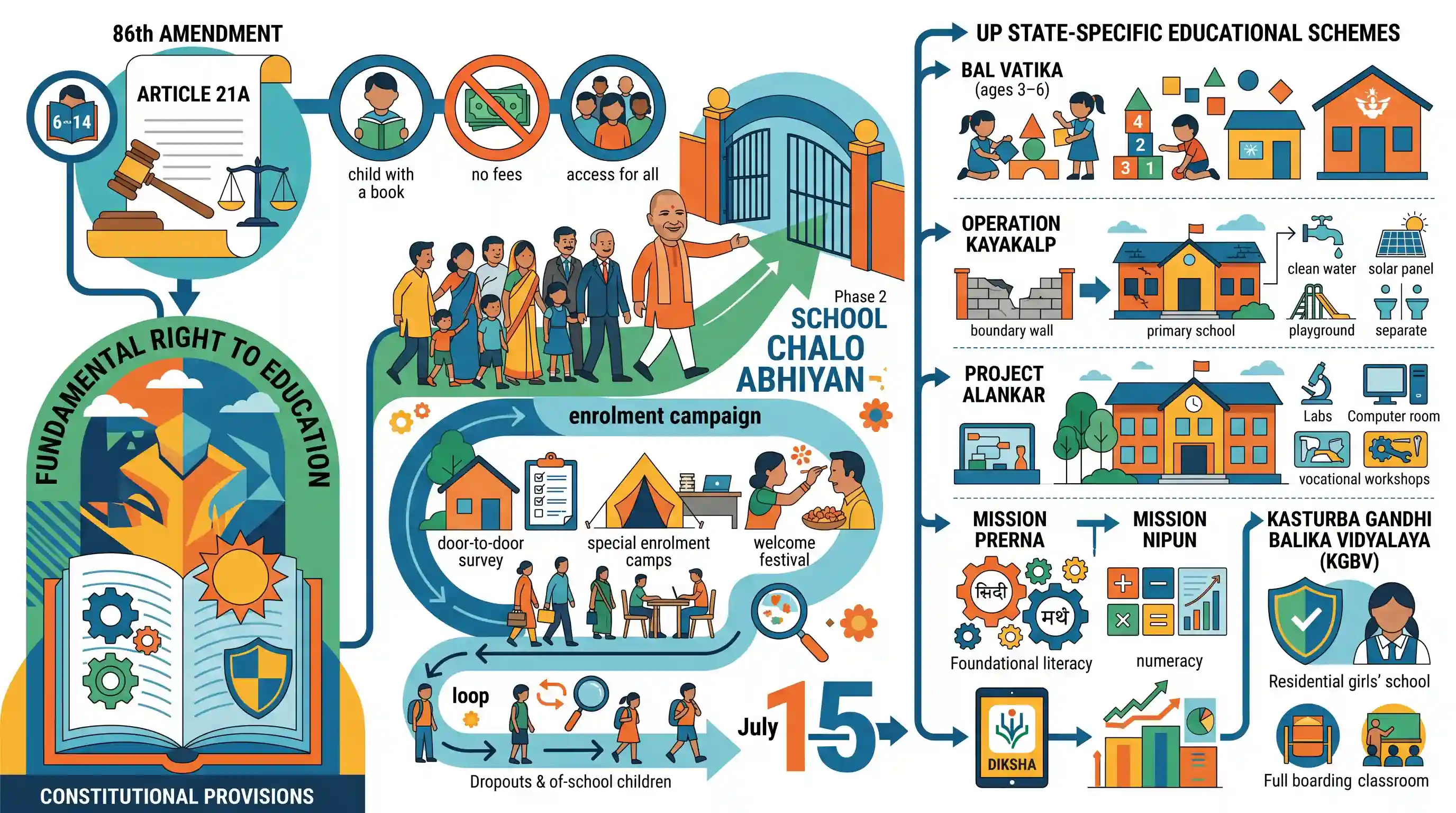
Uttar Pradesh Chief Minister Yogi Adityanath announced the second phase of the 'School Chalo Abhiyan' from July 1 to 15, 2026, aiming for universal school enrolment and re-enrolling dropouts. The campaign emphasizes early childhood education through the 'Bal Vatika' program (ages 3–6) and outlines key state interventions in school education, including Operation Kayakalp (primary infrastructure), Project Alankar (secondary school modernization), Mission Prerna, Mission Nipun, and the Kasturba Gandhi Balika Vidyalaya scheme.
Key Points
- UP Chief Minister Yogi Adityanath announced the launch of the second phase of the School Chalo Abhiyan, running from July 1 to 15, 2026.
- The campaign aims to achieve universal school enrolment, bring out-of-school and dropout children back into classrooms, and ensure the Right to Education is implemented effectively.
- The state highlighted several major educational initiatives, including Operation Kayakalp (for infrastructure improvement in primary schools), Project Alankar (for modernising secondary schools), and Mission Prerna & Mission Nipun (focused on quality of teaching and foundational learning outcomes).
- There is a special focus on Early Childhood Care and Education (ECCE) by encouraging parents to enrol children aged 3 to 6 years in the Bal Vatika programmes.
- The Kasturba Gandhi Balika Vidyalaya (KGBV) scheme remains a core driver for expanding educational opportunities and residential schooling for girls from disadvantaged backgrounds.
Important Terms
Constitution (86th Amendment) Act, 2002

A landmark amendment that made the Right to Education for children aged 6 to 14 a Fundamental Right under Article 21A, modified Article 45, and added a Fundamental Duty under Article 51A(k).
UPSC context
GS Paper II: Constitutional amendments and social sector education. Tests understanding of constitutional mechanisms promoting universal education.
Right of Children to Free and Compulsory Education Act, 2009
A central legislation giving effect to Article 21A, guaranteeing free, compulsory elementary education to children aged 6-14, and mandating 25% reservations for disadvantaged sections in private schools.
UPSC context
GS Paper II: Welfare schemes and social sector interventions. Tests familiarity with statutory provisions ensuring equitable and inclusive schooling.
NIPUN Bharat Mission
A national mission launched under Samagra Shiksha in 2021 to ensure every child in the country necessarily attains Foundational Literacy and Numeracy (FLN) by Grade 3.
UPSC context
GS Paper II: Social Sector/Services relating to Education. Tests knowledge of national policies targeting fundamental learning outcomes.
Kasturba Gandhi Balika Vidyalaya Scheme
A central scheme launched in 2004 setting up residential schools for girls belonging to SC, ST, OBC, minority communities, and BPL families in educationally backward blocks.
UPSC context
GS Paper II: Social justice, welfare schemes, and female literacy. Tests ability to analyze educational gender equity measures.
Operation Kayakalp
A flagship governance initiative launched by the Uttar Pradesh government in 2018 to upgrade primary and upper primary school infrastructure to modern, 19-point quality standards.
UPSC context
GS Paper II: State-specific governance models and education infrastructure. Tests understanding of local-level institutional transformations.
Project Alankar
An infrastructural modernization scheme launched by the Uttar Pradesh secondary education department to renovate, repair, and upgrade government-run and aided secondary schools across specific parameters.
UPSC context
GS Paper II: State education policies and administrative initiatives. Tests knowledge of public secondary education modernization programs.
School Chalo Abhiyan
A statewide school enrolment campaign in Uttar Pradesh targeting 100% registration of children and the re-enrolment of school dropouts in primary and upper-primary schools.
UPSC context
GS Paper II: State welfare and educational development strategies. Tests awareness of targeted, grassroots-level enrolment drives.
Bal Vatika Programme
A pre-primary education initiative under the National Education Policy (NEP) 2020 targeting children aged 3 to 6 to build a robust foundational learning and cognitive base.
UPSC context
GS Paper II: NEP 2020, early childhood care, and education. Tests understanding of restructured pre-school frameworks.
Prelims Trap
The Right to Education Act, 2009 guarantees free and compulsory education for children starting from age three under the Bal Vatika initiative.
The RTE Act legally covers ages 6 to 14. Although NEP 2020 incorporates age 3-6 (Bal Vatika) into the foundational block, it remains a DPSP target (Article 45) and is not a justiciable fundamental right.
Static Concepts Connected
How did the 86th Constitutional Amendment restructure educational obligations under the Constitution?
- Fundamental Right: Inserted Article 21A, making free and compulsory education a fundamental right for children aged 6 to 14 years.
- DPSP Shift: Substituted Article 45 to direct the State to provide early childhood care and education for all children until age six.
- Fundamental Duty: Added clause (k) to Article 51A, making it a parental duty to provide education opportunities to children aged 6 to 14.
What are the mandate and targeting criteria of Kasturba Gandhi Balika Vidyalayas (KGBVs)?
- Target Group: Sets up residential schools from class VI to XII for girls belonging to SC, ST, OBC, minority communities, and BPL families.
- Geographic Focus: Established specifically in Educationally Backward Blocks (EBBs) where female literacy is below the national average and gender gap is high.
- Policy Integration: KGBVs have been integrated as a component under the overarching Centrally Sponsored Scheme of Samagra Shiksha.
Cross-Topic Patterns
ECCE + Demographic Dividend
Investing in Early Childhood Care and Education (ECCE) for ages 3-6 reduces downstream school dropouts, maximizing India's window of demographic dividend by improving lifetime cognitive development and earning potential.
Fiscal Federalism + School Infrastructure
Programs like 'Project Alankar' showcase how states deploy unique public-aided and public-private cost-sharing ratios to bridge public finance gaps in secondary education, complementing federal Samagra Shiksha funds.

NEP's 5+3+3+4 structural transition is likely to be cross-examined with Article 21A, testing the legal status of the 3-6 age group.
Linked PYQs · 3
Linked PYQs · 3
- 2023UPPSC_PRELIMSGS1
Which of the following Scheme/Programme is not the Central Government Programme and it is Uttar Pradesh Government's Programme?
- 2022UPPSC_PRELIMSGS1
Right to Education has been included into the Fundamental Rights by the
- 2015UPPSC_PRELIMSGS1
The Right to Education Act, 2009 aims at making a free and compulsory education a right for children upto
