साक्ष्य-आधारित नीति निर्माण और गवर्नेंस के लिए जाति जनगणना में सुधार
स्रोत:इंडियन एक्सप्रेस ↗
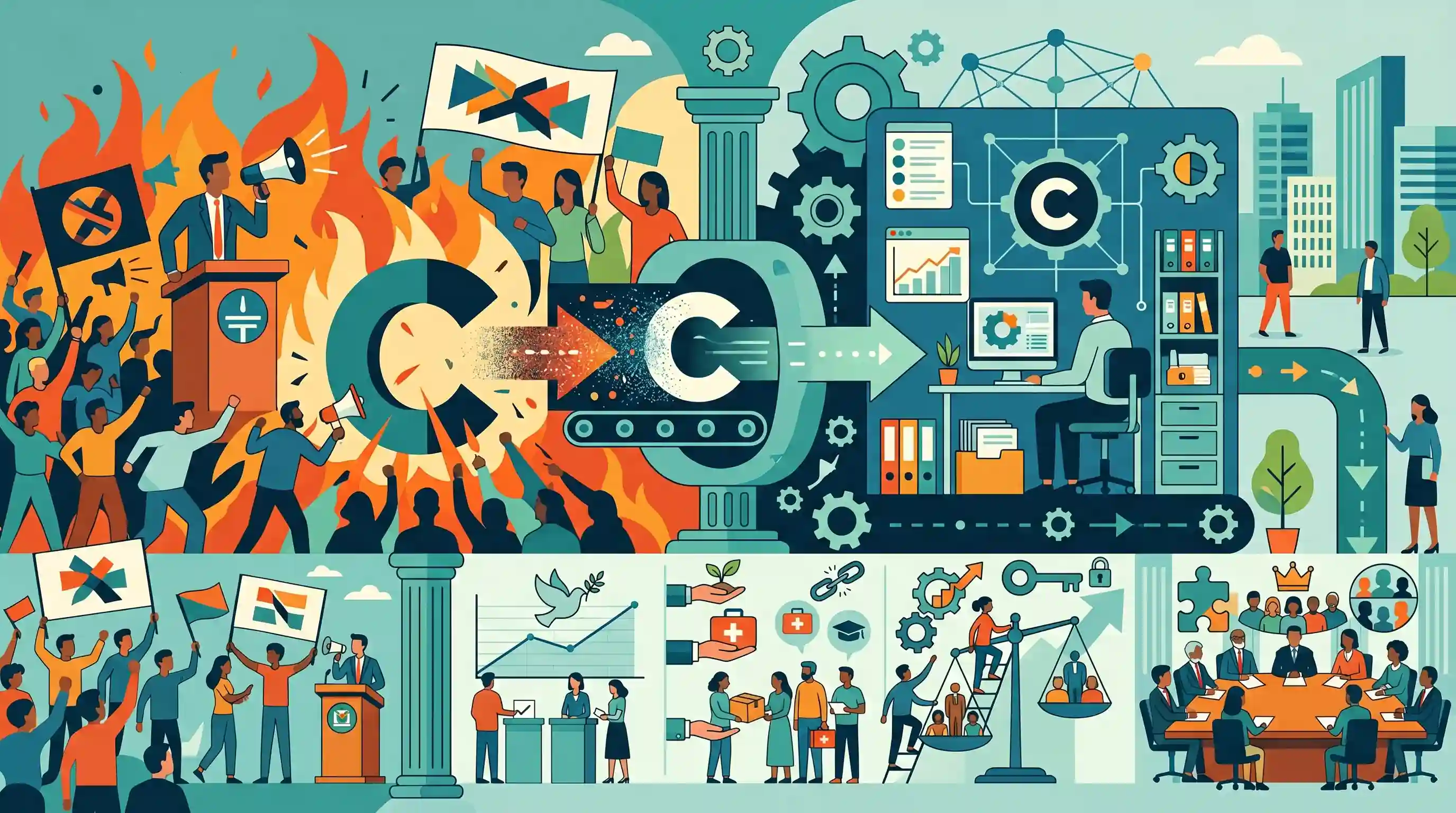
क्यों मायने रखता है
The article provides a mature, administrative perspective on the highly contested political issue of the Caste Census. By shifting the focus from electoral politics to data-driven governance and policy formulation, it offers a constructive framework for Mains answers regarding caste politics, social justice, and affirmative action.
सारांश
Political scientist Yogendra Yadav advocates for transitioning the debate around the caste census from a highly politicised, polarizing mega-event ("capital C") to a routine, administrative, and de-politicised data collection exercise ("small c"). He argues that integrating caste data into regular bureaucratic processes and governance systems will reduce electoral volatility while generating the necessary empirical evidence base for effective affirmative action, targeted welfare, and equitable representation.
मुख्य बिंदु
- "Capital C" approach: The current discourse often treats the caste census as a highly politicised, emotionally charged, and polarizing mega-event aimed at electoral gains.
- "Small c" approach: Advocates for making the collection of caste data a routine, decentralized, and mundane administrative practice rather than a grand political battle.
- De-politicisation for Governance: Shifting the focus from political tokenism to standard bureaucratic procedure helps mitigate social upheaval while securing necessary demographic data.
- Evidence-based Policymaking: Routine and depoliticised caste data collection is essential for empirically evaluating affirmative action, assessing socio-economic backwardness, and improving the targeting of welfare schemes.
- Nuanced Social Justice: A structured, less sensationalized administrative approach ensures the goals of social justice and equitable representation are met without unnecessarily deepening societal fault lines.
प्रारंभिक ट्रैप
State governments have the constitutional mandate to conduct their own Caste Census.
Only the Union government conducts a 'Census' (Entry 69, Union List). States only conduct 'Socio-Economic Surveys' (Entry 20, Concurrent List), a vital legal distinction.
संबंधित अवधारणाएँ
What is the constitutional basis for conducting a Census vs State surveys?
- Union List (Entry 69): 'Census' is exclusively a Union subject under the Seventh Schedule, governed by the Census Act, 1948.
- Concurrent List (Entry 20): 'Economic and social planning' empowers states to conduct socio-economic and caste surveys (e.g., Bihar's recent exercise) without encroaching on the Union's Census mandate.
Which Constitutional provisions necessitate quantifiable data for Affirmative Action?
- Article 340: Empowers the President to appoint a commission to investigate the conditions of socially and educationally backward classes (SEBCs), inherently requiring data.
- Article 16(4): Allows the state to reserve appointments in favor of any backward class that is 'inadequately represented' in state services, requiring statistical proof.
- Indra Sawhney Judgement: The Supreme Court mandated 'quantifiable data' to prove backwardness and inadequacy of representation for providing reservations.
अंतर-विषय पैटर्न
Caste data & OBC sub-categorization
Without empirical, routine caste data, initiatives like the Justice G. Rohini Commission's mandate to equitably distribute 27% OBC reservations remain difficult to implement and legally justify.
Welfare targeting & Poverty estimation
Routine socio-economic tracking parallels the evolution of poverty estimation (Tendulkar, Rangarajan), shifting from political narratives to quantifiable data for targeted welfare and Direct Benefit Transfers.

Expect a 2026 Prelims question testing the legal difference between Union 'Census' and State 'Socio-Economic Surveys' under 7th Schedule.
संबद्ध PYQ · 2
संबद्ध PYQ · 2
- 2018MainsGS1
Caste system is assuming new identities and associational forms. Hence, caste system cannot be eradicated in India." Comment.
- 2022MainsGS2
Discuss the role of the National Commission for Backward Classes in the wake of its transformation from a statutory body to a constitutional body.
