Democratic Lessons for Political Opposition from Global South
Source:Indian Express ↗
Why It Matters
This article provides highly analytical, academic frameworks (such as Przeworski's theories on democratic coexistence and Pippa Norris's 11 dimensions of electoral integrity) alongside Global South comparative models. These are invaluable for writing sophisticated, multi-dimensional answers in GS Paper 2 on the role of political opposition, challenges to the Election Commission, and the health of Indian democracy.
Summary
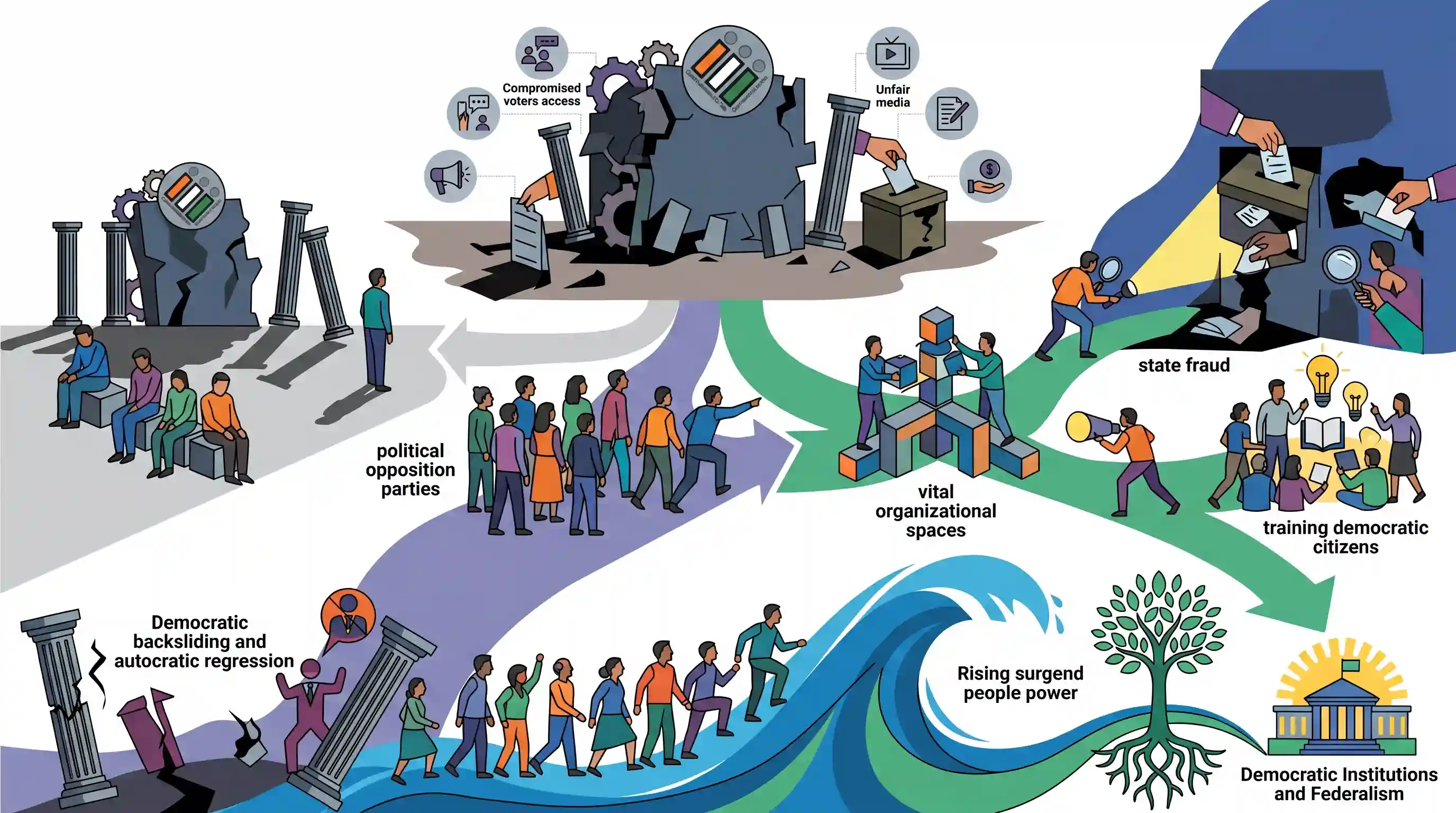
Yogendra Yadav discusses the critical dilemma facing the Indian political opposition regarding whether to contest or boycott elections given growing concerns about declining electoral integrity. While acknowledging that India's electoral standards have slipped across several of Pippa Norris's 11 dimensions of integrity, he argues that boycotts are a counterproductive strategy. Drawing from democratic theorists like Adam Przeworski and comparative studies of authoritarian regimes in the Global South (such as Belarus and Hungary), Yadav demonstrates that contesting flawed elections provides vital organizational spaces, trains democratic citizens, exposes state fraud, and maintains the pressure of popular legitimacy until a genuine mass political wave can reverse democratic backsliding.
Key Points
- Rationale of Elections: Drawing from Adam Przeworski's book 'Why Bother with Elections?', elections in deeply divided societies serve the primary function of allowing peaceful coexistence and transfer of power without sliding into civil war.
- Electoral Integrity Framework: Pippa Norris, Richard W. Frank, and Ferran Martínez i Coma's 11-dimension cycle assesses election fairness. Historically challenging in terms of campaign finance, India's recent electoral ecosystem is argued to have experienced declines in dimensions like neutral electoral authorities, transparent procedures, fair media access, and constituency boundaries.
- Why Boycotting Elections Fails: Ethically, the political opposition must first build widespread public consensus and consciousness regarding irregularities before boycotting. Strategically, global data shows that election boycotts are ineffective unless they drop turnout drastically; instead, contesting elections preserves critical 'organizational spaces' to recruit cadres, mobilize citizens, and generate political capital.
- Global South / Comparative Politics Lessons: In highly restricted settings such as Belarus (2020) and Hungary, opposition participation in flawed elections succeeded in generating credible proof of voter sentiment, training democratic citizens, and puncturing regime legitimacy.
- The Barrier of Popular Legitimacy: Modern electoral autocracies are structurally constrained because they still require the facade of popular legitimacy. A powerful mass upsurge of public anger (historically exemplified by India's 1977 election post-Emergency) can ultimately bypass and overwhelm electoral manipulation.
Important Terms
Election Commission of India

A permanent, autonomous constitutional body established under Article 324 of the Constitution of India, responsible for administering and supervising free and fair national and state legislative elections.
UPSC context
GS Paper II: Constitutional Bodies. It tests understanding of institutional autonomy, electoral governance, and the appointment and powers of election commissioners.
Representation of the People Act
Key legislation (enacted in 1950 and 1951) that provides the statutory framework for elections in India, detailing seat allocation, delimitation, voter qualification, election conduct, and candidate disqualification.
UPSC context
GS Paper II: Salient Features of the Representation of People’s Act. It tests understanding of statutory rules governing candidates, parties, and electoral conduct.
Delimitation Act
Parliamentary legislation enacted under Article 82 of the Constitution that mandates the establishment of a Delimitation Commission to redraw the territorial boundaries of electoral constituencies based on demographic changes.
UPSC context
GS Paper II: Elections and Constitutional Bodies. It tests understanding of federal seat allocation, regional representation, and the redrawing of electoral boundaries.
Swaraj India
A registered, unrecognized political party launched in 2016 by Yogendra Yadav and other activists, which emphasizes alternative politics, democratic decentralization (Swaraj), and grassroots citizen empowerment.
UPSC context
GS Paper II: Pressure Groups, Political Parties, and Civil Society. Tests understanding of alternative political movements and the evolution of political parties in India.
Bharat Jodo Abhiyaan
A civil society platform and initiative coordinated by social activists to promote and protect constitutional values, democratic institutions, and federalism against political polarization and institutional decay.
UPSC context
GS Paper II: Role of Civil Society and Pressure Groups. It tests the role of non-party political formations in democratic mobilizations.
Prelims Trap
The Chief Justice of India remains a member of the statutory Selection Committee that appoints the Chief Election Commissioner under the 2023 Act.
The 2023 Act bypassed the Supreme Court's interim ruling in Anoop Baranwal (2023) by replacing the Chief Justice of India (CJI) with a Union Cabinet Minister nominated by the Prime Minister.
Static Concepts Connected
What is the constitutional and legislative framework for appointing and removing Election Commissioners in India?
- Constitutional Basis: Article 324(2) empowers the President to make these appointments, subject to any law enacted by Parliament.
- Appointment Mechanism: Under the 2023 Act, a panel of the PM, Leader of Opposition (or largest party), and a Cabinet Minister recommends appointments.
- Removal Disparity: The CEC enjoys SC-judge-like tenure security, whereas other ECs can be removed simply on the recommendation of the CEC.
How has the Supreme Court linked electoral integrity to the Basic Structure doctrine?
- Basic Structure Status: In the Indira Nehru Gandhi case (1975), the Court held that 'free and fair elections' are part of the Basic Structure.
- Plenary Powers: In Mohinder Singh Gill (1977), the SC declared that Article 324 acts as a plenary reservoir of power to ensure election fairness.
Cross-Topic Patterns
Electoral Reforms + Global South Backsliding
Linking India's domestic institutional challenges (such as campaign finance and ECI neutrality) with comparative political shifts in the Global South helps address complex GS-II questions on democratic backsliding.
Basic Structure + Legislative Sovereignty
The clash between declaring 'free and fair elections' as part of the Basic Structure and passing laws that alter executive influence over ECI appointments illustrates key GS-II separation of powers dynamics.

The shift from judicial mandates to legislative frameworks in ECI appointments will likely be tested under separation of powers in 2026.
Linked PYQs · 3
Linked PYQs · 3
- 2018MainsGS2
In the light of recent controversy regarding the use of Electronic Voting Machines (EVM), what are the challenges before the Election Commission of India to ensure the trustworthiness of elections in India?
- 2017MainsGS2
To enhance the quality of democracy in India the Election Commission of India has proposed electoral reforms in 2016. What are the suggested reforms and how far are they significant to make democracy successful?
- 2024MainsGS2
Examine the need for electoral reforms as suggested by various committees with particular reference to "one nation one election" principle.
