Delimitation Exercise Challenges and Federal Implications in India
Source:Indian Express ↗
Why It Matters
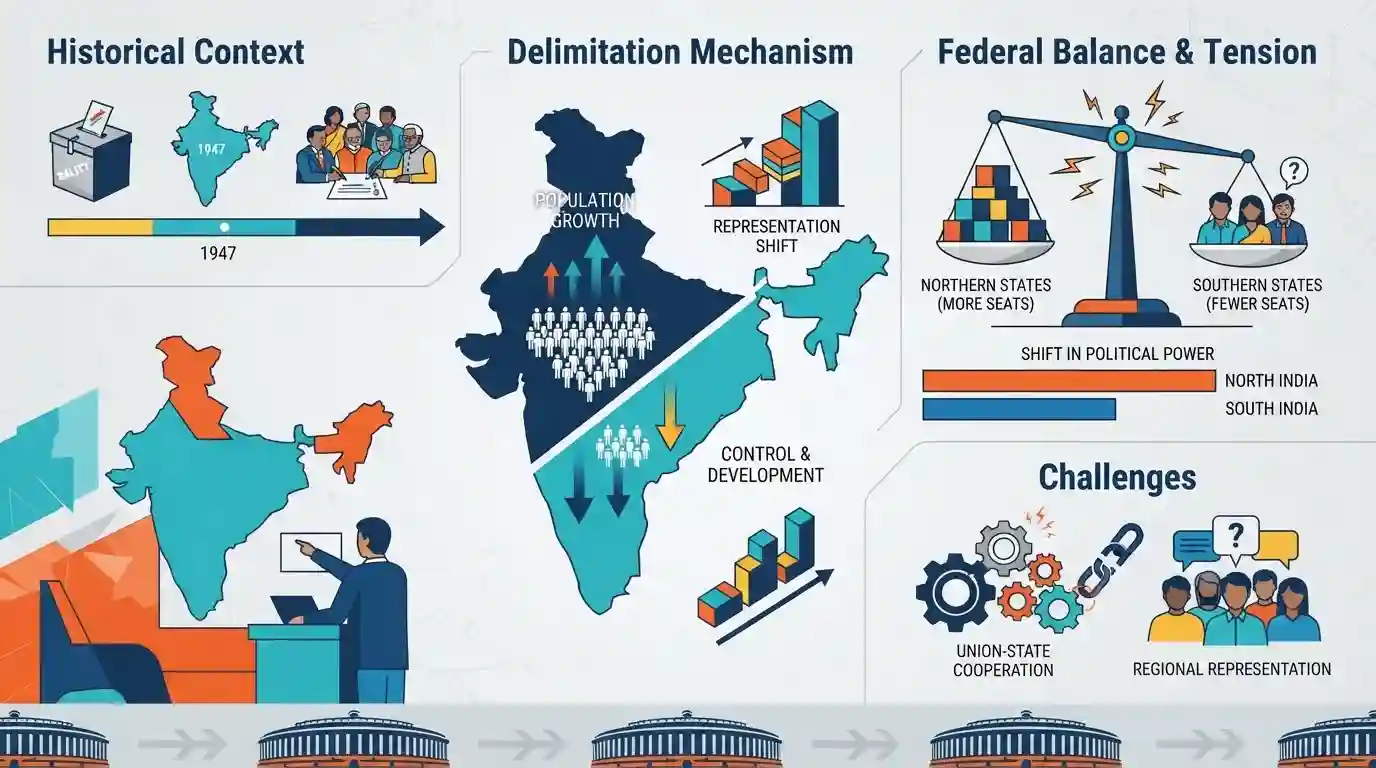
The impending delimitation of parliamentary constituencies is one of the most critical governance and federal challenges for India, impacting regional representation equity and Centre-State trust.
Summary
An analytical view on the upcoming delimitation exercise in India, focusing on its implications for federal balance, regional representation, and the political tensions between northern and southern states.
Key Points
- The upcoming delimitation exercise poses significant challenges to India's federal structure, potentially penalizing southern states that successfully implemented population control policies.
- The debate highlights a clash between the principle of representation based strictly on population versus democratic equity and regional balance.
- Opposition parties must formulate a comprehensive institutional and political response to address the disproportionate shift in parliamentary seat shares.
- Concerns surround federal friction, cooperative federalism, and the integrity of regional representation in the Lok Sabha.
Important Terms
Delimitation Exercise

The process of redrawing boundaries of Lok Sabha and state assembly constituencies based on recent population changes, governed by Articles 82 and 170 of the Constitution.
UPSC context
UPSC GS Paper II (Polity & Governance) — tests understanding of federalism, representation, and the North-South demographic imbalance.
Prelims Trap
Delimitation Commission orders can be challenged in the Supreme Court on grounds of federal imbalance.
Aspirants often assume the Delimitation Commission's orders can be challenged in a High Court or Supreme Court on grounds of constitutional violation. Article 82 explicitly states its orders have the force of law and cannot be questioned in any court.
Static Concepts Connected
What are the constitutional provisions governing Delimitation and the freezing of seats in India?
- Article 82 Provision: Article 82 provides for the readjustment of seat allocation in the Lok Sabha after every census, executed by a Delimitation Commission enacted by Parliament.
- 42nd Amendment Freeze: The 42nd Amendment Act (1976) froze seat allocation based on the 1971 census till the year 2001 to encourage family planning compliance.
- 84th Amendment Extension: The 84th Amendment Act (2001) extended this freeze until the first census after 2026 (typically expected post-2026 census, i.e., around 2028-2030).
- Judicial Bar Clause: Delimitation Commission orders possess statutory force of law and cannot be called in question in any court under any circumstances.
Cross-Topic Patterns
Delimitation vs. Finance Commission Vertical Devolution
Delimitation intersects with the Finance Commission's devolution criteria, where states performing well on population control face dual penalties in parliamentary weight and tax resource allocation.
Federal Boundaries and Asymmetric Representation
The debate over population-based representation connects directly to the representation of UTs, Jammu & Kashmir reorganisation, and fifth/sixth schedule boundary adjustments.

Delimitation + Article 82 + 84th Amendment freeze is high-yield for both Prelims statements and Mains federalism questions.
Linked PYQs · 2
Linked PYQs · 2
- 2024MainsGS2
What changes has the Union Government recently introduced in the domain of Centre-State relations ? Suggest measures to be adopted to build the trust between the Centre and the States and for strengthening federalism.
- 2020MainsGS2
How far do you think cooperation, competition and confrontation have shaped the nature of federation in India? Cite some recent examples to validate your answer.
