Electoral Roll Revision Triggers Disenfranchisement Concerns
Source:Indian Express ↗
Why It Matters
The article highlights critical vulnerabilities in India's electoral roll revision process and the severe consequences of institutional overreach and hasty judicial interventions on the fundamental constitutional right to vote. It is highly relevant for GS2 topics concerning electoral reforms, the ECI's functional autonomy, and democratic inclusion.
Summary
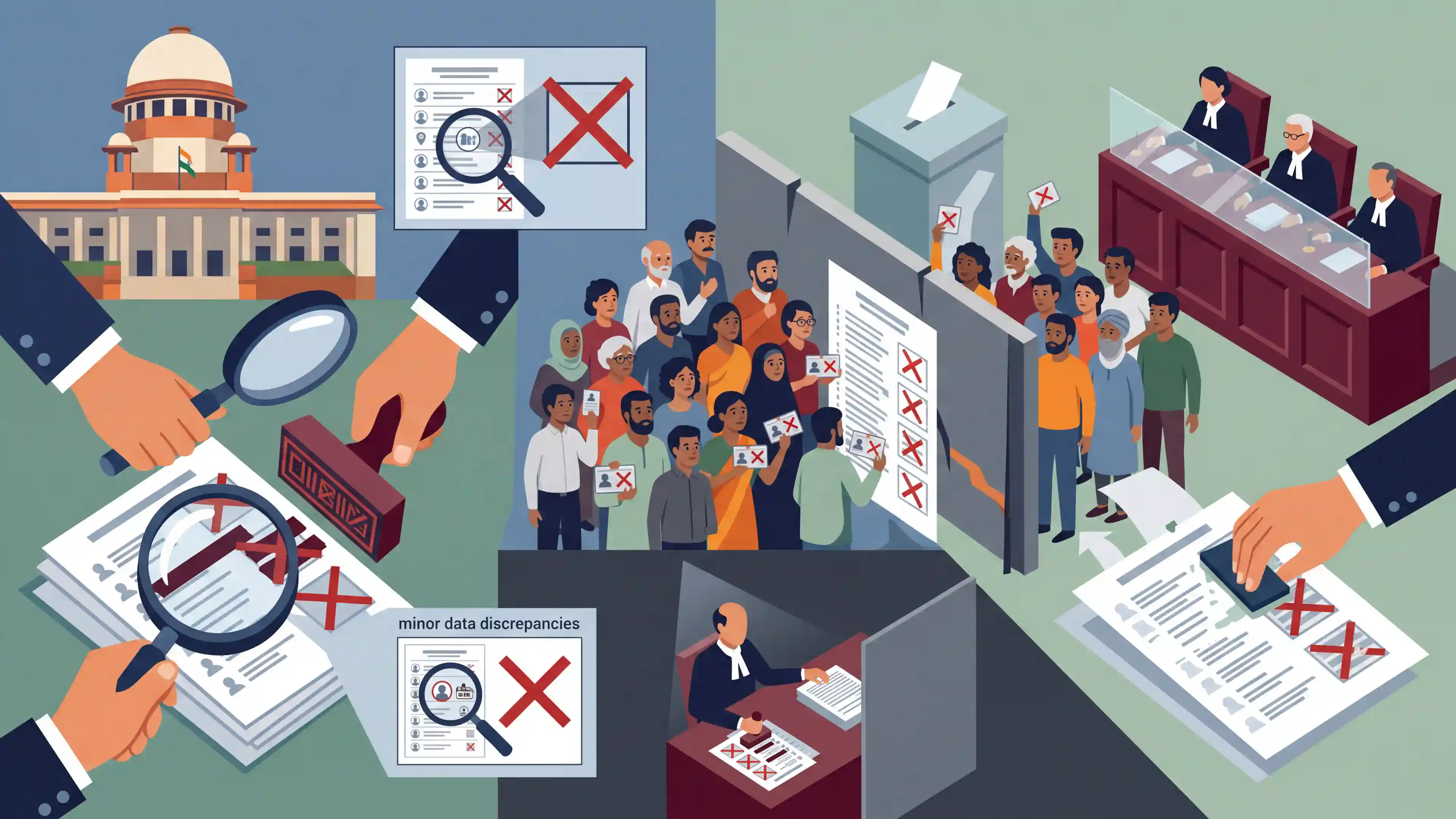
Yogendra Yadav critiques the 'Special Impediment Removal' (SIR) exercise in West Bengal, executed by the Election Commission of India (ECI) and overseen by the Supreme Court, which led to the massive disenfranchisement of voters, predominantly from minority communities. He argues that the process bypassed established procedures, weaponised minor data discrepancies, and relied on a rushed, opaque judicial adjudication mechanism. This ultimately resulted in a significant miscarriage of justice, evidenced by appellate tribunals later overturning a vast majority of the deletions.
Key Points
- The ECI implemented a Special Impediment Removal (SIR) exercise in West Bengal that resulted in the unprecedented, large-scale deletion of names from the electoral rolls.
- The ECI appointed an extraordinarily high number of special roll observers and micro-observers in Bengal, bypassing standard operating procedures and weaponizing logical discrepancies in voter data.
- Over 60 lakh voter discrepancies were sent for adjudication to a Supreme Court-mandated special mechanism, resulting in 27 lakh deletions within a rushed 35-day window.
- A significant proportion of the 27 lakh deleted voters were from minority communities and had provided valid documentation (Aadhaar, PAN, birth certificates).
- Appellate tribunals later set up by the Supreme Court have so far overturned 89% of the initial adjudication decisions, exposing the flawed nature of the deletion process.
Important Terms
Special Intensive Revision (SIR)

The formal ECI process for large-scale, door-to-door verification to update electoral rolls; critiqued by activists as a 'Special Impediment Removal' exercise designed to target specific voter demographics.
UPSC context
GS Paper II: Constitutional bodies (ECI); Electoral reforms and voter rights. tests understanding of administrative processes and their democratic impacts.
Election Commission of India (ECI)
A constitutional body established under Article 324, empowered with the superintendence, direction, and control of elections, including the preparation and revision of electoral rolls across India.
UPSC context
GS Paper II: Constitutional bodies; powers and responsibilities of the ECI. Core topic for Prelims and Mains.
SABAR Institute
A Kolkata-based public policy and data research organization that analyzed the 2026 West Bengal voter deletions, documenting disproportionate impacts on minority communities and women.
UPSC context
GS Paper II: Role of civil society, NGOs, and pressure groups in a democracy. Relevant for issues related to institutional transparency.
Logical Discrepancy
A technical criteria used by ECI algorithms to flag voters for re-verification based on data mismatches, criticized as an opaque mechanism leading to mass disenfranchisement.
UPSC context
GS Paper II: E-governance and its impact on rights; potential for technological bias in administrative decision-making.
Appellate Tribunal (Electoral Rolls)
Temporary judicial bodies constituted under Supreme Court oversight to adjudicate millions of appeals from voters whose names were deleted during the SIR process in West Bengal.
UPSC context
GS Paper II: Judiciary and quasi-judicial bodies; judicial oversight of executive actions during elections.
Universal Adult Suffrage
The principle under Article 326 of the Constitution granting every citizen above 18 the right to vote; it forms the bedrock of electoral democracy in India.
UPSC context
GS Paper II: Features of the Constitution; Fundamental rights vs Constitutional rights. tests core democratic concepts.
Prelims Trap
The ECI can suo motu delete voters from electoral rolls based on software-flagged discrepancies without prior notice.
Under Section 22 of the Representation of the People Act, 1950, Electoral Registration Officers cannot suo motu delete names without granting a reasonable hearing.
Static Concepts Connected
Which provisions govern the preparation and revision of electoral rolls in India?
- Article 324: Vests the superintendence, direction, and control of the preparation of all electoral rolls entirely in the Election Commission of India.
- Article 326: Provides for universal adult suffrage, serving as the constitutional foundation for a citizen's right to be registered as a voter.
- RPA 1950: Provides the statutory framework for the allocation of seats, delimitation of constituencies, and the detailed preparation and revision of electoral rolls.
What is the specific legal nature of the Right to Vote in India?
- Constitutional Right: It is a constitutional right guaranteed under Article 326, but it is not classified as a Fundamental Right under Part III of the Constitution.
- Subject to Disqualification: The right is not absolute; it is subject to disqualifications under the Constitution or statutory laws (e.g., non-residence, unsoundness of mind, corrupt practices).
- RPA 1951 Implementation: While Article 326 grants the right, the actual voting mechanics, dispute resolution, and statutory protections are detailed under the Representation of the People Act, 1951.
Cross-Topic Patterns
Algorithmic governance and exclusion
Disenfranchisement via 'logical discrepancies' mirrors issues in Aadhaar-PDS linkages, where algorithmic sorting and data-matching errors frequently lead to the exclusion of marginalized communities from constitutional or statutory entitlements.
Judicial oversight of ECI autonomy
The SC mandating ad-hoc tribunals for voter deletions reflects an ongoing trend of judicial intervention in the ECI's administrative domain (Article 324) to safeguard fundamental democratic processes.

Expect a 2026 Prelims question testing the exact legal bounds of voter deletion, contrasting RPA 1950 powers with Article 326.
Linked PYQs · 4
Linked PYQs · 4
- 2022MainsGS2
Discuss the role of the Election Commission of India in the light of the evolution of the Model Code of Conduct.
- 2024MainsGS2
Examine the need for electoral reforms as suggested by various committees with particular reference to "one nation one election" principle.
- 2017PrelimsGS1
Right to vote and to be elected in India is a
- 2025MainsGS2
Comment on the need of administrative tribunals as compared to the court system. Assess the impact of the recent tribunal reforms through rationalization of tribunals made in 2021.
