Seva Dal legacy offers valuable grassroots lessons for modern politics
Source:Indian Express ↗
Why It Matters
The article connects the historical ethos of the freedom struggle's volunteer movements to contemporary governance challenges, highlighting the importance of constructive work, civil society engagement, and ideological discipline in modern democratic politics.
Summary
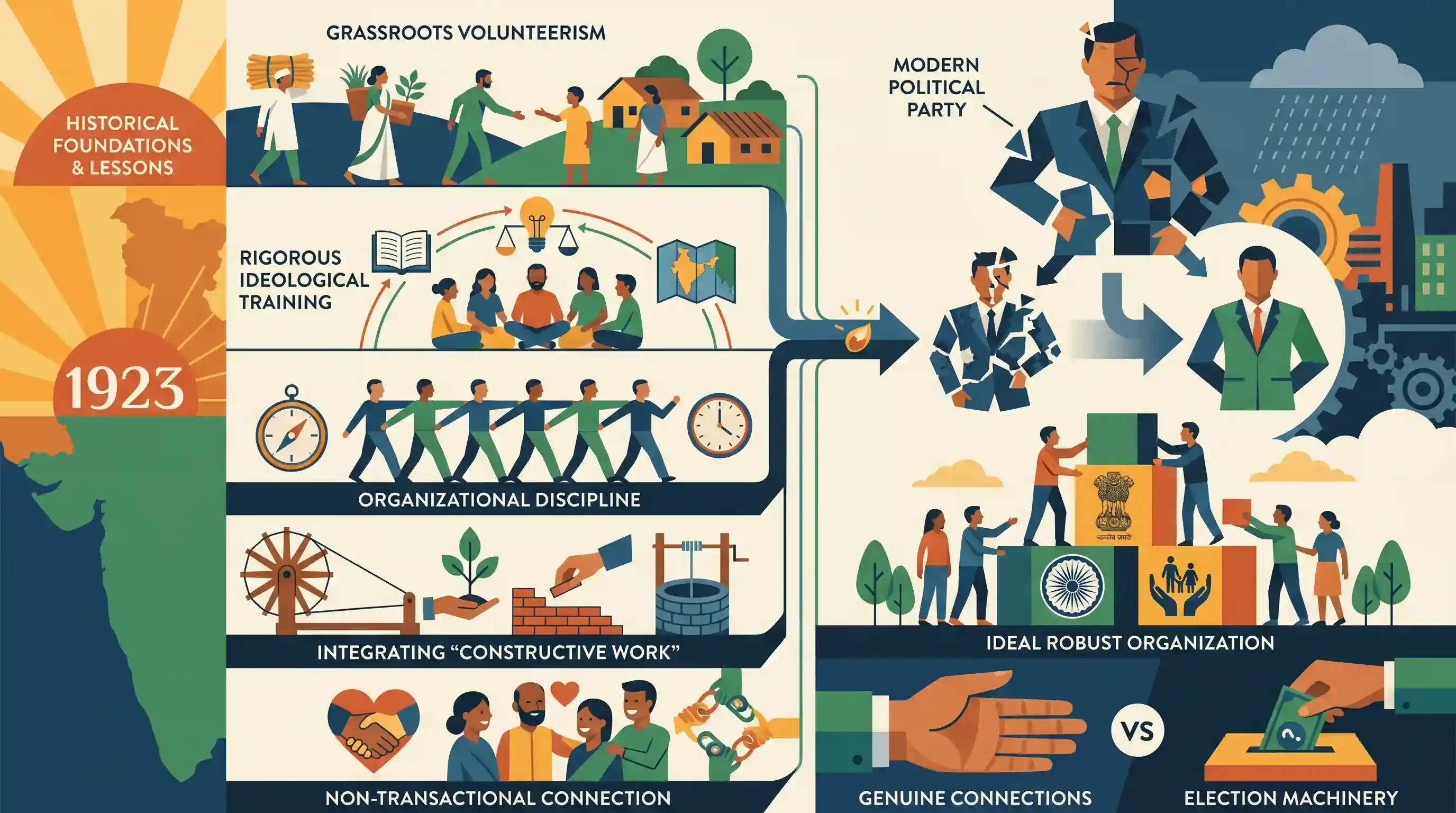
In this article, Yogendra Yadav examines the historical legacy of the Congress Seva Dal (founded as Hindustani Seva Dal in 1923) to outline five crucial lessons for contemporary Indian politics. He emphasizes that modern political parties can learn from the Seva Dal's foundational principles, which prioritized grassroots volunteerism, rigorous ideological training, and organizational discipline. By integrating Mahatma Gandhi’s vision of 'constructive work' with daily political action, parties can build genuine, non-transactional connections with the masses. The article highlights the necessity of shifting away from purely electoral machinery toward building robust, democratic organizations anchored in constitutional values and public service.
Key Points
- Historical Significance: Founded in 1923 by N.S. Hardikar, the Hindustani Seva Dal served as the disciplined grassroots volunteer force of the Congress during the freedom struggle.
- Integrating Service and Politics: Contemporary political parties need to revive the Gandhian model of 'constructive work', blending grassroots social service with political mobilization.
- Ideological Grounding: Sustained political movements require volunteers who are deeply trained in democratic, secular, and constitutional values rather than transient electoral rhetoric.
- Cadre Discipline: Cultivating a dedicated, non-violent, and disciplined cadre is crucial to counter polarized narratives and ensure long-term organizational resilience.
- Organizational Democracy: The Seva Dal's legacy underscores the importance of intra-party democracy, inclusivity, and robust internal structures within modern political outfits.
Important Terms
Hindustani Seva Dal

The original volunteer organization of the Indian National Congress, founded in 1923 to create a disciplined, trained cadre for the freedom struggle.
UPSC context
GS1: Modern Indian History; identifies significant volunteer organizations and their role in mass mobilization during the freedom movement.
N. S. Hardikar
The founder of the Hindustani Seva Dal; a medical doctor and freedom fighter who envisioned a disciplined volunteer force after the 1923 Flag Satyagraha.
UPSC context
GS1: Modern Indian History; tests knowledge of key personalities and institutional founders within the Indian National Congress.
Gandhian Constructive Programme
Mahatma Gandhi’s socio-economic initiatives (e.g., Khadi promotion, removal of untouchability) designed to build national strength from within, which he considered the foundation of true independence.
UPSC context
GS1: Modern History/Gandhian Phase; examines the intersection of social reform and political agitation in the independence movement.
Congress Seva Dal
The contemporary uniformed volunteer wing of the Indian National Congress, officially renamed from Hindustani Seva Dal in 1931 to serve as the party's central grassroots mobilization unit.
UPSC context
GS2: Political Parties and Civil Society; relevant for understanding the organizational structure and internal volunteer mechanisms of major political entities.
Flag Satyagraha
A 1923 protest in Nagpur against British bans on the National Flag, which served as the catalyst for establishing a more disciplined Congress volunteer corps.
UPSC context
GS1: Modern Indian History; an important regional movement that influenced the broader organizational strategies of the INC.
Prelims Trap
"The Congress Seva Dal was founded by Jawaharlal Nehru in 1931."
While Nehru was its first president, it was actually founded by Dr. N.S. Hardikar in 1923 (Kakinada session) as the Hindustani Seva Dal.
Static Concepts Connected
What were the core components of Gandhian Constructive Work?
- Communal Harmony: Bridging the Hindu-Muslim divide to ensure united, mass-based resistance against British rule.
- Untouchability Removal: Integrating depressed classes into the nationalist mainstream through temple entry and anti-discrimination campaigns.
- Khadi Promotion: Promoting economic self-reliance (Swadeshi), decentralization, and rural mass employment via the charkha.
- National Education: Establishing alternative, nationalist educational institutions (Vidyapeeths) outside the British administrative curriculum.
What hampers intra-party democracy in modern Indian political parties?
- Statutory Vacuum: The Representation of the People Act (1951) does not explicitly mandate or enforce internal elections for party posts.
- Centralized Finances: High-commands tightly control election ticket distribution and campaign finance, marginalizing grassroots voices.
- Limited ECI Power: The Election Commission of India has limited statutory power to de-register political parties for violating their own internal democratic constitutions.
Cross-Topic Patterns
Constructive work to modern CSOs
The Gandhian ethos of non-state, village-level service laid the historical foundation for India’s modern Civil Society Organizations (CSOs), bridging GS1 Modern History and GS2 Governance.
Intra-party democracy vs Anti-Defection
Centralized party structures lacking democratic ethos exacerbate the misuse of the 10th Schedule, linking historical organizational lessons to current GS2 anti-defection debates.

Expect a 2026 Prelims question matching obscure volunteer organizations (like Hindustani Seva Dal/N.S. Hardikar) to their founders.
Linked PYQs · 2
Linked PYQs · 2
- 2021MainsGS1
Bring out the constructive programmes of Mahatma Gandhi during Non-Cooperation Movement and Civil Disobedience Movement.
- 2021MainsGS2
Can Civil Society and Non-Governmental Organizations present an alternative model of public service delivery to benefit the common citizen? Discuss the challenges of this alternative model.
