Yoga as Soft Power and Global Policy for Holistic Well-being
Source:The Hindu ↗
Why It Matters
Yoga is a cornerstone of India's soft power strategy and cultural diplomacy. The emphasis on 'Yoga for Humanity 2.0' and holistic well-being directly aligns with GS2 topics on health policy and international relations, as well as GS4 themes related to ethics, stress management, and the holistic well-being of individuals and society.
Summary
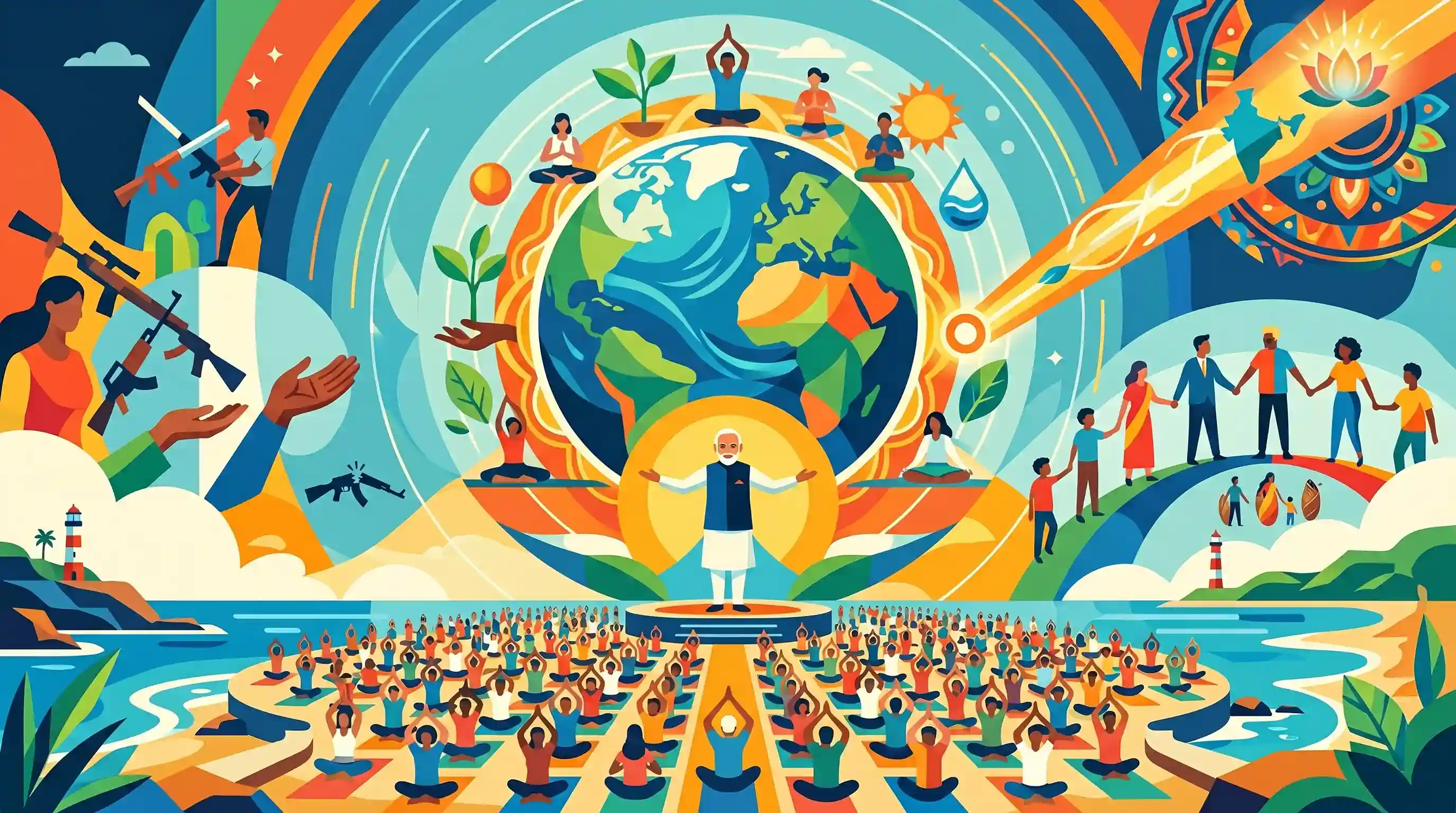
Prime Minister Narendra Modi addressed the 11th International Day of Yoga in Visakhapatnam, introducing the concept of 'Yoga for Humanity 2.0' to elevate inner peace into a global policy priority. Emphasizing the 2025 theme 'Yoga for One Earth, One Health', he highlighted yoga as an instrument for holistic wellness, conflict resolution, and global cooperation. The event, marked by mass participation and records like the Yogandhra Abhiyan, underscored yoga's evolution as a critical component of India's soft power and cultural diplomacy on the world stage.
Key Points
- PM Modi led the 11th International Day of Yoga celebrations in Visakhapatnam, proposing 'Yoga for Humanity 2.0' where inner peace becomes global policy.
- The 2025 theme is 'Yoga for One Earth, One Health', emphasizing the interconnectedness of human health, society, and the environment.
- Yoga is highlighted as a catalyst for global partnerships and a holistic discipline that transitions individuals from a 'Me to We' mindset.
- The Yogandhra Abhiyan in Andhra Pradesh set a Guinness record with massive participation.
Important Terms
Soft Power

The ability of a nation to influence others through attraction and persuasion—using culture, political values, and foreign policies—rather than military or economic coercion (Hard Power).
UPSC context
GS Paper II (International Relations). Tests understanding of non-traditional tools in foreign policy and India's global influence through heritage.
Cultural Diplomacy
The use of cultural exchanges, such as Yoga, Bollywood, or heritage, to foster mutual understanding and achieve foreign policy objectives by building a positive national image.
UPSC context
GS Paper II (International Relations). Relevant for questions on India's 'Vasudhaiva Kutumbakam' philosophy and civilizational influence.
International Day of Yoga (IDY)
An annual global observance on June 21st, established by UN Resolution 69/131 in 2014, to promote the physical, mental, and spiritual benefits of yoga.
UPSC context
GS Paper I (Culture) and GS Paper II. Tests knowledge of India's initiatives at the United Nations and global health leadership.
Yogandhra Abhiyan
A mass yoga campaign launched by the Andhra Pradesh government in 2025, aiming for large-scale public participation and promoting yoga as a lifestyle for holistic health.
UPSC context
GS Paper II (Governance/Social Justice). Example of state-level initiatives for public health and community mobilization (Jan Andolan).
Yoga for Humanity 2.0
A conceptual framework introduced by PM Modi in 2025, proposing that 'Inner Peace' should transition from a personal pursuit to a global policy priority for conflict resolution.
UPSC context
GS Paper IV (Ethics) or GS Paper II. Relevant for discussions on ethical governance and the role of spiritual values in global peace.
Yoga for One Earth, One Health
The official theme for the 11th International Day of Yoga (2025), emphasizing the intrinsic link between individual human health and the ecological health of the planet.
UPSC context
GS Paper III (Environment) and GS Paper II (Health). Connects traditional Indian philosophy with modern sustainable development and planetary health goals.
Prelims Trap
"The International Day of Yoga was established globally through a World Health Organization (WHO) resolution."
The Day was established by a UN General Assembly (UNGA) resolution in 2014, not by the WHO, despite its strong focus on global health.
Static Concepts Connected
What are the core components of India's Intangible Cultural Heritage (ICH) under UNESCO?
- UNESCO Convention: Governed by the 2003 UNESCO Convention for the Safeguarding of the Intangible Cultural Heritage.
- India's Entries: India has 15 elements, including Yoga (2016), Kumbh Mela (2017), Durga Puja (2021), and Garba of Gujarat (2023).
- Nodal Agency: The Sangeet Natak Akademi acts as the nodal office for ICH matters under the Ministry of Culture.
How is 'Soft Power' deployed in Indian diplomacy?
- Concept: Coined by Joseph Nye, it is the ability to influence international outcomes through attraction rather than coercion or financial payments.
- Key Instruments: Leverages cultural heritage (Yoga, Buddhism), a vast diaspora, and capacity-building programs like ITEC to build global goodwill.
- Institutional Backing: Spearheaded internationally by the Indian Council for Cultural Relations (ICCR) and the Ministry of AYUSH.
Cross-Topic Patterns
Traditional Medicine & Global Health
India hosts the WHO Global Centre for Traditional Medicine in Jamnagar, structurally linking Yoga and Ayurveda to international preventive healthcare targets.
G20 Theme Continuity
The 2025 Yoga theme 'One Earth, One Health' is a direct legacy of India's G20 'Vasudhaiva Kutumbakam' (One Earth, One Family, One Future) diplomatic framing.

Expect a multi-statement question combining UNESCO Intangible Heritage elements (Garba, Yoga) with WHO traditional medicine initiatives.
Linked PYQs · 4
Linked PYQs · 4
- 2015MainsGS2
Terrorist activities and mutual distrust have clouded India-Pakistan relations. To what extent the use of soft power like sports and cultural exchanges could help generate goodwill between the two countries? Discuss with suitable examples.
- 2021MainsGS2
“Besides being a moral imperative of a Welfare State, primary health structure is a necessary precondition for sustainable development.” Analyze.
- 2016MainsGS4
Explain how ethics contributes to social and human well-being.
- 2022MainsGS4
It is believed that adherence to ethics in human actions would ensure in smooth functioning of an organization/system. If so, what does ethics seek to promote in human life? How do ethical values assist in the resolution of conflicts faced by him in his day-to-day functioning?
