Erosion of Grassroots Democracy and Panchayati Raj Challenges
Source:The Hindu ↗
Why It Matters
The article directly addresses the contemporary challenges of democratic decentralization, moving from a debate on 'Funds, Functions, and Functionaries' to a critical examination of 'Functionality.' This provides excellent analytical points for Mains answers concerning local self-governance, tribal rights (PESA), and fiscal devolution.
Summary
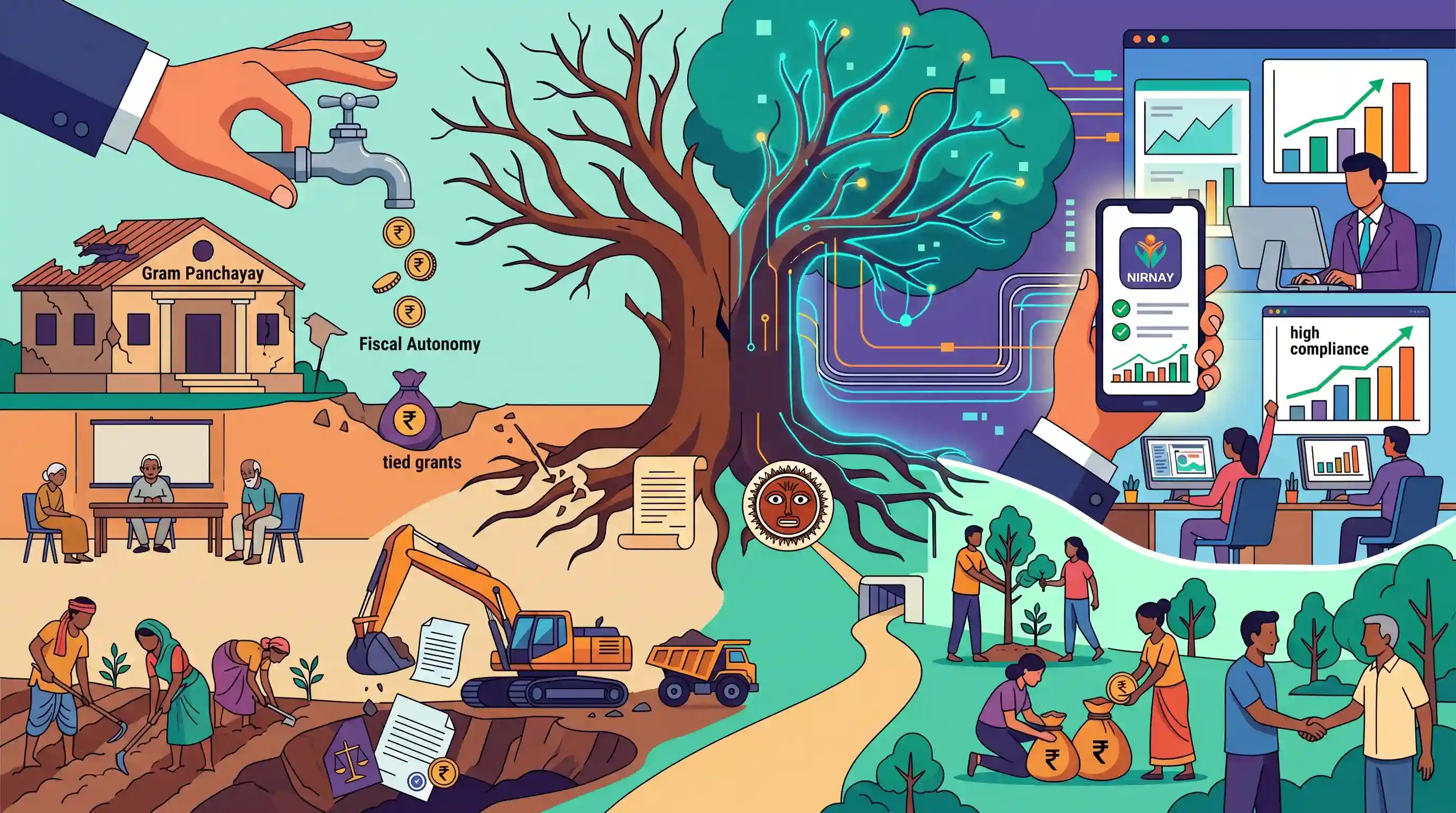
This article critically evaluates the structural, functional, and fiscal erosion of India's grassroots democracy. While government reports point to a technocratic 'vibrancy' based on compliance metrics like the NIRNAY app, on-the-ground reality reveals 'participation fatigue' due to a lack of genuine outcomes. Local governance is crippled by a combination of precarious rural livelihoods that prevent the poor from participating, an extreme lack of fiscal autonomy (with overreliance on centrally-tied grants), and the systematic bypassing of Gram Sabhas' legal consent under the PESA and Forest Rights Acts for land acquisition and mining. True revitalization requires shifting away from superficial digitization to real decentralization of power and funds.
Key Points
- The Ministry of Panchayati Raj equates 'vibrancy' with technocratic and compliance-driven metrics, such as uploading meeting minutes on the NIRNAY app and hosting frequent meetings, which burdens panchayat secretaries and alienates the rural working class.
- Over 50% of the barriers to Gram Sabha participation stem from the precarity of rural livelihoods. Because attending meetings offers no compensation for lost daily wages, meetings remain dominated by the local leisured elite (landlords and contractors).
- Gram Sabhas spend only 4% of their time on revenue generation and are systematically restricted from raising local taxes, making them heavily reliant on Finance Commission grants.
- Central and state grants are often tightly 'tied' to top-down national priorities (e.g., Jal Jeevan Mission, Swachh Bharat), which leaves Gram Sabhas with no room to fund local priorities and disincentivizes citizen participation.
- Despite having statutory powers of prior informed consent for land acquisition and mining under the PESA Act and Forest Rights Act, Gram Sabhas' authority is frequently bypassed or manufactured by the state to push development projects (e.g., Hasdeo Arand) without genuine local consent.
Important Terms
73rd Constitutional Amendment Act

A landmark 1992 amendment that granted constitutional status to Panchayati Raj Institutions, establishing a uniform three-tier local self-governance system (Part IX) and the 11th Schedule in India.
UPSC context
GS Paper II (Polity & Governance): Essential for topics on decentralisation, federalism, and the structure/functioning of rural local bodies.
Provisions of the Panchayats (Extension to the Scheduled Areas) Act (PESA), 1996
A central legislation extending Part IX of the Constitution to Fifth Schedule Areas, empowering Gram Sabhas with self-governance, resource control, and mandatory consultation before land acquisition.
UPSC context
GS Paper II (Governance & Tribal Rights): Important for questions on tribal self-rule, scheduled areas administration, and grassroots democracy.
Scheduled Tribes and Other Traditional Forest Dwellers (Recognition of Forest Rights) Act, 2006
A transformative legislation that recognizes and vests forest land and resource rights to forest-dwelling Scheduled Tribes and traditional forest dwellers, correcting historical colonial-era injustices.
UPSC context
GS Paper II & III (Governance, Environment): Vital for topics on tribal welfare, community forest rights, and conservation vs livelihood debates.
Gram Sabha
A permanent constitutional body comprised of all registered adult voters in a village panchayat area, acting as the foundation of direct grassroots democracy and accountability.
UPSC context
GS Paper II (Polity): Crucial for analyzing direct democracy, participatory governance, and institutional accountability at the village level.
Central Finance Commission
A constitutional body (Article 280) that recommends fiscal devolution and grants from the Consolidated Fund of India to supplement the resources of local self-governments.
UPSC context
GS Paper II & III (Fiscal Federalism): Vital for evaluating devolution criteria, financial autonomy of local bodies, and tied versus untied grants.
NIRNAY App
A mobile application developed by the Ministry of Panchayati Raj to digitize local decision-making, manage meeting agendas, upload resolutions, and enhance rural governance transparency.
UPSC context
GS Paper II (e-Governance): Key for answers on digital initiatives in rural administration, compliance tracking, and technical decentralisation challenges.
Gram Panchayat
The lower executive tier of rural local self-governance consisting of elected ward members and a Sarpanch, responsible for implementing developmental schemes approved by the Gram Sabha.
UPSC context
GS Paper II (Governance): Essential for understanding local administration, the three-tier PRI system, and executive versus legislative village-level bodies.
Prelims Trap
The PESA Act, 1996 mandates absolute 'prior informed consent' of the Gram Sabha for land acquisition in Scheduled Areas.
PESA uses the term 'consulted' (Section 4(i)) for land acquisition, which is legally weaker than the 'prior informed consent' explicitly mandated under the Forest Rights Act (FRA), 2006.
Static Concepts Connected
What is the 15th Finance Commission’s framework for Rural Local Body (RLB) grants?
- Tied vs Untied Split: Grants are split into 60% Tied Grants (for water, sanitation, and ODF maintenance) and 40% Basic Untied Grants for flexible local needs.
- Horizontal Devolution Formula: Determined using a 90:10 weighted ratio of population (based on 2011 Census) to geographical area of the state.
- Digital Conditionality: Release of funds is conditionally tied to local bodies uploading their provisional and audited accounts online on portals like eGramSwaraj.
How do PESA 1996 and FRA 2006 differ in Gram Sabha resource rights?
- Consent vs Consultation: PESA requires 'consultation' for land acquisition in Scheduled Areas, while FRA requires absolute 'prior informed consent' before diverting forest lands.
- Nodal Ministries: PESA is administered by the Ministry of Panchayati Raj, whereas FRA is overseen by the Ministry of Tribal Affairs.
- Geographical Mandate: PESA targets Scheduled Areas (Fifth Schedule), while FRA applies to all traditional forest-dwelling communities across India.
Cross-Topic Patterns
Federalism vs Mineral Resource Extraction
Bypassing Gram Sabhas for mining leases in Fifth Schedule regions highlights the clash between central/state economic priorities and tribal self-governance rights.
Digital Governance vs Marginalized Exclusion
The transition to app-based compliance (like NIRNAY) shifts governance focus from qualitative local participation to quantitative technocratic reporting, alienating vulnerable groups.

The 2026 exam will likely contrast PESA's 'consultation' with FRA's 'prior informed consent' regarding mining in Fifth Schedule areas.
Linked PYQs · 2
Linked PYQs · 2
- 2020MainsGS2
The strength and sustenance of local institutions in India has shifted from their formative phase of 'Functions, Functionaries and Funds' to the contemporary stage of 'Functionality'. Highlight the critical challenges faced by local institutions in terms of their functionality in recent times.
- 2013PrelimsGS1
The Government enacted the Panchayat Extension to Scheduled Areas (PESA) Act in 1996. Which one of the following is not identified as its objective?
