Yemen Houthi Rebel Raids on UN Facilities and Aid Crisis
Source:Indian Express ↗
Why It Matters
The article highlights the operational challenges faced by international organizations like the UN and its agencies (WFP, UNICEF) in conflict zones. For UPSC aspirants, understanding the ongoing Yemen crisis, the key actors involved (Houthis, Saudi-led coalition), and the geographical significance of the region (Sanaa, Red Sea) is essential for mapping questions in Prelims and International Relations topics in Mains GS-2.
Summary
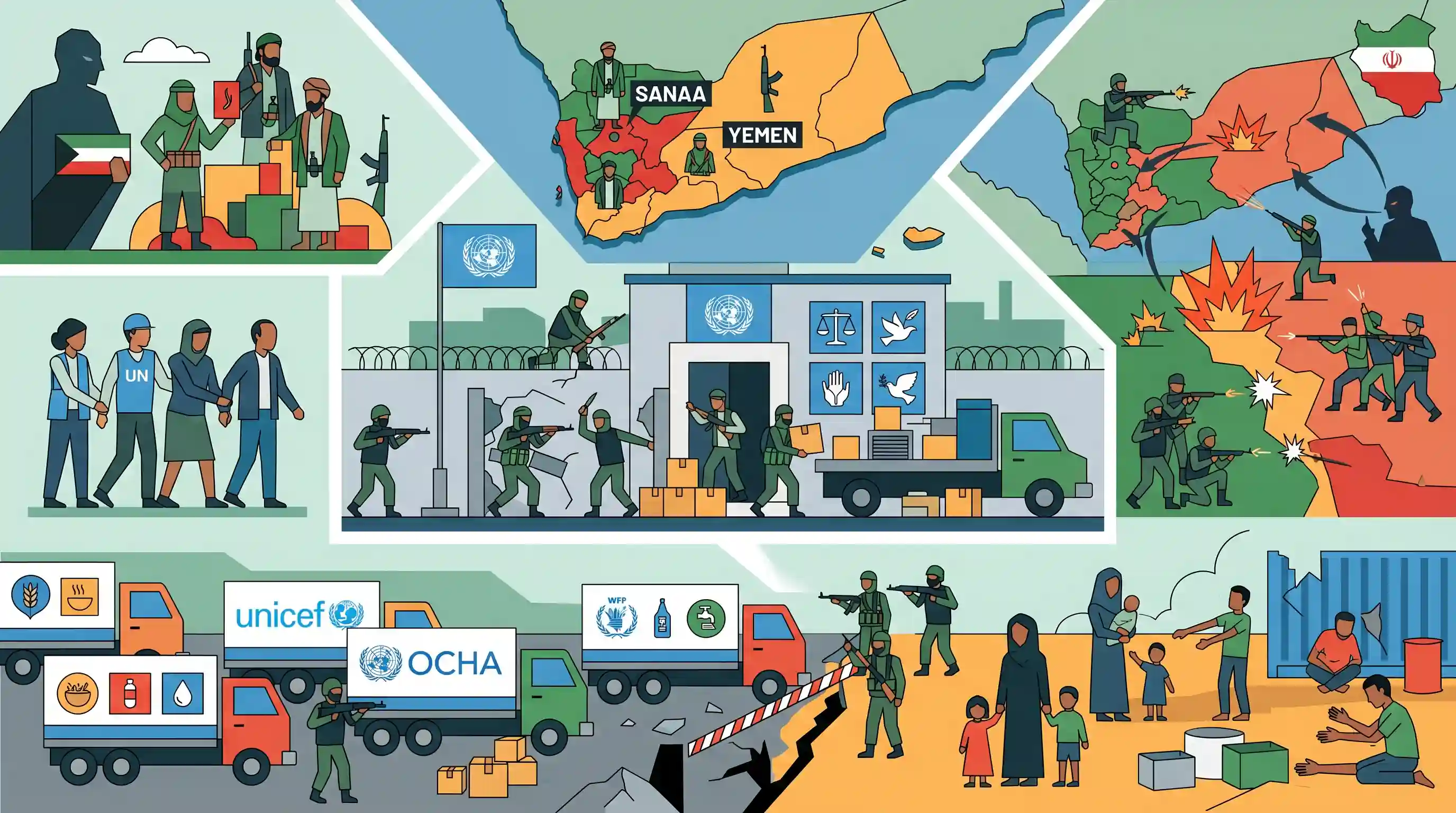
Yemen's Houthi rebels recently raided a United Nations human rights facility in the capital, Sanaa, further escalating tensions following their recent detention of multiple UN and NGO workers. Although all staff members were reported safe, the seizure of UN property underscores the perilous environment for international organizations operating in the war-torn country. Yemen's civil war, which began in 2014 when the Iran-aligned Houthis captured Sanaa and ousted the internationally recognized government, continues to severely hinder the delivery of critical humanitarian aid by agencies such as the WFP, UNICEF, and OCHA.
Key Points
- Yemen's Houthi rebels raided a UN human rights office in the capital city of Sanaa, seizing documents, furniture, and vehicles.
- The incident follows the recent detention of dozens of UN and NGO employees by the Houthis, highlighting the severe risks faced by humanitarian workers in the region.
- Yemen has been embroiled in a brutal civil war since 2014 when Houthi insurgents ousted the internationally recognized government from Sanaa, triggering a prolonged military intervention by a Saudi-led coalition.
- The ongoing conflict has created one of the world's worst humanitarian crises, making the presence of international relief organizations like WFP and UNICEF crucial but highly vulnerable.
Important Terms
Houthi rebels

Iran-aligned Zaidi Shia group that captured Yemen's capital in 2014, triggering a civil war and regional conflict impacting global shipping.
UPSC context
GS Paper II/III: West Asian geopolitics, maritime security, and impact on India’s trade and energy security.
World Food Programme (WFP)
The UN's food-assistance agency and 2020 Nobel Peace Prize winner, providing emergency aid and building food security in conflict-torn regions.
UPSC context
GS Paper II: Important International Institutions; essential for topics on global food security and humanitarian aid.
UNICEF
UN agency providing humanitarian and developmental assistance to children and mothers; monitors grave rights violations in conflict zones like Yemen.
UPSC context
GS Paper II: Important International Institutions; relevant for child rights and international social welfare bodies.
UN Office for the Coordination of Humanitarian Affairs (OCHA)
UN body that coordinates global emergency response, managing humanitarian funding and advocating for the safety of aid workers in crises.
UPSC context
GS Paper II: International Relations; tests knowledge of humanitarian diplomacy and international response to disasters.
United Nations (UN)
Global intergovernmental organization established to maintain international peace, develop relations among nations, and coordinate humanitarian action.
UPSC context
GS Paper II: Important International Institutions; fundamental for understanding global governance and multilateralism.
Prelims Trap
"The Bab el-Mandeb Strait connects the Persian Gulf to the Arabian Sea."
Bab el-Mandeb connects the Red Sea to the Gulf of Aden. It is the Strait of Hormuz that connects the Persian Gulf to the Gulf of Oman/Arabian Sea.
Static Concepts Connected
Which countries border Yemen and the strategic Bab el-Mandeb strait?
- Land Borders: Yemen shares land borders strictly with Saudi Arabia to the north and Oman to the east.
- Maritime Chokepoint: Bab el-Mandeb lies between Yemen on the Arabian Peninsula and Djibouti and Eritrea in the Horn of Africa.
- Water Linkage: It is a vital strategic link connecting the Red Sea (northwest) to the Gulf of Aden and the Arabian Sea (southeast).
How do UN OCHA, WFP, and UNICEF differ in their institutional structure?
- UN OCHA: It is a core office of the UN Secretariat, directly supporting the Under-Secretary-General for Humanitarian Affairs.
- WFP & UNICEF: These are UN funds and programmes established by the General Assembly, governed by their own executive boards and relying largely on voluntary contributions.
Cross-Topic Patterns
Red Sea disruptions & Indian macroeconomic stability
Houthi attacks force global shipping around the Cape of Good Hope, spiking freight rates, inflating imported energy costs, and hurting India's export competitiveness in European markets.
Asymmetric warfare & non-state actors
The Houthis (Yemen), Hezbollah (Lebanon), and Hamas (Gaza) represent Iran's 'Axis of Resistance', shifting regional geopolitical dynamics from conventional state-to-state conflicts to prolonged non-state asymmetric warfare.

Expect a map-based Prelims question pairing Middle-Eastern maritime chokepoints (Bab el-Mandeb, Hormuz) with nearby non-state actors.
Linked PYQs · 4
Linked PYQs · 4
- 2023PrelimsGS1
Consider the following pairs: Area of conflict mentioned in news Country where it is located 1. Donbas : Syria 2. Kachin : Ethiopia 3. Tigray : North Yemen How many of the above pairs are correctly matched?
- 2011MainsGS2
Write a short note on the World Food Programme (WFP) of the United Nations (UN).
- 2024PrelimsGS1
Consider the following statements : 1. The Red Sea receives very little precipitation in any form. 2. No water enters the Red Sea from rivers. Which of the statements given above is/are correct?
- 2018PrelimsGS1
The term "two-state solution" is sometimes mentioned in the news in the context of the affairs of
