Yemen missile attack on Tel Aviv and West Asia maritime security
Source:The Hindu ↗
Why It Matters
The ongoing conflict involving Israel, Hamas, and Houthi rebels in Yemen has significant implications for global maritime security and trade, particularly in the Red Sea. For UPSC aspirants, understanding the strategic geography of the Middle East, the involvement of global powers like the U.S., and the spillover effects of regional conflicts is crucial for GS2 (International Relations) and GS1 (Mapping).
Summary
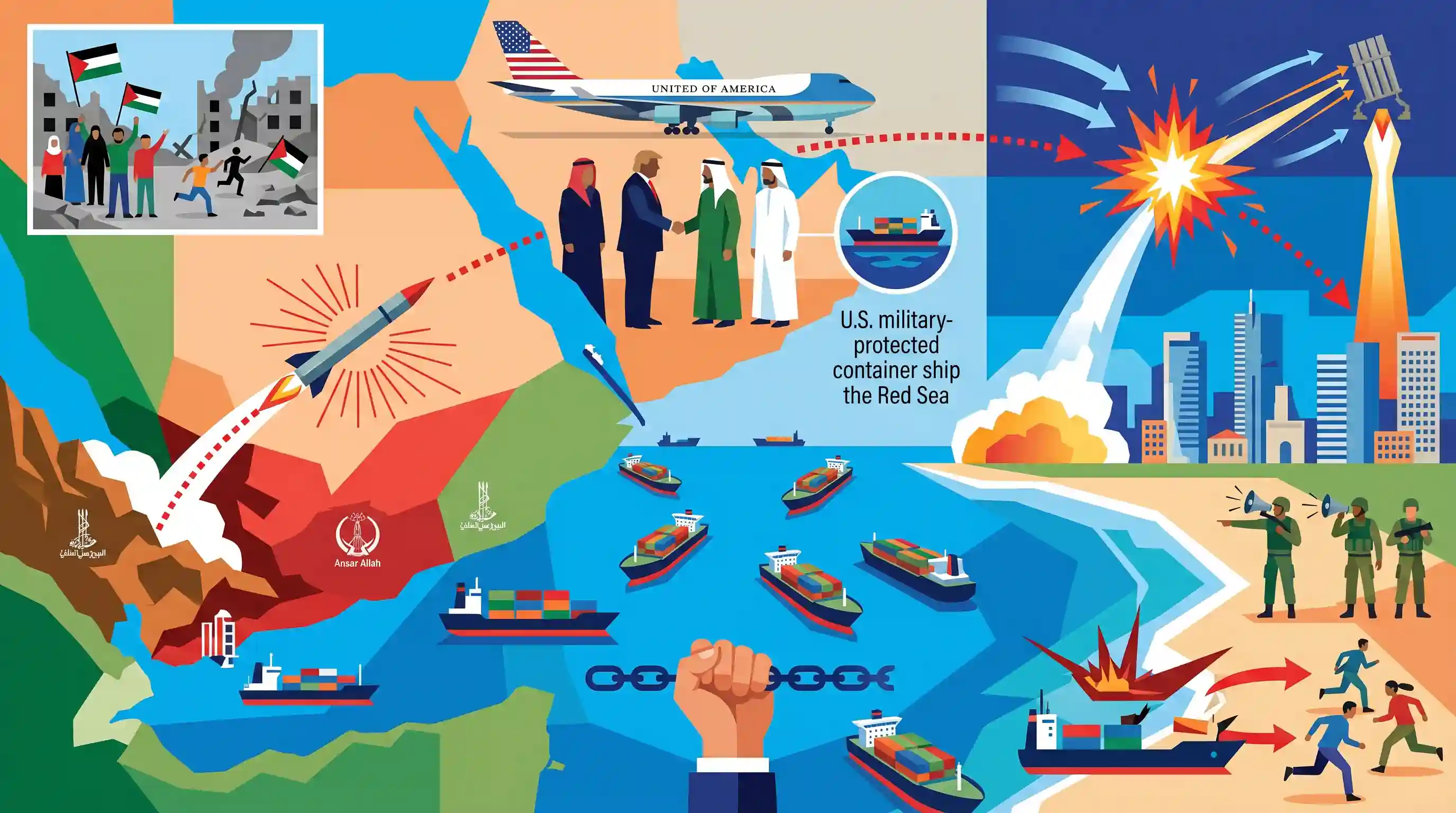
A missile launched from Yemen, presumably by Houthi rebels, targeted Tel Aviv, Israel, and was intercepted by Israeli defenses. The attack occurred during U.S. President Donald Trump's visit to the Gulf, which followed a U.S.-brokered ceasefire aimed at stopping Houthi attacks on international shipping. While the Houthis agreed to halt strikes on U.S. vessels, they maintained their intent to target Israel in solidarity with Palestinians in Gaza. In response, the Israeli military warned civilians to evacuate key Houthi-controlled ports, indicating potential retaliatory strikes. The incident underscores the continuing volatility in West Asia and the geopolitical challenges of securing maritime routes like the Red Sea.
Key Points
- Israel intercepted a missile fired from Yemen toward Tel Aviv, highlighting ongoing regional hostilities.
- The attack coincided with U.S. President Donald Trump's diplomatic tour of the Gulf region.
- A recent U.S.-brokered ceasefire with the Houthis was intended to halt attacks on international shipping in exchange for ending U.S. bombardments.
- Despite the U.S. deal, the Houthis vowed to continue their attacks against Israel in solidarity with Palestinians in Gaza.
- The Israeli military warned civilians to evacuate Houthi-controlled ports (Hodeida, Ras Issa, Salif), signaling impending retaliatory strikes.
Important Terms
Houthis

A Zaydi Shia militant group in Yemen, also known as Ansar Allah. They control Sana\'a and large parts of northern Yemen, receiving significant military and financial backing from Iran.
UPSC context
GS-II: International Relations. Crucial for understanding West Asian proxy wars and their impact on India\'s energy security and maritime trade.
Hamas
A Sunni Islamist political and militant organization governing the Gaza Strip since 2007. It is a central belligerent in the Israel-Palestine conflict and a member of the Iran-led \'Axis of Resistance.\'
UPSC context
GS-II: International Relations. Essential for analyzing the Israel-Palestine issue and regional stability in the Middle East.
Axis of Resistance
A strategic military and political alliance led by Iran, including the Syrian government, Hezbollah, Hamas, and the Houthis, aimed at countering Western and Israeli influence in the Middle East.
UPSC context
GS-II: International Relations. Key to understanding Iran\'s regional influence and the multi-polar nature of Middle Eastern security.
Bab al-Mandab Strait
A critical maritime chokepoint between Yemen and Djibouti connecting the Red Sea to the Gulf of Aden. It is vital for global oil and natural gas shipments.
UPSC context
GS-I: Geography & GS-III: Security. A strategic chokepoint often tested in Prelims and Mains regarding global trade security.
Operation Prosperity Guardian
A U.S.-led multinational military operation launched to protect commercial shipping in the Red Sea from Houthi drone and missile attacks, ensuring freedom of navigation.
UPSC context
GS-II & GS-III: International security collaborations and their effectiveness in protecting India\'s maritime trade routes.
Asymmetric Warfare
A form of conflict between two parties of significantly different military power or status, typically involving unconventional tactics like drone swarms or sea mines used by non-state actors.
UPSC context
GS-III: Internal and External Security. Tests understanding of modern conflict where small groups challenge state militaries.
Prelims Trap
Hodeida, Ras Issa, and Salif are strategic Yemeni ports located along the Gulf of Aden.
These ports are situated on Yemen's western coast directly along the Red Sea, not the Gulf of Aden, making them critical for controlling Red Sea maritime traffic.
Static Concepts Connected
What are the key geographical boundaries and maritime features of Yemen?
- Land borders: Yemen shares land borders with Saudi Arabia to the north and Oman to the east.
- Maritime borders: It is bordered by the Red Sea to the west and the Gulf of Aden (Arabian Sea) to the south.
- Bab el-Mandeb: The Bab el-Mandeb strait separates Yemen from Djibouti and Eritrea in the Horn of Africa, acting as a critical trade chokepoint.
What comprises Israel's multi-tiered air and missile defense architecture?
- Short-range: The Iron Dome is designed to intercept and destroy short-range rockets and artillery shells fired from close distances.
- Medium-range: David's Sling targets medium-to-long-range rockets, tactical ballistic missiles, and cruise missiles.
- Long-range: The Arrow system (Arrow-2 and Arrow-3) intercepts long-range and exo-atmospheric ballistic missiles, such as those fired from Yemen.
Cross-Topic Patterns
Red Sea crisis & India's export trade
Rerouting commercial shipping around the Cape of Good Hope increases freight and insurance costs, directly impacting India's macroeconomic stability and export competitiveness in European markets.
Asymmetric warfare at maritime chokepoints
Non-state actors using cheap drones and missiles to disrupt global Sea Lines of Communication (SLOCs) forces massive, asymmetric economic and logistical costs on conventional state navies.

Yemen's Red Sea ports (Hodeida, Salif) and Bab el-Mandeb are highly probable map-based match-the-following questions in Prelims 2026.
Linked PYQs · 3
Linked PYQs · 3
- 2022PrelimsGS1
The term "Levant" often heard in the news roughly corresponds to which of the following regions?
- 2024PrelimsGS1
Consider the following statements : Statement-I : Sumed pipeline is a strategic route for Persian Gulf oil and natural gas shipments to Europe. Statement-II : Sumed pipeline connects the Red Sea with the Mediterranean Sea. Which one of the following is correct in respect of the above statements?
- 2014MainsGS2
With respect to the South China sea, maritime territorial disputes and rising tension affirm the need for safeguarding maritime security to ensure freedom of navigation and over flight throughout the region. In this context, discuss the bilateral issues between India and China.
