India Macroeconomic Resilience Amid Global Tariff Wars in 2025
Source:Indian Express ↗
Why It Matters
The transition of the global economy towards protectionism and trade wars directly impacts India's export growth and economic stability. Understanding how India successfully navigates these external shocks is essential for aspirants to analyze contemporary economic policies, trade strategies, and macroeconomic management.
Summary
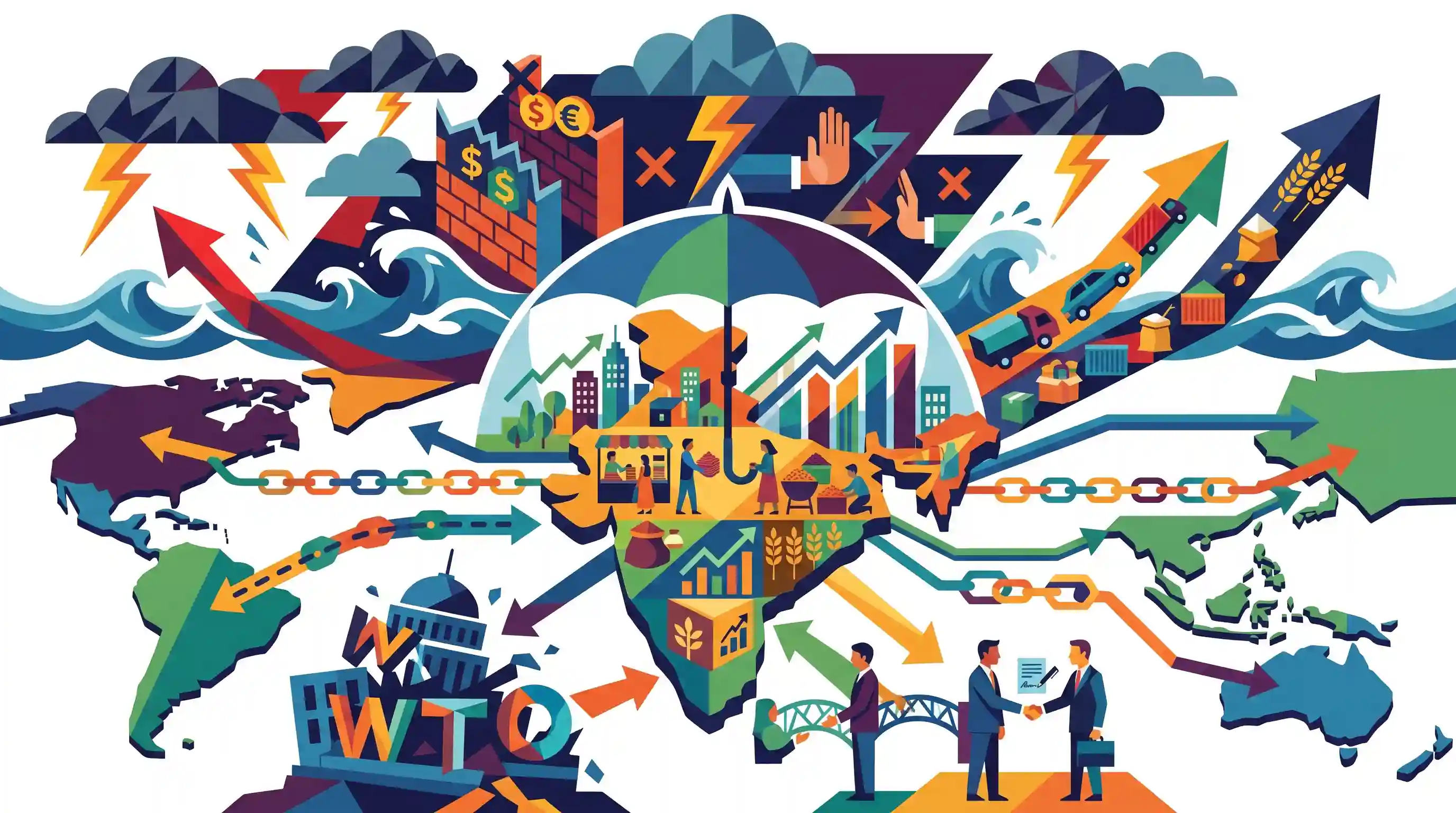
The year 2025 was marked by a global 'tariff storm' as major economies increasingly adopted protectionist trade policies and engaged in trade wars. A year-end economic analysis reveals that India managed to weather these global headwinds effectively. Relying on its strong macroeconomic fundamentals, robust domestic demand, and strategic diversification of supply chains, India mitigated the impacts of reduced multilateralism. The shift from WTO-led free trade towards bilateralism presented both challenges and opportunities, prompting India to focus on strategic Free Trade Agreements (FTAs) and improve its export competitiveness to sustain economic growth.
Key Points
- The global economy in 2025 witnessed a surge in protectionist policies and trade barriers, often described as a 'tariff storm', driven primarily by advanced economies aiming to protect domestic industries.
- Despite external trade shocks, India demonstrated notable macroeconomic resilience, supported by robust domestic demand, high foreign exchange reserves, and stable fiscal policies.
- The ongoing shift away from multilateral free trade frameworks (such as the WTO) towards bilateralism required India to actively pursue and negotiate strategic Free Trade Agreements (FTAs).
- Supply chain realignments, including the 'China-Plus-One' strategy, provided India with opportunities to attract manufacturing investments and diversify its export base amidst global trade wars.
- Future economic strategy requires a continued focus on enhancing domestic manufacturing competitiveness, reducing import dependencies on critical goods, and navigating a fractured global trade landscape.
Important Terms
Protectionism

An economic policy of restricting imports through tariffs, quotas, and subsidies to shield domestic industries and workers from foreign competition.
UPSC context
GS-3 (Economy) and GS-2 (IR); tests understanding of global trade barriers and their impact on India's domestic manufacturing and growth.
Free Trade Agreements (FTAs)
Legally binding treaties between two or more nations to reduce or eliminate trade barriers like tariffs and quotas, facilitating the flow of goods and services.
UPSC context
GS-3 (Economy); critical for questions on India's trade strategy, export competitiveness, and recent pacts like those with UAE and EFTA.
World Trade Organization (WTO)
The primary international body dealing with global trade rules, dispute settlement, and trade negotiations among its 164 member nations.
UPSC context
GS-2 (International Organizations); focuses on the challenges of a rules-based order, dispute settlement paralysis, and India's food security concerns.
Supply Chain Diversification
A strategy of reducing dependence on specific suppliers or countries by broadening sourcing networks to mitigate risks from geopolitical or economic shocks.
UPSC context
GS-3 (Economy); links to 'Atmanirbhar Bharat' and India's positioning in the 'China Plus One' global manufacturing shift.
Bilateralism
Coordination or trade agreements between exactly two nations, often preferred for speed and specificity over complex multilateral negotiations.
UPSC context
GS-2 (International Relations); relevant for analyzing India's shift toward strategic partnerships in a fragmented global trade environment.
Multilateralism
The practice of coordinating relations between three or more states through global institutions to solve shared issues and ensure non-discriminatory trade.
UPSC context
GS-2 (IR); tests knowledge of the declining efficacy of global institutions and the rise of regional trading blocs.
Prelims Trap
"India's recent bilateral FTAs guarantee a trade surplus and complete immunity from the global tariff storm."
India historically runs trade deficits even with key FTA partners (like ASEAN). FTAs increase trade volume but do not automatically eliminate deficits or ensure total immunity.
Static Concepts Connected
What are the primary trade remedy measures permitted by the WTO?
- Anti-dumping duties: Tariffs applied to imported goods sold below their fair market value to protect domestic industries from predatory pricing.
- Countervailing duties: Tariffs imposed to neutralize the negative effects of subsidies granted by foreign governments to their exporting domestic industries.
- Safeguard measures: Temporary, emergency restrictions on imports of a product to prevent or remedy serious injury to domestic producers from sudden surges.
What constitutes India's Foreign Exchange Reserves managed by the RBI?
- Foreign Currency Assets: The largest component, consisting of foreign currencies, foreign treasury bills, and bonds held by the RBI.
- Gold reserves: Physical gold holdings used as a traditional buffer and store of value during global macroeconomic shocks.
- SDRs and RTP: Special Drawing Rights (SDR) and the Reserve Tranche Position (RTP) maintained with the International Monetary Fund (IMF).
Cross-Topic Patterns
Tariff wars & 'Rules of Origin'
As India shifts to bilateral FTAs amidst global tariffs, strict 'Rules of Origin' are enforced to prevent third-country dumping, specifically stopping China from routing goods through India's FTA partners.
PLI Schemes vs. WTO Subsidies
Global protectionism pushes India toward import substitution. UPSC frequently tests the linkage between India's domestic PLI schemes and compliance with the WTO's Agreement on Subsidies and Countervailing Measures (ASCM).

Expect a 2026 multi-statement Prelims question linking 'China-Plus-One', FTA Rules of Origin, and the paralyzed WTO Appellate Body.
Linked PYQs · 3
Linked PYQs · 3
- 2018MainsGS3
How would the recent phenomena of protectionism and currency manipulations in world trade affect macroeconomic stability of India?
- 2025MainsGS3
What are the challenges before the Indian economy when the world is moving away from free trade and multilateralism to protectionism and bilateralism? How can these challenges be met?
- 2018MainsGS2
What are the key areas of reform if the WTO has to survive in the present context of "Trade War', especially keeping in mind the interest of India?
