India Foreign Policy 2025: Strategic Autonomy and Global Wins
Source:Indian Express ↗
Why It Matters
This yearender review is crucial for UPSC aspirants as it encapsulates India's foreign policy trajectory over the past year, offering valuable insights into trade negotiations, strategic autonomy, and global diplomacy needed for GS Paper 2 answers.
Summary
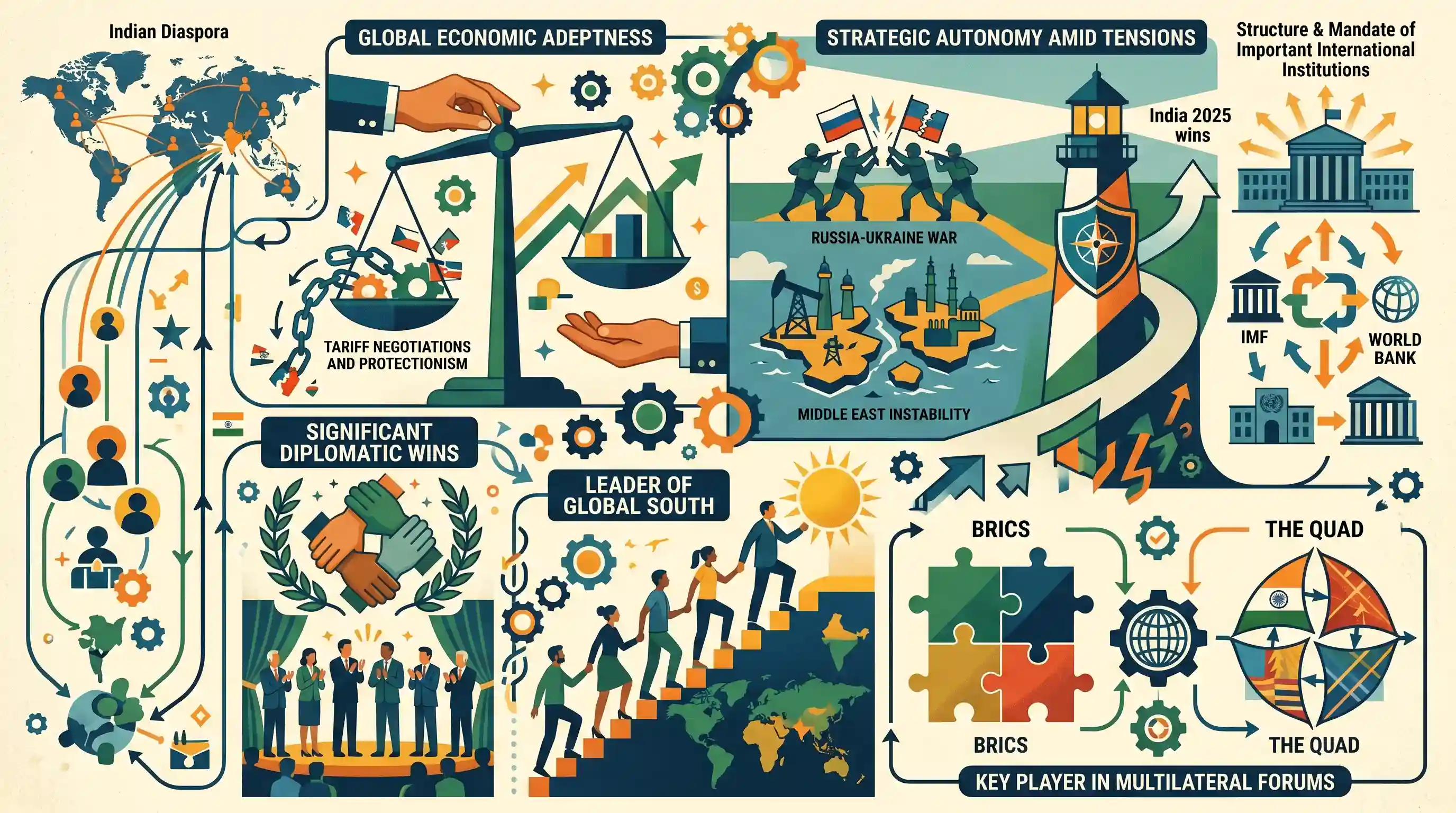
A comprehensive review of India's foreign policy and diplomatic engagements in 2025 highlights its adept management of global economic challenges, such as tariff negotiations and protectionism. Amidst ongoing geopolitical tensions, including the Russia-Ukraine war and instability in the Middle East, India successfully maintained its strategic autonomy. The year was marked by significant diplomatic wins, underscoring India's growing role as a leader of the Global South and a key player in multilateral forums like BRICS and the Quad.
Key Points
- India actively navigated global trade disruptions and rising protectionism by negotiating tariff structures and focusing on diversified trade partnerships.
- Maintained strategic autonomy amidst global geopolitical crises, such as the Russia-Ukraine and Middle Eastern conflicts, prioritizing energy security and advocating for diplomatic resolutions.
- Cemented its position as the voice of the Global South through active participation and leadership in multilateral forums like BRICS, SCO, and the Quad.
- Balanced multi-alignment by simultaneously engaging with Western powers and strengthening strategic partnerships in Eurasia and the Indo-Pacific.
Important Terms
Global South

A collective term for developing, less-developed, or underdeveloped nations in Asia, Africa, and Latin America, often sharing histories of colonialism and seeking equitable global governance.
UPSC context
GS II: International Relations. India's leadership role and its strategy to bridge the North-South divide in multilateral forums.
BRICS
An intergovernmental organization of major emerging economies—Brazil, Russia, India, China, South Africa, and recent 2024-25 additions like Egypt, Iran, UAE, Ethiopia, and Indonesia.
UPSC context
GS II: Global Groupings. Tests India’s role in reshaping global economic governance and managing internal group dynamics.
G20
The premier forum for international economic cooperation, comprising 19 countries, the European Union, and the African Union, representing major developed and emerging economies.
UPSC context
GS II: Important International Institutions. Focuses on global economic stability, sustainable development, and India's 'Vishwa Bandhu' diplomatic strategy.
Shanghai Cooperation Organisation (SCO)
A 10-member Eurasian political, economic, and security organization focusing on counter-terrorism (RATS), regional stability, and connectivity among members like China, Russia, India, and Pakistan.
UPSC context
GS II: Regional Groupings. Relevance to India’s 'Extended Neighbourhood' policy and its stance on cross-border terrorism.
Quad (Quadrilateral Security Dialogue)
A strategic security dialogue between India, USA, Japan, and Australia focused on ensuring a 'free and open Indo-Pacific' through maritime, technological, and supply chain cooperation.
UPSC context
GS II: Bilateral/Regional Groupings. Tests India's balancing act between Western partnerships and its strategic autonomy in the Indo-Pacific.
Prelims Trap
"The Voice of Global South Summit is a formal treaty-based international organization with a permanent secretariat."
VOGSS is an Indian-led diplomatic initiative and summit-level dialogue, not a formal treaty-based multilateral organization with a permanent secretariat.
Static Concepts Connected
What is 'Multi-alignment' in India's foreign policy?
- Definition: Simultaneous, issue-based engagement with multiple competing global powers to maximize national interest and strategic autonomy.
- Contrast with NAM: Unlike traditional Non-Alignment's deliberate equidistance or neutrality, multi-alignment involves proactive, parallel engagement across conflicting blocs.
- Examples: India's concurrent participation in the US-led Quad while maintaining active membership in the China/Russia-led SCO and BRICS.
What trade defense measures can India use against protectionism?
- Anti-dumping duty: Imposed by the WTO framework when a country exports a product at a price lower than its normal domestic market value.
- Countervailing duty: Specific tariffs levied on imported goods to offset unfair financial subsidies given by the exporting country's government to its producers.
- Safeguard measures: A temporary restriction or tariff on imports to protect a specific domestic industry from a sudden, unforeseen surge in imports.
Cross-Topic Patterns
Global South & Climate Equity
India leverages its Global South leadership in forums like BRICS and G20 to advocate for Common But Differentiated Responsibilities (CBDR) and equitable climate finance transfers.
FTAs bypassing Global Protectionism
As Western tariff barriers rise, India's pivot to comprehensive FTAs (e.g., UAE CEPA, Australia ECTA) connects diplomatic strategy directly to macroeconomic export resilience.

Multi-statement Prelims question mapping India's membership overlaps in BRICS, SCO, G20, and Quad, specifically testing China's presence.
Linked PYQs · 3
Linked PYQs · 3
- 2025MainsGS2
"Energy security constitutes the dominant kingpin of India's foreign policy, and is linked with India's overarching influence in Middle Eastern countries.” How would you integrate energy security with India's foreign policy trajectories in the coming years?
- 2019MainsGS2
‘What introduces friction into the ties between India and the United States is that Washington is still unable to find for India a position in its global strategy, which would satisfy India's national self-esteem and ambitions.’ Explain with suitable examples.
- 2023MainsGS2
‘Virus of Conflict is affecting the functioning of the SCO’ In the light of the above statement point out the role of India in mitigating the problems.
