BJP Political Funding Growth Sparks Debate On Electoral Transparency
Source:Indian Express ↗
Why It Matters
Political funding directly impacts the fairness of elections. The massive financial asymmetry and reliance on opaque funding instruments (like the now-scrapped Electoral Bonds) pose persistent challenges to democratic integrity, making it a critical area for GS2 questions on governance, electoral reforms, and the RPA.
Summary
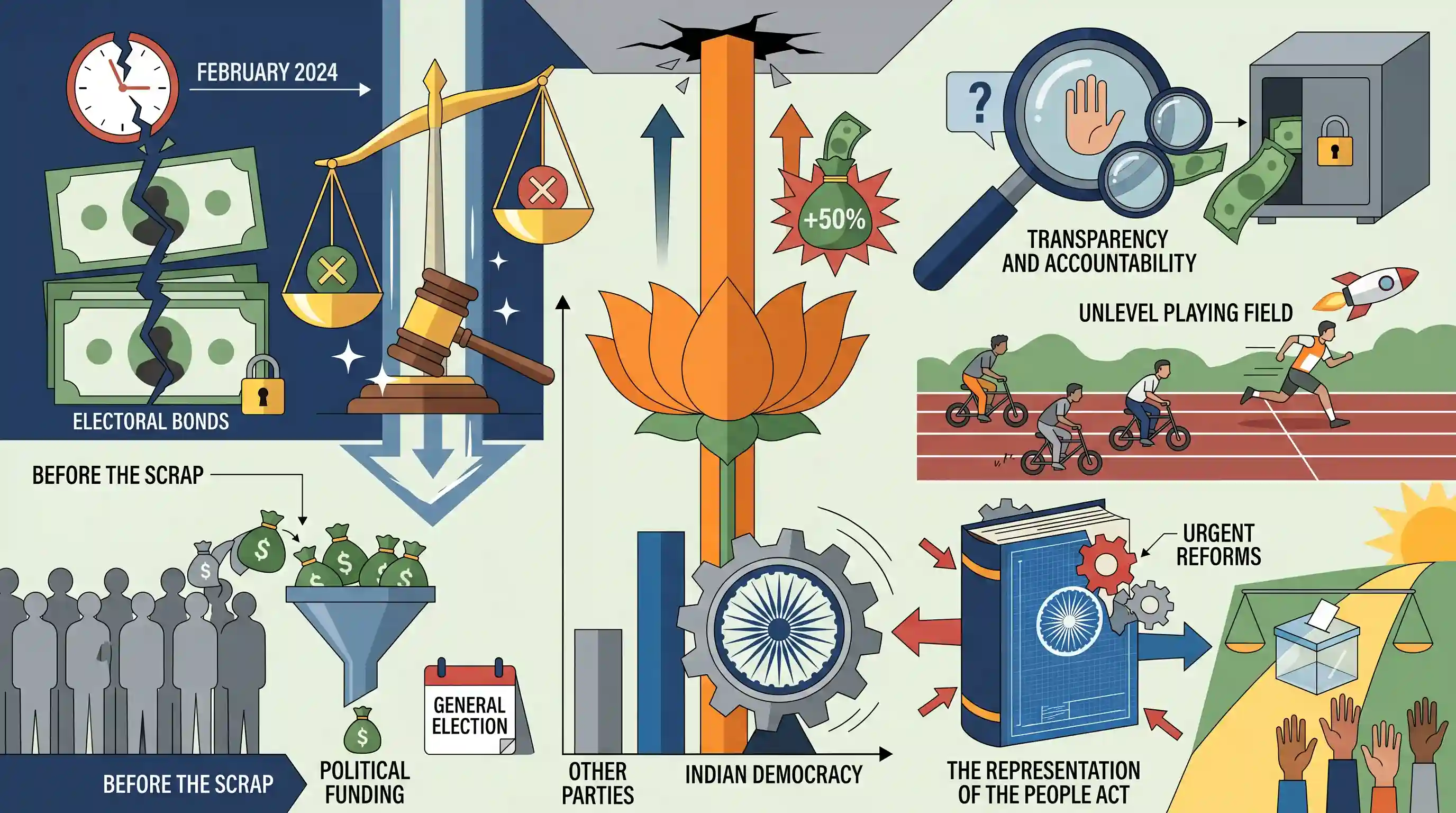
Despite the Supreme Court's scrapping of the controversial Electoral Bonds scheme in February 2024, the BJP's financial coffers saw a massive 50% growth, reaching Rs 6,088 crore in the 2023-24 financial year. This surge underscores the massive influx of corporate and voluntary donations ahead of the general elections, much of it secured before the scheme was invalidated. The disclosure to the Election Commission spotlights the enduring challenges of achieving transparency in political funding and maintaining a level playing field in Indian democracy, reinforcing the urgent need for robust electoral reforms under the Representation of the People Act.
Key Points
- The ruling party reported a total income of Rs 6,088 crore for FY 2023-24, a 50% increase compared to the previous financial year.
- The majority of these funds were likely mobilized through Electoral Bonds prior to the Supreme Court striking down the scheme as unconstitutional in February 2024.
- The significant accumulation of political funds highlights the stark financial asymmetry between ruling and opposition parties, potentially skewing the electoral playing field.
- The findings reinvigorate debates around the necessity of comprehensive electoral finance reforms and mechanisms to ensure transparency in corporate donations.
Important Terms
Electoral Bonds Scheme

Interest-free bearer instruments used for anonymous donations to political parties, struck down by the Supreme Court in 2024 for violating the Right to Information.
UPSC context
GS Paper II: Governance and Polity. Tests understanding of transparency, judicial review, and the right to information in democratic funding.
Representation of the People Act, 1951
The primary parliamentary legislation governing the conduct of elections, candidate qualifications/disqualifications, and the registration of political parties in India.
UPSC context
GS Paper II: Salient features of RPA. Essential for questions on electoral integrity and candidate accountability.
Election Commission of India (ECI)
An autonomous constitutional authority (Article 324) responsible for administering election processes in India and enforcing transparency in political funding.
UPSC context
GS Paper II: Constitutional Bodies. Focuses on the commission's role in maintaining free and fair elections.
Electoral Reforms
Legislative and administrative changes intended to enhance the transparency, accountability, and fairness of the electoral process, including curbing illicit financing.
UPSC context
GS Paper II: Polity. Crucial for discussing the evolution of democracy and addressing issues like money power.
Political Funding
The process by which political parties and candidates raise and manage financial resources for election campaigns and operational activities.
UPSC context
GS Paper II & IV: Ethics and Governance. Analyzes the impact of corporate influence and transparency on public policy.
Prelims Trap
Political parties receive unconditional tax exemptions, and there is no cap on corporate donations to parties following the Finance Act 2017.
Tax exemption (Sec 13A IT Act) is conditional on declaring >Rs 20k donations. Further, the SC's 2024 ruling struck down the 2017 amendments, curbing unlimited corporate funding.
Static Concepts Connected
How do statutory provisions regulate political funding in India?
- RPA Sec 29C: Mandates political parties to submit a report declaring all donations exceeding Rs 20,000 to the Election Commission.
- IT Act Sec 13A: Grants 100% income tax exemption to parties only if they fulfill the disclosure requirements under Section 29C of the RPA.
- Companies Act Sec 182: Regulates corporate contributions. The 2024 SC ruling struck down the 2017 amendment that allowed unlimited corporate funding, restricting corporate influence.
What are the key committee recommendations on State Funding of Elections?
- Indrajit Gupta Committee: Recommended partial state funding of elections 'in-kind' (free airtime, fuel, rent) rather than direct cash subsidies to ensure a level playing field.
- Law Commission (255th): Supported partial state funding, but cautioned it must be preceded by a robust regulatory framework and strict inner-party democracy.
Cross-Topic Patterns
Right to Information vs. Donor Privacy
The SC invalidated the bonds by elevating the voter's Right to Information (Article 19(1)(a)) over the donor's right to privacy, a constitutional balancing act highly relevant for Mains.
Money Bill Route & Judicial Review
The scheme was introduced via the Finance Act 2017 as a Money Bill, connecting political funding to the ongoing constitutional debate over legislative circumvention and bypassing the Rajya Sabha.

Expect a multi-statement Prelims question testing the interplay of RPA Section 29C, Income Tax exemptions, and corporate donation caps.
Linked PYQs · 3
Linked PYQs · 3
- 2024MainsGS2
Examine the need for electoral reforms as suggested by various committees with particular reference to "one nation one election" principle.
- 2001PrelimsGS1
Consider the following statements regarding the political parties in India: I. The Representation of the People Act, 1951 provides for the registration of political parties. II. Registration of political parties is carried out by the Election Commission. III. A national level political party is one which is recognised in four or more States. IV. During the 1999 general elections, there were six National and 48 State level parties recognised by the Election Commission. Which of these statements are correct?
- 2025MainsGS2
Discuss the 'corrupt practices' for the purpose of the Representation of the People Act, 1951. Analyze whether the increase in the assets of the legislators and/or their associates, disproportionate to their known sources of income, would constitute 'undue influence' and consequently a corrupt practice.
