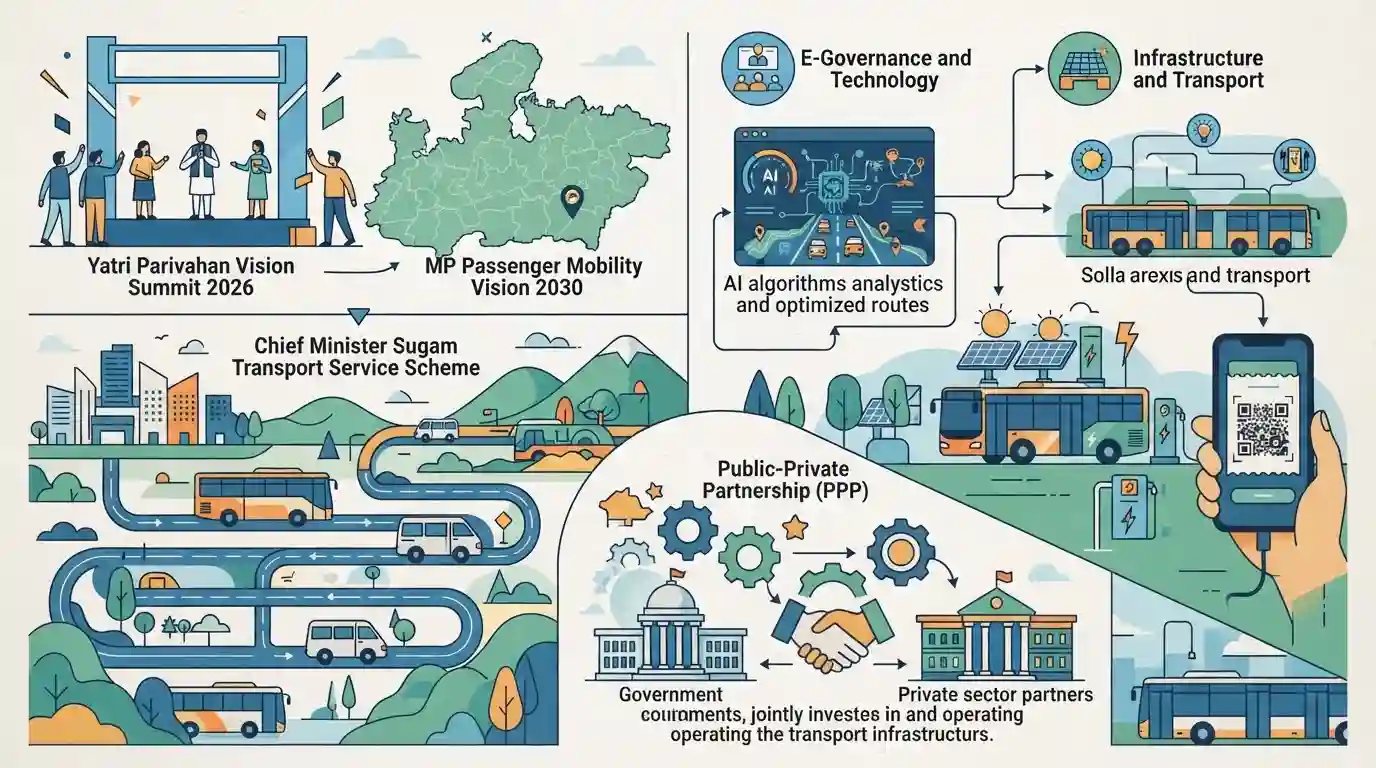
Yatri Parivahan Vision Summit held in Indore
Source:indianmasterminds ↗
Why It Matters
Infrastructure, state government initiatives, and the application of technology (AI in transport) are extremely important for MPPSC Prelims. Specific schemes like the 'MP Passenger Mobility Vision 2030' and 'Chief Minister Sugam Transport Service Scheme' represent directly testable current affairs facts.
Summary
The Madhya Pradesh Government hosted the 'Yatri Parivahan Vision Summit 2026' in Indore to transform and future-proof the state's public transport infrastructure. Inaugurated by Chief Minister Mohan Yadav, the event focused on the ambitious 'MP Passenger Mobility Vision 2030' and introduced the 'Chief Minister Sugam Transport Service Scheme' to ensure seamless connectivity, especially in remote areas. Strategies highlighted during the summit include the integration of Artificial Intelligence (AI) for intelligent traffic management, promoting sustainable electric vehicles, transitioning to fully digital ticketing, and building robust Public-Private Partnership (PPP) models to deliver safe, accessible, and eco-friendly mobility solutions for citizens.
Key Points
- The 'Yatri Parivahan Vision Summit 2026' was organized in Indore to modernize Madhya Pradesh's public transportation network.
- Discussions were held on executing the 'MP Passenger Mobility Vision 2030' which aims to upgrade state mobility with future-ready technologies.
- Launch of the 'Chief Minister Sugam Transport Service Scheme' focusing on bridging connectivity gaps in remote and rural areas.
- Emphasis was placed on public-private partnerships (PPP), deploying AI-integrated Intelligent Transport Management Systems (ITMS), and transitioning to electric mobility and digital ticketing.
Important Terms
MP Passenger Mobility Vision 2030

A strategic roadmap by the Madhya Pradesh government to modernize public transit. It focuses on integrating AI, expanding electric mobility, and developing resilient, sustainable transport networks across regions using PPP models.
UPSC context
GS-3 (Infrastructure). Tests knowledge of state-level smart mobility frameworks, green transitions, and technology-driven infrastructure planning.
Chief Minister Sugam Transport Service Scheme
A Madhya Pradesh initiative to strengthen public bus networks. Operated by a newly formed state enterprise, MPYPIL, it aims to deliver organized, safe, and modern public transit connectivity across urban and rural routes.
UPSC context
GS-2 (Government Policies). Evaluates state initiatives for rural and urban connectivity, transport governance, and institutional structuring.
Yatri Parivahan Vision Summit 2026
A national platform hosted in Indore to accelerate MP's transition to smart public transportation. Policymakers and industry leaders collaborate here on digital ticketing, green mobility, AI analytics, and public-private partnership models.
UPSC context
GS-3 (Infrastructure/Investment Models). Useful as a case study for government-industry partnerships in building sustainable, tech-enabled mobility ecosystems.
Prelims Trap
Under the Mukhyamantri Sugam Parivahan Seva, the state government directly owns and operates the entire bus fleet.
The scheme is structured as a PPP model where the state acts as a facilitator and equity provider, while private operators purchase and run the fleet.
Static Concepts Connected
What are the key Public-Private Partnership (PPP) models?
- BOT Model: Private partner builds, operates for a concession period, collects user fees, and transfers ownership back to the government.
- HAM Model: Government pays 40% in installments during construction; private partner finances 60% and recovers it through annuity payments.
- Viability Gap Funding: One-time capital grant provided by the government to make economically essential projects financially viable for private developers.
What is the PM-eBus Sewa Scheme?
- Targeted Deployment: Aims to deploy 10,000 electric buses in 169 target cities under a Public-Private Partnership (PPP) model.
- Funding Support: Provides central assistance for bus operations, behind-the-meter power infrastructure, and charging facilities.
- Environmental Goal: Prioritizes cities lacking organized public transport, fostering green urban mobility and reduced emissions.
Cross-Topic Patterns
Central-state synergies in green transit
Shows how state-level initiatives leverage central funds (like PM e-Bus Sewa) to optimize capital expenditure and scale up eco-friendly public infrastructure.
Evolution of transport PSU models
Illustrates the transition from loss-making state-run monopolies (like the disbanded MPSRTC) to agile, private-sector-led holding structures.

GS-3 Mains could use MP's shift to MPYPIL to test the viability of asset-light holding models over traditional capital-heavy STUs.
Linked PYQs · 2
Linked PYQs · 2
- 2024MPPSC_PRELIMSGS1
UNNATI (Agri-GISl project of Madhya Pradesh Government is for :
- 2019MPPSC_PRELIMSGS1
Headquarter of Madhya Pradesh Finance Corporation is
