Yamuna Water Agreement Sparks Political Controversy in Rajasthan
Source:newindianexpress ↗
Why It Matters
Interstate water sharing and major irrigation/drinking water projects are recurring themes in the RPSC RAS Prelims. The Yamuna water agreement is critical for the arid Shekhawati region (Sikar, Jhunjhunu, Churu) and relates directly to past questions on joint ventures (like Mahi Bajaj Sagar) and district-wise irrigation benefits.
Summary
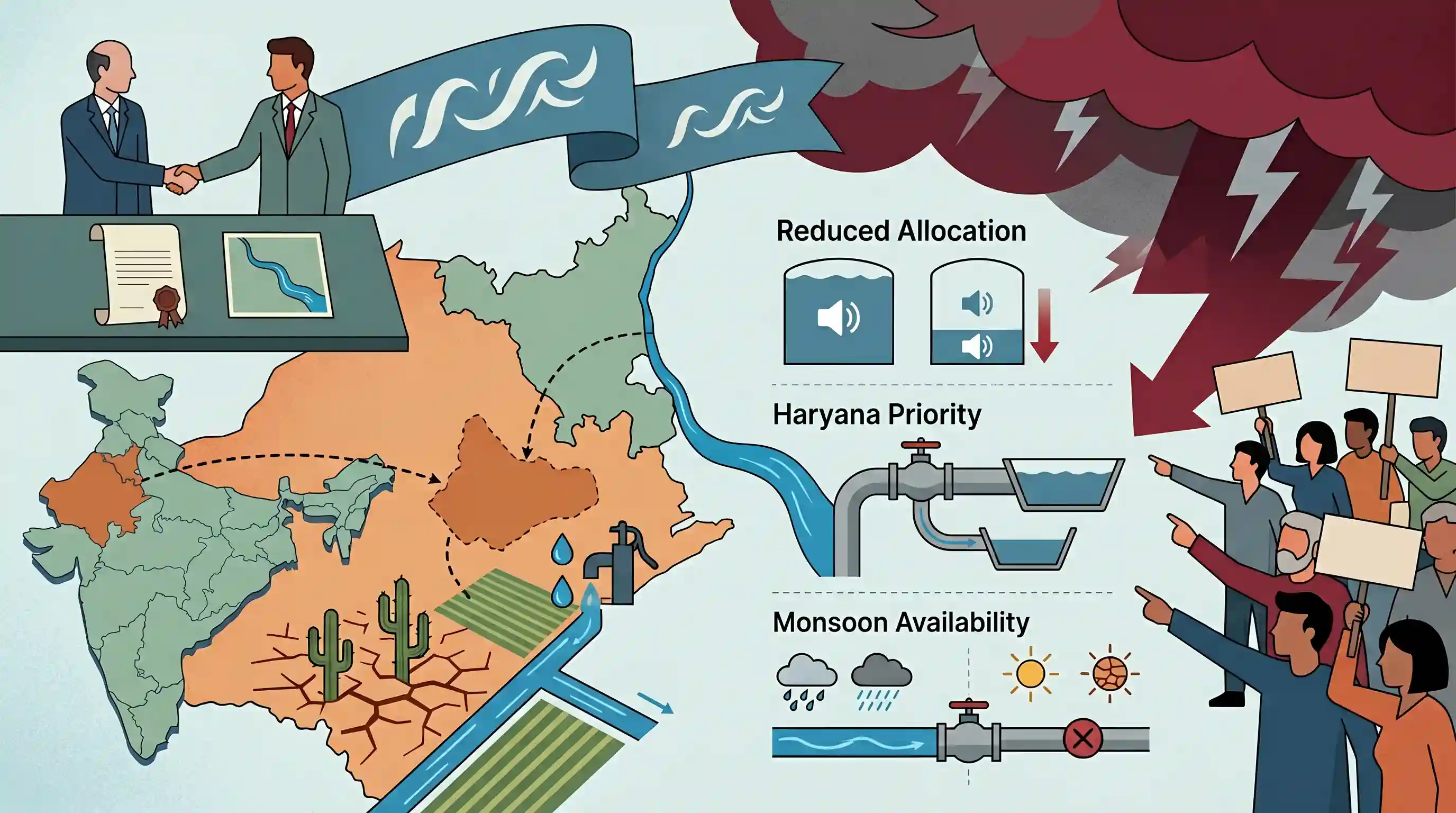
On June 29, 2026, Rajasthan and Haryana signed an implementation Memorandum of Agreement (MoA) for the 1994 Yamuna water-sharing agreement, aiming to resolve a 32-year deadlock and provide drinking water and irrigation to Rajasthan's arid Shekhawati region. However, the agreement has sparked a political storm in Rajasthan. The opposition Congress alleges that the state's interests have been compromised, pointing to a potential reduction in the water allocation from 1.19 BCM to 580 MCM, priority drawing rights for Haryana, and water availability limited to monsoon months.
Key Points
- Rajasthan and Haryana signed an implementation Memorandum of Agreement (MoA) in June 2026 to resolve a 32-year deadlock over the 1994 Yamuna water-sharing agreement.
- The agreement was signed by Rajasthan CM Bhajan Lal Sharma and Haryana CM Nayab Saini in the presence of Union Home Minister Amit Shah.
- The project aims to supply Yamuna water to the water-scarce Shekhawati region of Rajasthan (including Sikar, Jhunjhunu, and Churu districts), promising drinking water and potential irrigation benefits for 1.05 lakh hectares.
- The opposition Congress has heavily criticized the agreement, alleging that it violates the spirit of the original 1994 pact and compromises Rajasthan's water rights.
- Key criticisms include allegations of keeping the agreement's terms secret, granting Haryana priority to draw water first (up to 24,000 cusecs), limiting water supply to monsoon months, and reducing Rajasthan's share from 1.19 BCM to 580 MCM.
Important Terms
1994 Yamuna Water-Sharing Agreement

A landmark pact signed on May 12, 1994, by five Yamuna basin states allocating the river's surface flow and establishing the Upper Yamuna River Board.
UPSC context
GS-II: Inter-State Water Disputes. Tests cooperative federalism, river basin management, and historical water allocation frameworks.
2026 Yamuna Water Implementation MoA
An agreement signed on June 29, 2026, by Rajasthan and Haryana to implement the 1994 pact, transferring 580 MCM of monsoon water via underground pipelines.
UPSC context
GS-II: Inter-State Relations. Tests contemporary bilateral agreements, federal dispute resolution, and water infrastructure governance.
February 2024 Yamuna Water MoU
A preliminary bilateral agreement signed on February 17, 2024, to prepare a joint Detailed Project Report for transferring Rajasthan's Yamuna water share via pipeline.
UPSC context
GS-II: Inter-State Relations. Tests preparatory administrative steps, feasibility planning, and collaborative governance in resolving water blockades.
Government of India
The central executive authority of India, which facilitated the Yamuna water agreement through the Union Home and Jal Shakti ministries to promote cooperative federalism.
UPSC context
GS-II: Federal Structure. Tests the Union's role in mediating interstate disputes and ensuring cooperative federalism.
Rajasthan Government
The subnational executive of Rajasthan, acting as the lower riparian state securing drinking and irrigation water for its water-stressed Shekhawati region.
UPSC context
GS-I: Resource Distribution; GS-II: State Governance. Tests state-level water security initiatives and executive actions in regional development.
Haryana Government
The subnational executive of Haryana, serving as the upper riparian authority managing the Hathnikund Barrage and Western Yamuna Canal systems.
UPSC context
GS-I: Geography of Water Resources. Tests upper riparian dynamics and state responsibilities in interstate water sharing.
Prelims Trap
The Supreme Court of India has exclusive original jurisdiction under Article 131 to resolve all interstate river water disputes.
Under Article 262 and the ISRWD Act of 1956, Parliament explicitly bars the Supreme Court from exercising original jurisdiction over interstate river water disputes referred to a tribunal.
Static Concepts Connected
What is the constitutional and statutory framework for interstate water disputes in India?
- State List Entry 17: Deals with water supply, irrigation, canals, drainage, and water power, making water primarily a state subject.
- Union List Entry 56: Empowers the Union to regulate and develop interstate rivers and river valleys to the extent declared by Parliament to be expedient.
- Article 262: Allows Parliament to enact laws to adjudicate disputes relating to interstate waters and explicitly bar the jurisdiction of any court, including the Supreme Court.
- ISRWD Act, 1956: Enacted under Article 262 to set up ad-hoc tribunals for dispute resolution, barring regular court jurisdiction once a dispute is referred.
What is the role and structure of the Upper Yamuna River Board (UYRB)?
- Establishment: Created in 1995 as a subordinate office under the Ministry of Jal Shakti following the 1994 MoU between basin states.
- Composition: Comprises representatives from all six basin units: Haryana, Uttar Pradesh, Rajasthan, Delhi, Himachal Pradesh, and Uttarakhand.
- Mandate: Regulates the allocation of available water, monitors progress of storage projects, and maintains water accounts up to the Okhla Barrage.
Cross-Topic Patterns
Executive Federalism vs Regional Resource Rights
Political alignment across states and the Centre can break decades-long administrative deadlocks on water sharing, yet it frequently triggers intense sub-national political friction over resource federalism.
Arid Zone Hydrology & Agrarian Shifts
Diverting seasonal monsoon waters to the hyper-arid Shekhawati zone addresses acute drinking shortages but risks altering dryland soil chemistry and undermining traditional water-harvesting systems like Johads.

Analysis of Article 262, statutory river boards, and the exclusion of Supreme Court jurisdiction will likely feature in GS-II federalism.
Linked PYQs · 2
Linked PYQs · 2
- 2018RPSC_PRELIMSGS1
Match the following: List-I – List-II (Major Irrigation Project) (Districts benefited by irrigation facilities) A. Siddhmukh Project (i) Jalore and Barmer B. Narmada Project (ii) Jalore, Pali and Jodhpur C. Jawai Project (iii) Udaipur and Pratapgarh D. Jakham Project (iv) Hanumangarh and Churu Code:
- 2023RPSC_PRELIMSGS1
The Mahi Bajaj Sagar project is a joint venture of:
