Mathura Yamuna Expressway Accident Highlights Road Safety Risks
Source:The Hindu ↗
Why It Matters
Road accidents are a leading cause of mortality in India. Events like these illustrate the urgent need for comprehensive road safety policies, better expressway management, strict enforcement of the Motor Vehicles Act, and rapid emergency response systems, all of which are pertinent to the GS3 infrastructure and GS2 governance syllabi.
Summary
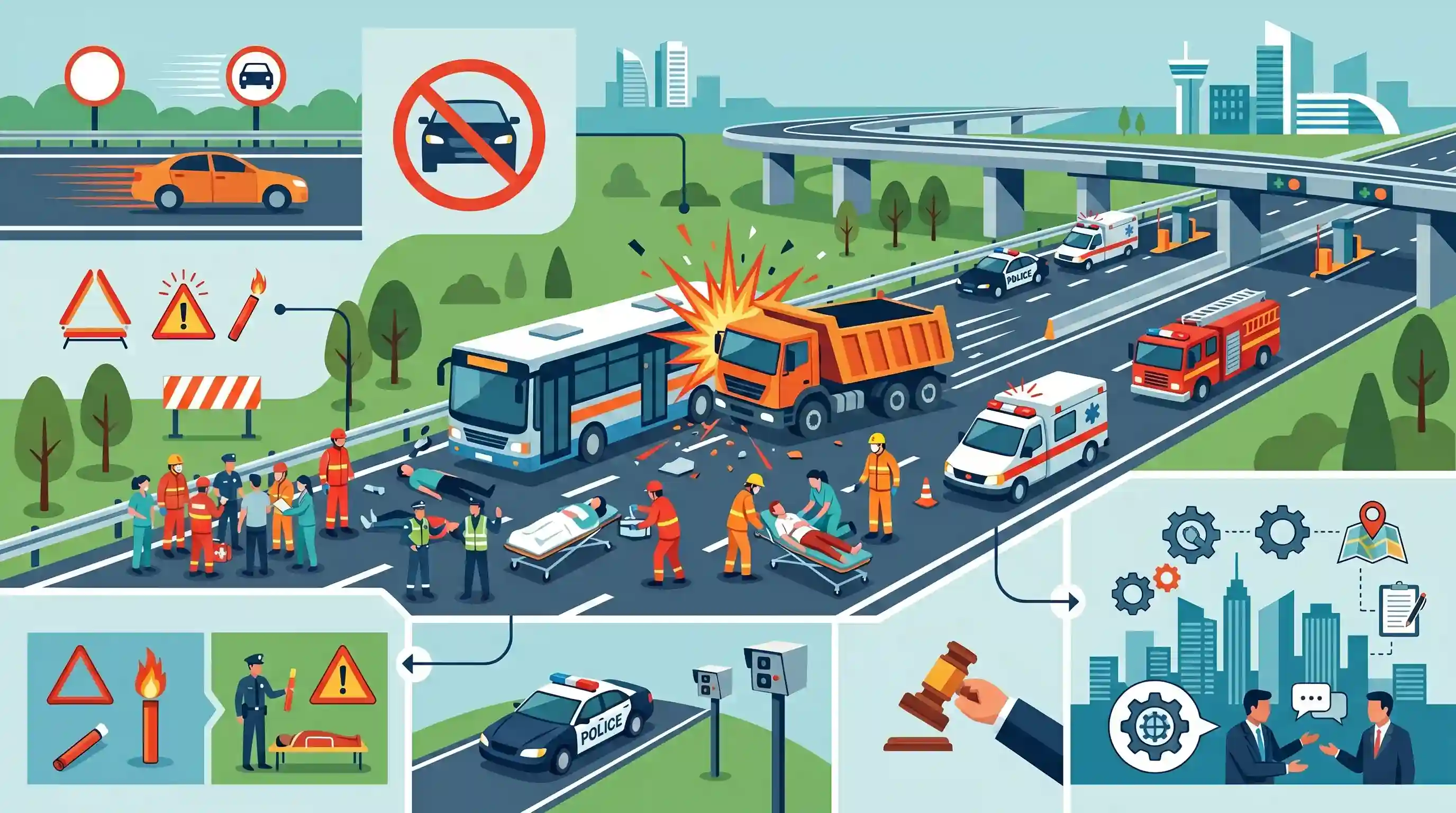
A tragic road accident on the Yamuna Expressway in Mathura, Uttar Pradesh, claimed six lives and left three others critically injured. The collision occurred when a dumper truck rammed into a stationary bus that had parked on the side of the road due to a burst tire. The bus was ferrying passengers from Bihar to Delhi. The incident brings to the forefront critical road safety issues, particularly the dangers of parking or halting on high-speed expressways without adequate warning mechanisms, emphasizing the need for robust emergency response and better enforcement of traffic regulations to prevent such fatalities.
Key Points
- Six people were killed and three critically injured in a severe accident on the Yamuna Expressway in Mathura.
- A dumper truck collided with a bus that was parked on the expressway following a tire burst.
- The bus was traveling from Bihar to Delhi, while the truck was en route from Noida to Agra.
- The incident highlights significant road safety concerns regarding the enforcement of rules against halting vehicles on high-speed expressways and emergency protocols.
Important Terms
Road Safety

The systematic measures and multi-sectoral strategy (encompassing Engineering, Enforcement, Education, and Emergency Care) aimed at reducing road-traffic accidents, injuries, and fatalities on the transport network.
UPSC context
Crucial for GS Paper 3 (Infrastructure) and GS Paper 2 (Governance). Tests knowledge of socio-economic impacts and policy interventions.
Golden Hour
The first 60 minutes after a traumatic injury when prompt medical treatment has the highest likelihood of preventing death. It is legally defined in the Motor Vehicles Act, 2019.
UPSC context
Significant for GS Paper 3 (Disaster Management/Safety) and GS Paper 2 (Health Governance). Relates to emergency response efficiency.
Motor Vehicles (Amendment) Act, 2019
A 2019 amendment to the 1988 Act that increased penalties for violations, protected Good Samaritans, and introduced the National Road Safety Board to improve transport governance.
UPSC context
Core legal framework for GS Paper 2 (Government Policies). Important for understanding deterrent mechanisms and regulatory reforms.
Yamuna Expressway Industrial Development Authority (YEIDA)
The state-level authority established under the UP Industrial Development Act, 1976, responsible for the planning, development, and management of the Yamuna Expressway and surrounding industrial areas.
UPSC context
Relevant for GS Paper 3 (Infrastructure) and State PCS. Tests understanding of regional developmental authorities and land-use planning.
Intelligent Transport Systems (ITS)
The integration of advanced communication and information technologies (like speed cameras and real-time alerts) into transport infrastructure to enhance safety, reduce congestion, and improve efficiency.
UPSC context
Key topic for GS Paper 3 (Science and Technology/Infrastructure). Relates to modernizing Indian logistics and urban mobility.
Road Safety Audit
A formal, independent, and systematic evaluation of a road project or existing road to identify potential safety hazards and recommend mitigation measures.
UPSC context
Important for GS Paper 3 (Infrastructure). Tests knowledge of preventive engineering and standard safety protocols (like IRC standards).
Prelims Trap
"The Brasilia Declaration, often seen in the news, relates to the conservation of Amazon rainforests."
The Brasilia Declaration (2015) is specifically about global Road Safety and achieving SDG 3.6. Aspirants often confuse it with environmental protocols or BRICS summits.
Static Concepts Connected
What are the key statutory provisions for road safety administration in India?
- National Road Safety Board: The Motor Vehicles (Amendment) Act 2019 provides for the National Road Safety Board to advise the Central and State governments on safety and traffic management.
- Good Samaritan Law: The 2019 Act formally codified protections for Good Samaritans, shielding individuals who assist crash victims from civil or criminal liability and police harassment.
Which global mandates and tech initiatives define India's road safety strategy?
- Brasilia Declaration: India is a signatory to this 2015 UN mandate committing to halve global road traffic deaths and injuries by 2030, aligning with SDG 3.6.
- iRAD Initiative: The Integrated Road Accident Database (iRAD) is a MoRTH initiative developed by IIT Madras and supported by the World Bank to scientifically analyze crash causes.
Cross-Topic Patterns
Infrastructure pace vs. safety enforcement
India's rapid expansion of greenfield expressways (Bharatmala) often outpaces the deployment of intelligent traffic management systems (ITMS) and highway patrol enforcement, leading to fatal operational gaps.
Economic and demographic burden of collisions
Road accidents cost India roughly 3% of its GDP annually, disproportionately impacting the demographic dividend as the vast majority of victims are young, working-age breadwinners.

Expect a Prelims multi-statement question mixing MV Act 2019 provisions (National Road Safety Board) with SDG 3.6 (Brasilia Declaration).
Linked PYQs · 1
Linked PYQs · 1
- 2024MainsGS3
What is the technology being employed for electronic toll collection on highways? What are its advantages and limitations? What are the proposed changes that will make this process seamless? Would this transition carry any potential hazards?
