Taiwan Strait Flashpoint and US-China Strategic Competition
Source:The Hindu ↗
Why It Matters
The evolving dynamic between the U.S. and China is the defining geopolitical relationship of the 21st century. Their ability to manage flashpoints like Taiwan, the Middle East, and technological trade directly impacts global macroeconomic stability and India's strategic calculations in the Indo-Pacific.
Summary
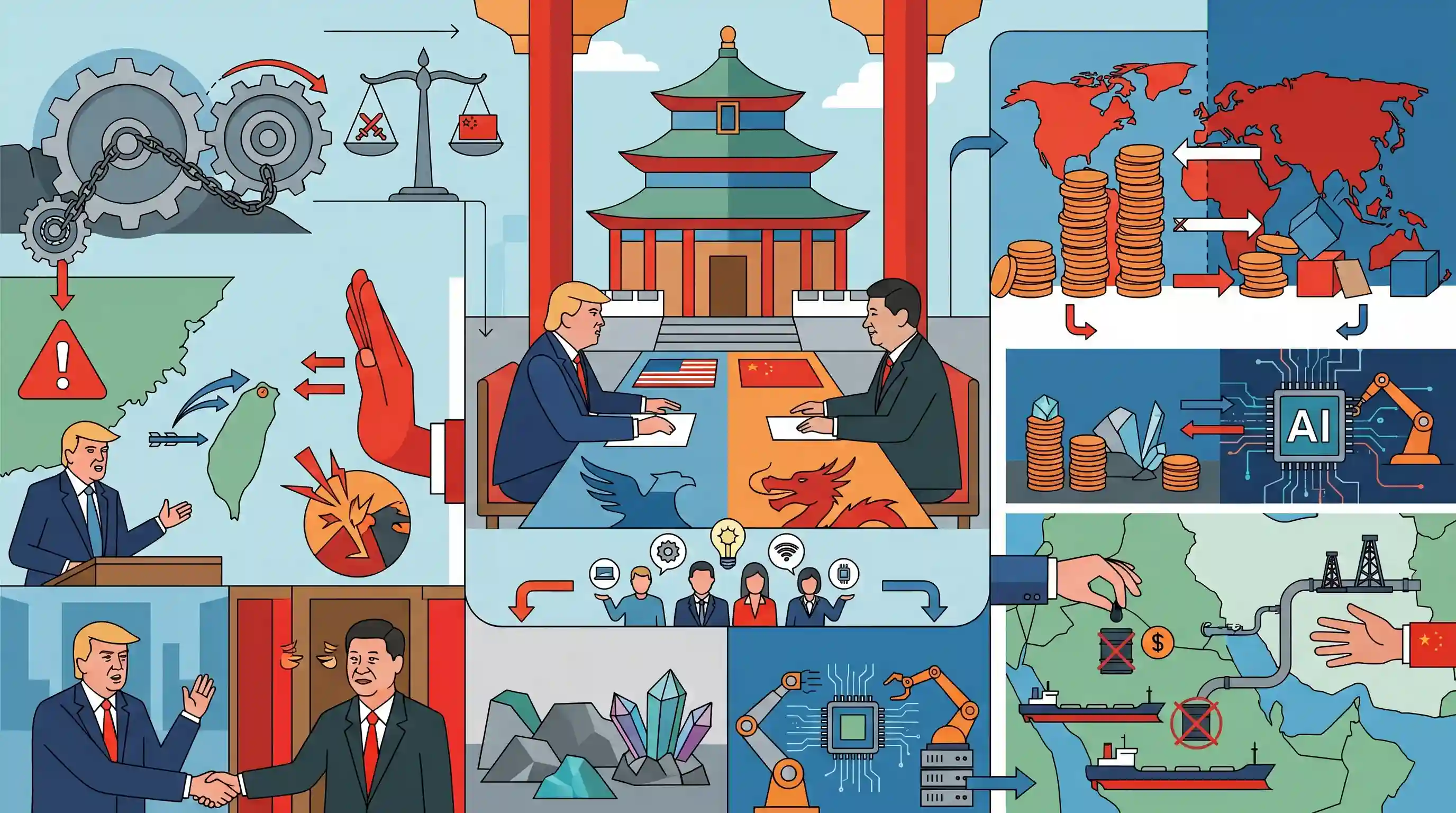
During a high-stakes summit in Beijing, Chinese President Xi Jinping and U.S. President Donald Trump navigated key geopolitical and economic flashpoints. While Trump adopted a conciliatory public tone, Xi emphasized the need to avoid the 'Thucydides Trap' and warned that mishandling the Taiwan issue—such as through U.S. arms sales—could lead to direct conflict. The agenda also heavily featured efforts to mitigate a punishing trade war, covering tariffs, rare earth exports, and AI technology, underscored by the presence of U.S. tech leaders. Additionally, the U.S. side sought China's assistance in addressing the Iran war crisis by curbing its purchases of sanctioned Iranian oil.
Key Points
- U.S. President Donald Trump and Chinese President Xi Jinping held a summit in Beijing, focusing on global geopolitical stability and power competition, with Xi cautioning against falling into the 'Thucydides Trap'.
- Xi warned that the Taiwan issue is the most perilous factor in bilateral relations and could lead to conflict, especially as Trump plans to discuss U.S. arms sales to the island.
- The leaders are seeking to manage their ongoing trade war, discussing tit-for-tat tariffs, rare earth export controls, and rivalry in artificial intelligence.
- The U.S. is pressuring China to limit its purchases of sanctioned Iranian oil and use its influence to de-escalate the ongoing crisis involving Iran in the Persian Gulf.
Important Terms
Thucydides Trap

A theory in international relations where a rising power's challenge to an established hegemon creates structural stress, making military conflict highly probable. Historically popularized to describe US-China rivalry.
UPSC context
GS Paper 2 (International Relations); tests understanding of power transitions and global security dynamics.
US-China Trade War
An ongoing economic conflict marked by tit-for-tat tariffs, intellectual property disputes, and technology restrictions between the world's two largest economies, significantly impacting global supply chains.
UPSC context
GS Paper 2 & 3; tests effects of foreign policies on India's interests and global economic stability.
One China Policy
The diplomatic acknowledgement of China's position that there is only one Chinese government and Taiwan is an inalienable part of it; a cornerstone of US-China relations.
UPSC context
GS Paper 2 (IR); central to Indo-Pacific security and India's own strategic ambiguity regarding Taiwan.
Rare Earth Elements
A group of 17 metallic elements essential for high-tech manufacturing (EVs, AI, defense). China's dominance in their supply chain provides significant geopolitical leverage.
UPSC context
GS Paper 1 (Geography) and GS Paper 3 (Security/Economy); tests resource-based geopolitics and supply chain resilience.
Secondary Sanctions
Sanctions applied by a country (typically the US) against third-party entities—often in other nations—to prevent them from trading with a sanctioned state like Iran.
UPSC context
GS Paper 2 (IR); tests the extraterritorial application of domestic laws and their impact on global trade and India's energy security.
Strategic Decoupling
The process of reducing economic interdependence between nations, particularly in critical sectors like semiconductors and AI, to mitigate national security risks and supply chain vulnerabilities.
UPSC context
GS Paper 3 (Economy/Science & Tech); tests understanding of the global "Tech Cold War" and semiconductor sovereignty.
Prelims Trap
The United States officially endorses China's sovereignty over Taiwan under its formal 'One China Policy'.
The US 'One China Policy' acknowledges but does not formally recognize Beijing's claim over Taiwan, whereas Beijing's 'One China Principle' asserts absolute sovereignty.
Static Concepts Connected
What is the 'Thucydides Trap' in International Relations?
- Core premise: The severe structural stress and high likelihood of conflict occurring when a rapidly rising power threatens to displace an established hegemonic power.
- Historical origin: Coined by Graham Allison, referencing the ancient Peloponnesian War where the rise of Athens instilled fear in established Sparta, making war inevitable.
What is the difference between One China Principle and Policy?
- One China Principle: Beijing's core geopolitical assertion that Taiwan is an inalienable part of China, and that the PRC is the sole legitimate government.
- One China Policy: The US diplomatic stance that merely acknowledges Beijing's claim without officially endorsing Chinese sovereignty over Taiwan, allowing informal defense ties with Taipei.
Cross-Topic Patterns
Critical Minerals + Tech Trade Wars
China's dominance in rare earth elements (REEs) processing acts as a major strategic lever in trade negotiations, deeply impacting the global transition to green energy and AI development.
Unilateral Sanctions + Energy Security
US pressure on China to curb Iranian oil imports highlights the extraterritorial reach of US secondary sanctions, echoing similar challenges faced by India in balancing its energy security and strategic autonomy.

Thucydides Trap, One China Policy vs Principle, and rare earth supply chains are highly likely to form a composite IR question.
Linked PYQs · 3
Linked PYQs · 3
- 2021MainsGS2
“The USA is facing an existential threat in the form of a China, that is much more challenging than the erstwhile Soviet Union.” Explain.
- 2025MainsGS3
What are the challenges before the Indian economy when the world is moving away from free trade and multilateralism to protectionism and bilateralism? How can these challenges be met?
- 2025MainsGS2
"The reform process in the United Nations remains unresolved, because of the delicate imbalance of East and West and entanglement of the USA vs. Russo-Chinese alliance.” Examine and critically evaluate the East-West policy confrontations in this regard.
