US-China Tech Duopoly and India Strategic Autonomy Challenges
Source:Indian Express ↗
Why It Matters
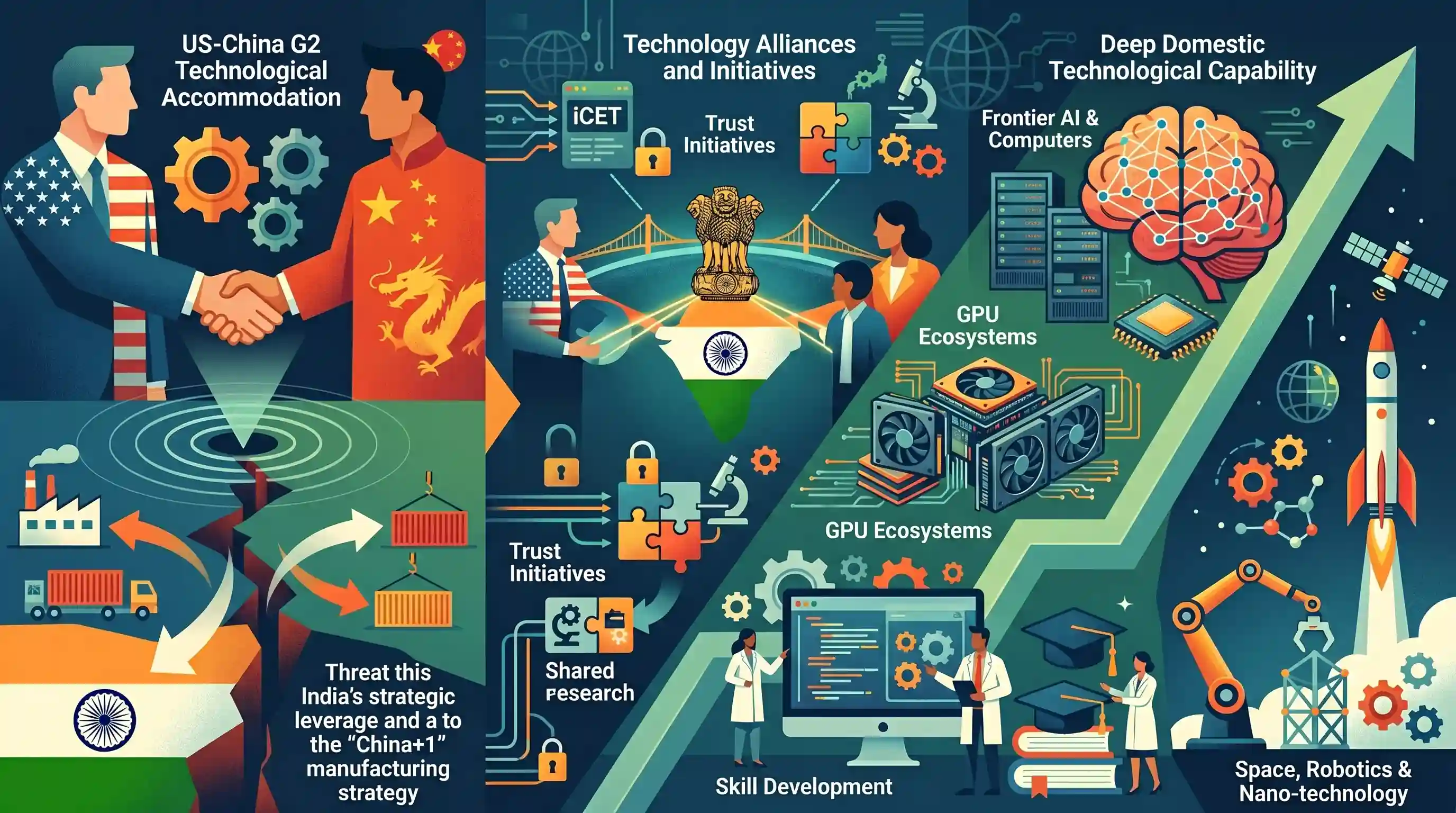
Geopolitical shifts driven by AI and critical technologies are fundamentally redefining international relations. Understanding the US-China tech rivalry is crucial for evaluating India's strategic autonomy, the viability of the 'China+1' strategy, and the pressing necessity of indigenizing frontier technologies for national security and economic growth.
Summary
A potential US-China 'G2' technological accommodation under the new US administration threatens India's strategic leverage and the 'China+1' manufacturing shift. While India has built significant technology alliances like the TRUST initiative and iCET with the US, an understanding between Beijing and Washington could sideline middle powers. As China closes the AI capability gap with the US, India's current investments, such as the $1.2 billion IndiaAI Mission, remain inadequate. To avoid being marginalized by a bilateral US-China tech framework, India must urgently transition from diplomatic multi-alignment to developing deep, domestic technological capability by investing heavily in frontier AI, GPU ecosystems, and skill development.
Key Points
- A potential US-China technological accommodation could marginalize middle powers and reduce the urgency of the 'China+1' strategy, which has benefited India's manufacturing ambitions.
- India has heavily relied on US partnerships, such as the TRUST initiative and iCET, to secure access to AI, semiconductors, and critical tech, positioning itself as a democratic counterweight.
- Recent data shows China nearly erasing America's lead in frontier AI model performance, highlighting a rapidly consolidating US-China technology duopoly.
- To become a global rule-shaper rather than a rule-taker, India must massively scale its domestic tech investments beyond the current $1.2 billion IndiaAI Mission, focusing on GPUs, foundational models, and startup ecosystems.
Important Terms
G2 framework

A proposed informal geopolitical framework envisioning the United States and China as a dual-superpower steering committee to manage global affairs, often viewed as a threat to multilateralism.
UPSC context
GS Paper II (International Relations); tests understanding of global power shifts and threats to India's strategic autonomy.
TRUST initiative
An evolved India-US strategic framework (launched February 2025) focusing on semiconductors, AI, quantum tech, and critical mineral supply chains to build "trusted" industrial ecosystems.
UPSC context
GS Paper II/III; highlights the deepening India-US technology alliance and the move toward resilient supply chains.
initiative on Critical and Emerging Technology (iCET)
A 2023 bilateral partnership to elevate cooperation in high-tech sectors like AI, space, and semiconductors, serving as the foundation for the subsequent TRUST initiative.
UPSC context
GS Paper II (IR); fundamental for understanding the "technology-led" shift in India-US strategic relations.
IndiaAI Mission
A ₹10,372 crore national program aimed at establishing indigenous AI computing capacity (10,000+ GPUs), developing foundational models, and building a self-reliant AI ecosystem in India.
UPSC context
GS Paper III (S&T); relevant for topics on indigenization of technology and digital sovereignty.
China+1 strategy
A global business strategy where multinational companies diversify manufacturing and sourcing away from China to alternative hubs like India to reduce geopolitical and supply chain risks.
UPSC context
GS Paper III (Economy); tests knowledge of global value chains (GVCs) and India's manufacturing competitiveness.
AI Infrastructure Roadmap
A specific bilateral plan under the TRUST initiative designed to facilitate the deployment of large-scale US-origin AI hardware and computing infrastructure within India.
UPSC context
GS Paper III (S&T/Economy); explores the role of foreign partnerships in bridging India's hardware infrastructure gap.
Prelims Trap
"The TRUST initiative is a multilateral technology framework established by the Quad."
TRUST is strictly a bilateral US-India initiative (succeeding iCET), driven by their respective National Security Councils, not a multilateral or Quad agreement.
Static Concepts Connected
What makes GPUs indispensable for Artificial Intelligence and deep learning?
- Parallel Processing: Unlike CPUs, GPUs can perform thousands of calculations simultaneously, drastically reducing the time required to train complex Large Language Models.
- Sovereign Compute: National tech autonomy relies on owning domestic GPU clusters (like IndiaAI's target of 10,000 GPUs) to prevent strategic dependency on foreign computing infrastructure.
What is the 'China Plus One' strategy in global supply chains?
- Supply Diversification: A corporate strategy to avoid over-concentration of manufacturing in China by adding secondary production hubs in emerging nations like India or Vietnam.
- Policy Synergy: India actively leverages this global shift through Production Linked Incentive (PLI) schemes and improved logistics infrastructure to attract multinational manufacturing FDI.
Cross-Topic Patterns
Sovereign AI & Data Governance
The ₹10,372 crore IndiaAI Mission's hardware goals (GPUs) overlap directly with the DPDP Act’s data localization and digital sovereignty mandates to reduce reliance on foreign big tech.
Middle Power Tech Diplomacy
A US-China 'G2' tech accommodation threatens India's multi-alignment, demonstrating how critical tech duopolies can easily bypass traditional geopolitical balancing blocs like the SCO or Quad.

Expect a 2026 Prelims question testing the bilateral US-India TRUST initiative against multilateral tech frameworks like GPAI or Quad.
Linked PYQs · 1
Linked PYQs · 1
- 2024MainsGS2
‘The West is fostering India as an alternative to reduce dependence on China's supply chain and as a strategic ally to counter China's political and economic dominance.’ Explain this statement with examples.
