Indo Pacific Geopolitics and APEC Bilateral Diplomatic Alignments
Source:The Hindu ↗
Why It Matters
The article highlights the shifting geopolitical alignments in the Asia-Pacific region in response to US-China trade tensions. It is highly relevant for UPSC aspirants as it touches upon control over critical minerals (rare earths), the role of multilateral forums like APEC in global trade, and how middle powers navigate the US-China rivalry—all of which directly impact India's strategic and economic interests in the Indo-Pacific.
Summary
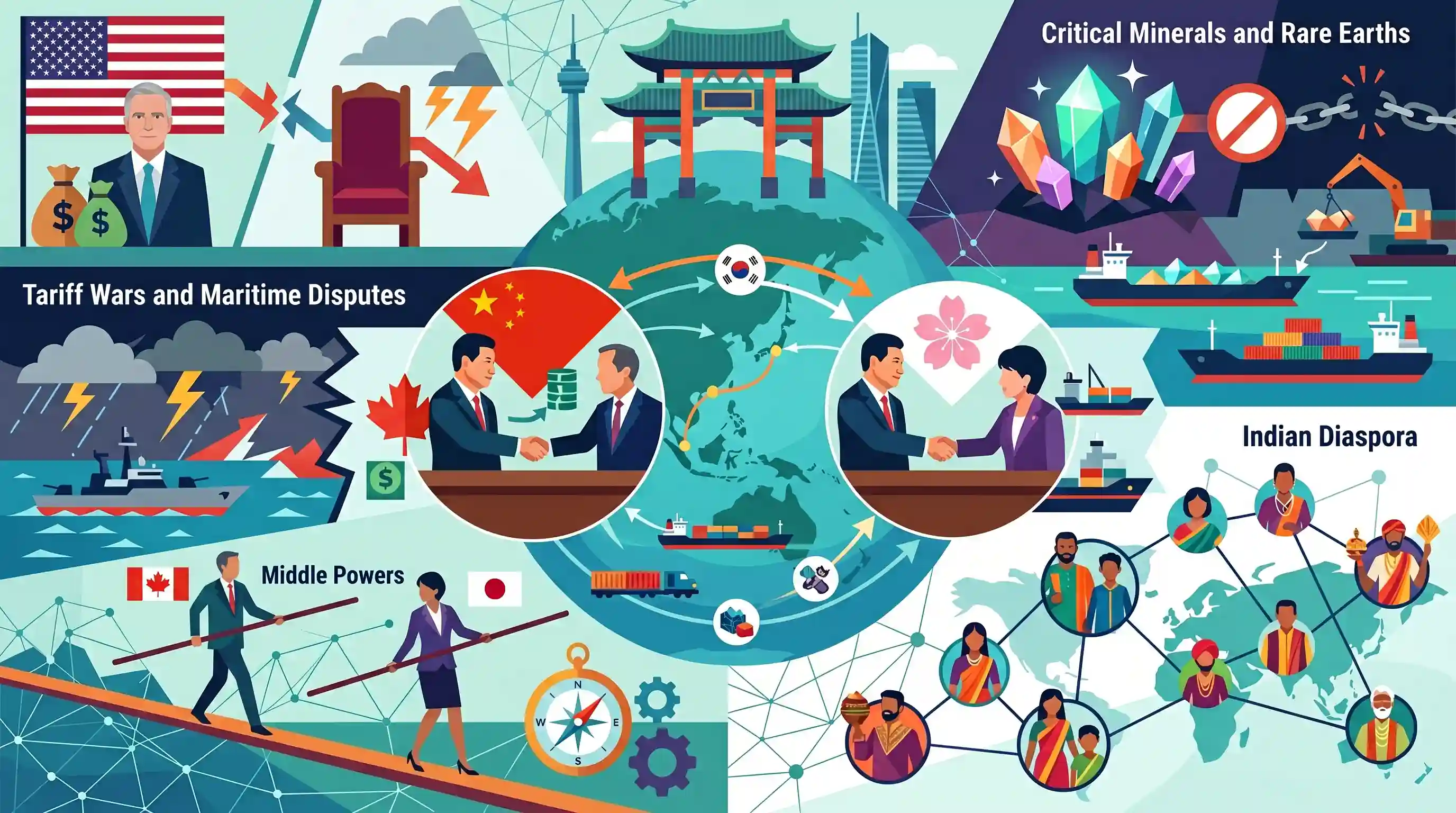
At the APEC summit in South Korea, Chinese President Xi Jinping is holding high-stakes bilateral meetings with Canada's Mark Carney and Japan's Sanae Takaichi. These diplomatic engagements come on the heels of a sudden "trade truce" between Xi and US President Donald Trump, which has paused further Chinese export curbs on critical rare earth minerals. With the US opting to send Treasury Secretary Scott Bessent instead of its head of state, middle powers like Canada and Japan are cautiously moving to stabilize relations with Beijing. They are attempting to secure their supply chains and navigate a complex geopolitical environment marked by tariff wars, maritime disputes, and shifting trade policies.
Key Points
- Chinese President Xi Jinping is scheduled to hold bilateral meetings with Canadian leader Mark Carney and Japanese Prime Minister Sanae Takaichi on the sidelines of the APEC summit in Gyeongju, South Korea.
- The meetings follow a temporary "trade truce" brokered between Xi and US President Donald Trump, which suspends further Chinese restrictions on the export of critical rare earth minerals.
- Canada is seeking to re-engage with China to hedge against potential trade disruptions with its largest partner (the US), despite ongoing disputes over EV tariffs and retaliatory anti-dumping duties on canola.
- Japan's new nationalistic leader, Sanae Takaichi, aims to address contentious issues with Beijing, including maritime security, the detention of Japanese citizens, and China's ban on Japanese seafood imports.
- The 21-member APEC bloc is primarily focusing on bolstering global supply chains and navigating the economic uncertainty generated by renewed US-China trade friction.
Important Terms
APEC (Asia-Pacific Economic Cooperation)

A 21-member regional economic forum established in 1989 to facilitate trade, investment, and growth in the Pacific Rim. It operates on non-binding, consensus-based principles.
UPSC context
GS Paper 2: Important for Regional Groupings and India's status as a non-member observer despite its massive economy.
Rare Earth Elements (REEs)
A group of 17 metallic elements vital for high-tech applications, including smartphones, permanent magnets for EVs, and defense systems; currently characterized by high supply concentration in China.
UPSC context
GS Paper 3: Essential for understanding global supply chain vulnerabilities and India's technology/energy security needs.
Critical Minerals
Metallic or non-metallic elements (like lithium, cobalt, and nickel) essential for modern technologies and national security but highly vulnerable to supply chain disruptions.
UPSC context
GS Paper 3: Crucial for topics like renewable energy transition, semiconductors, and India's National Critical Mineral Mission.
Indo-Pacific
A strategic region integrating the Indian and Pacific Oceans, characterized by intense maritime trade (90% of India's trade) and geopolitical competition for a rules-based order.
UPSC context
GS Paper 2: A core pillar of India's 'Act East' policy and maritime security strategy (SAGAR).
Trade Truce
A temporary cessation or de-escalation of trade hostilities, such as tariff hikes or export restrictions, allowing for further negotiations between competing economies.
UPSC context
GS Paper 2: Tests the effect of policies of developed countries on India's economic and strategic interests.
Middle Powers
Nations with significant diplomatic and economic influence that lack superpower status but play a stabilizing role in international relations through multilateralism.
UPSC context
GS Paper 2: Relevant for analyzing the agency of countries like Canada and Japan in a multipolar world order.
Prelims Trap
"India is a founding member of APEC, whose trade decisions are legally binding."
APEC operates on non-binding commitments and open dialogue. Furthermore, India is NOT a full member; it only has observer status.
Static Concepts Connected
What are Rare Earth Elements (REEs) and their strategic significance?
- Definition: A group of 17 elements (15 lanthanides, plus scandium and yttrium) crucial for electronics, defense systems, and green tech.
- Availability: They are not genuinely 'rare' in the earth's crust, but are geographically dispersed and highly toxic/difficult to refine.
- Market Dominance: China holds a near-monopoly on global processing and refining capacity, using export curbs as geopolitical leverage.
What is an Anti-Dumping Duty (ADD) under WTO rules?
- Definition: A protectionist tariff imposed by a domestic government on foreign imports that it believes are priced below fair market value.
- Objective: It prevents foreign manufacturers from undercutting local businesses to establish a monopoly.
- WTO Compliance: Permitted under WTO frameworks if the importing nation can definitively prove material injury to its domestic industry.
Cross-Topic Patterns
Mineral security & clean energy transition
The weaponization of rare earth minerals bridges IR and Environment. The US-led Minerals Security Partnership (MSP), which India joined, counters China's monopoly over clean-energy tech inputs.
Middle power geopolitical hedging
As the US-China bipolar contest intensifies, "middle powers" like Japan and Canada are actively hedging, seeking stabilized supply chains without fully alienating Beijing or Washington.
EV tariffs vs. agricultural retaliation
Trade wars are deeply asymmetric. Western tariffs on high-tech Chinese EVs consistently provoke retaliatory anti-dumping probes on primary agricultural exports like Canadian canola or European pork.

Expect a 2026 multi-statement prelims question mapping critical minerals (lithium, REEs) to geopolitical groupings (MSP, Quad, APEC).
Linked PYQs · 3
Linked PYQs · 3
- 2012PrelimsGS1
Recently, there has been a concern over the short supply of a group of elements called 'rare earth metals'. Why? 1. China, which is the largest producer of these elements, has imposed some restrictions on their export. 2. Other than China, Australia, Canada and Chile, these elements are not found in any country. 3. Rare earth metals are essential for the manufacture of various kinds of electronic items and there is a growing demand for these elements. Which of the statements given above is/are correct?
- 2021PrelimsGS1
Consider the following statements : 1. The Global Ocean Commission grants licences for seabed exploration and mining in international waters. 2. India has received licences for seabed mineral exploration in international waters. 3. 'Rare earth minerals' are present on seafloor in international waters. Which of the statements given above are correct?
- 2021MainsGS2
“The USA is facing an existential threat in the form of a China, that is much more challenging than the erstwhile Soviet Union.” Explain.
