India and China Acknowledge Diplomatic Progress in Bilateral Relations
Source:The Hindu ↗
हे का महत्त्वाचे आहे
India-China bilateral relations are critical for regional stability, Asian security, and global geopolitics, making shifts in their diplomatic engagement high-yield study material for GS Paper 2.
सारांश
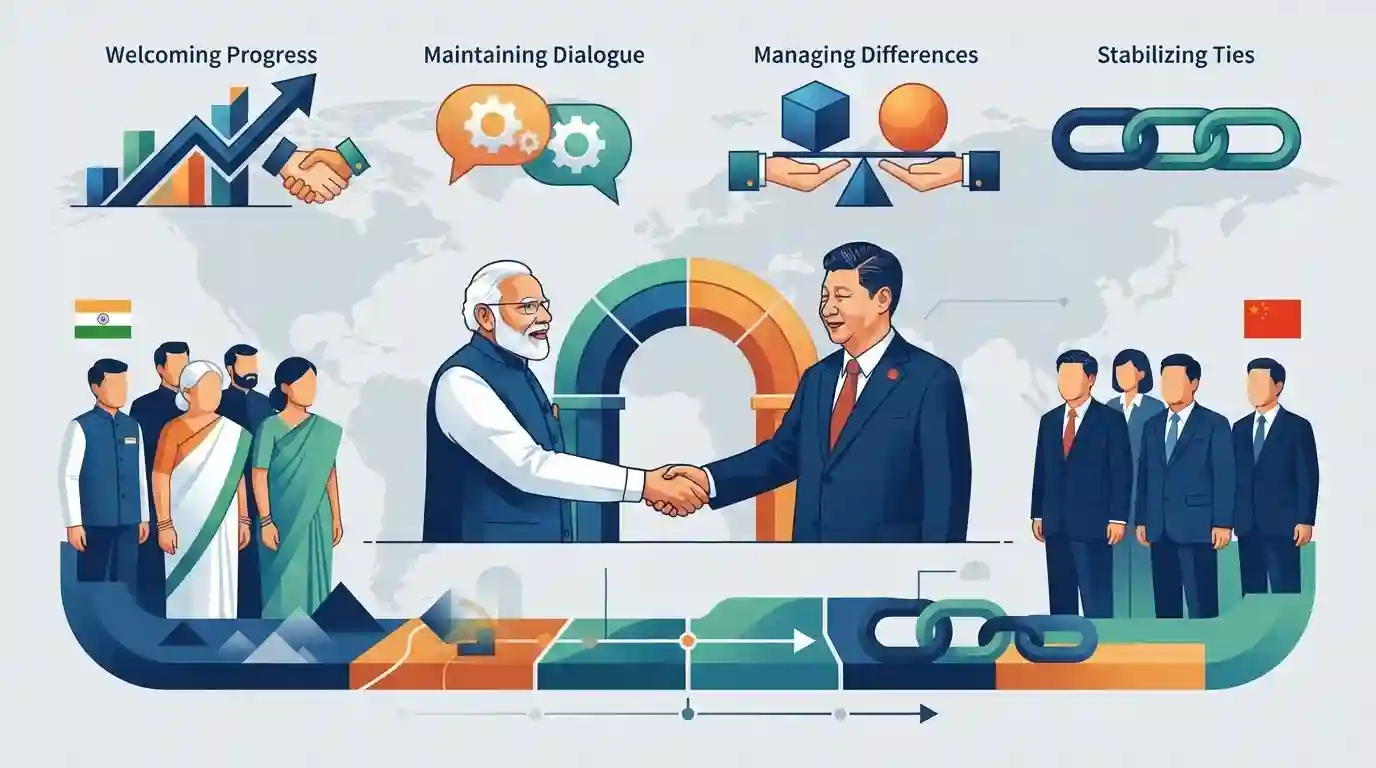
Prime Minister Narendra Modi and Chinese President Xi Jinping welcomed the steady progress in India-China relations, stressing the significance of maintaining dialogue, managing differences, and stabilizing bilateral ties.
मुख्य मुद्दे
- Prime Minister Narendra Modi and Chinese President Xi Jinping welcomed the steady progress made in bilateral relations during their diplomatic interactions.
- The leaders emphasized the importance of stabilizing ties and managing differences constructively between the two Asian giants.
- Discussions highlighted diplomatic engagement and bilateral stability amid complex geopolitical dynamics.
महत्त्वाच्या संज्ञा
India-China Relations

The bilateral relationship between India and China, shaped by historical ties, border disputes, trade interdependence, and strategic competition as major emerging economies and Global South leaders.
UPSC context
UPSC Mains Paper II (International Relations): Tests understanding of India's foreign policy, neighborhood diplomacy, and managing bilateral conflicts.
पूर्वपरीक्षा सापळा
Steady progress in bilateral relations implies the complete resolution of the Line of Actual Control dispute and normal trade conditions.
Aspirants often assume a complete normalization of diplomatic ties means the total resolution of the border dispute or the abandonment of strategic counter-measures like investment restrictions.
संबंधित स्थिर संकल्पना
What are the institutional mechanisms used by India and China for border management and diplomatic consultation?
- SR Talks: Special Representatives (SRs) mechanism was established in 2003 to find a political settlement to the boundary question at the highest level.
- WMCC Framework: Working Mechanism for Consultation and Coordination (WMCC) on Border Affairs was established in 2012 to handle day-to-day management and maintain peace along the LAC.
- BDCA 2013: Border Defense Cooperation Agreement (BDCA) signed in 2013 provides operational guidelines to prevent face-offs and military escalation along the border.
आंतर-विषय नमुने
Bilateral Diplomacy + Strategic Import Dependencies
India's calibrated economic decoupling from China must balance high bilateral trade volumes with critical import dependencies in Active Pharmaceutical Ingredients (APIs) and electronics.
India-China Rapprochement + Indo-Pacific Quad Alignment
Diplomatic re-engagement along the LAC demonstrates the pragmatic application of strategic autonomy, balancing Western-led security architectures like the Quad with Asian bilateral stability.

Expect a statement-based question evaluating bilateral mechanisms (WMCC, Special Representatives) vs unilateral strategic steps.
संबंधित PYQ · 2
संबंधित PYQ · 2
- 2014MainsGS2
With respect to the South China sea, maritime territorial disputes and rising tension affirm the need for safeguarding maritime security to ensure freedom of navigation and over flight throughout the region. In this context, discuss the bilateral issues between India and China.
- 2012MainsGS2
Do you think that China's emergence as one of the largest trading partners of India has adversely affected the settlement of the outstanding border problem?
