Chinese envoy highlights Xi Modi consensus for bilateral ties
Source:Indian Express ↗
Why It Matters
India-China relations are critical for regional stability, economic cooperation, and geopolitical equilibrium in Asia. Understanding diplomatic milestones like the Xi-Modi consensus is essential for analyzing India's foreign policy challenges.
Summary
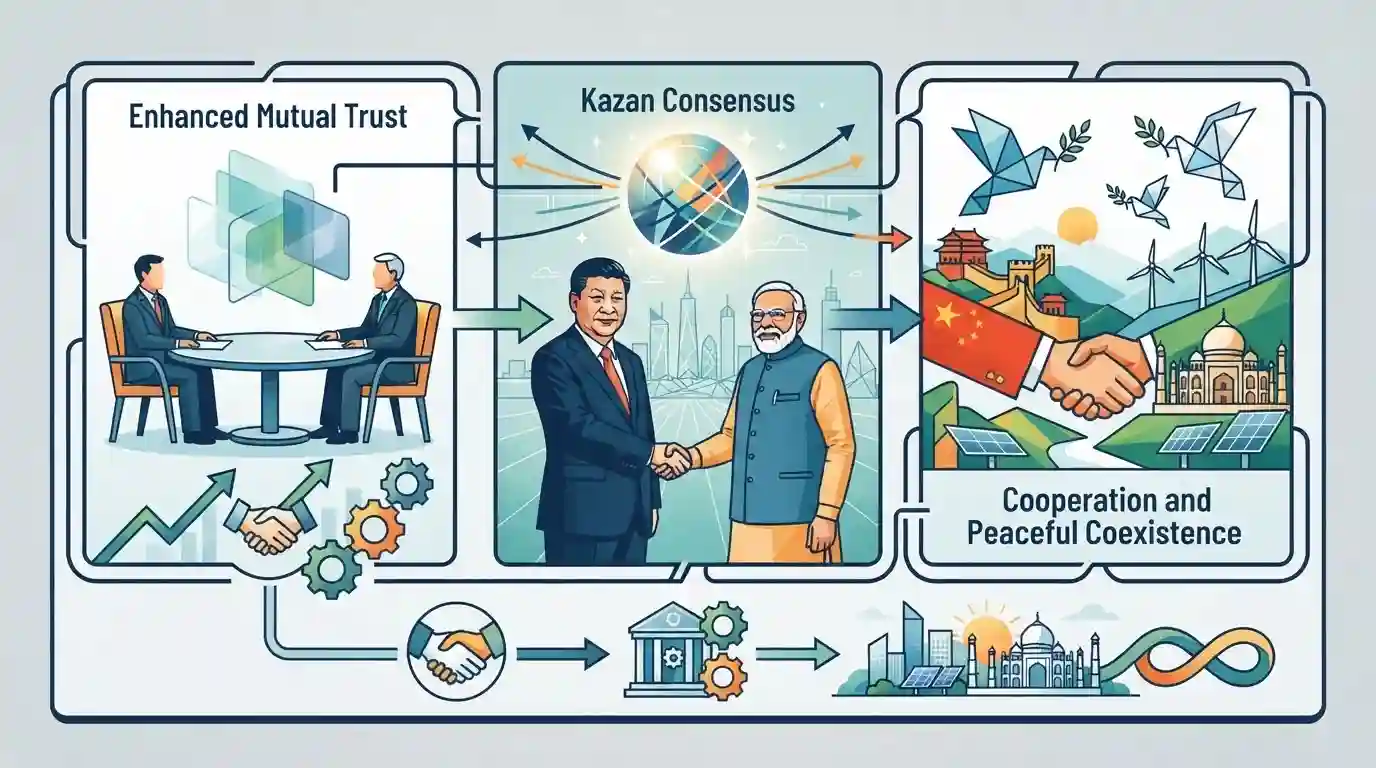
The Chinese envoy to India emphasized the 'Xi-Modi consensus' from the Kazan meeting as a cornerstone for improving India-China bilateral ties, urging enhanced mutual trust, cooperation, and peaceful coexistence.
Key Points
- The Chinese envoy highlighted the 'Xi-Modi consensus' reached at Kazan as a vital guide for stabilizing and improving India-China bilateral relations.
- Emphasis was placed on mutual trust, peaceful coexistence, and cooperative development rather than viewing each other as threats.
- The dialogue underscores ongoing diplomatic efforts to normalize relations following years of border friction.
Important Terms
BRICS

An intergovernmental organization comprising major emerging economies (Brazil, Russia, India, China, South Africa, and expanded members), aimed at promoting multilateralism, economic cooperation, and reforming global financial institutions.
UPSC context
UPSC GS Paper II (International Relations): Important international institutions, groupings, and global governance structures.
Static Concepts Connected
What are the key institutional mechanisms for managing the India-China boundary question?
- Special Representatives (SR):: Established in 2003, designated NSA-level (India) and State Councilor/Foreign Minister level (China) interlocutors to arrive at a framework for boundary settlement.
- WMCC:: Established in 2012 to handle emergency situations and prevent border incidents along the LAC, meeting regularly at diplomatic and military levels.
- BPM Points:: Border Personnel Meetings (BPM) held at designated huts along the LAC to foster communication and defuse local tactical friction.
Cross-Topic Patterns
Bilateral Thaw vs. Indo-Pacific Security Architecture
Diplomatic thaws and border normalization directly affect strategic postures like the Indo-Pacific construct and minilateral groupings such as the Quad.
India-China Trade Deficit & Supply Chain Vulnerabilities
High bilateral trade deficit persists despite political friction, linking border diplomacy with critical import dependencies in active pharma and electronics.

Xi-Modi Kazan consensus + LAC disengagement + Special Representatives mechanism likely to be tested in a multi-statement IR question.
Linked PYQs · 1
Linked PYQs · 1
- 2014MainsGS2
With respect to the South China sea, maritime territorial disputes and rising tension affirm the need for safeguarding maritime security to ensure freedom of navigation and over flight throughout the region. In this context, discuss the bilateral issues between India and China.
