India and China Discuss Bilateral Ties on Diplomatic Anniversary
Source:Indian Express ↗
Why It Matters
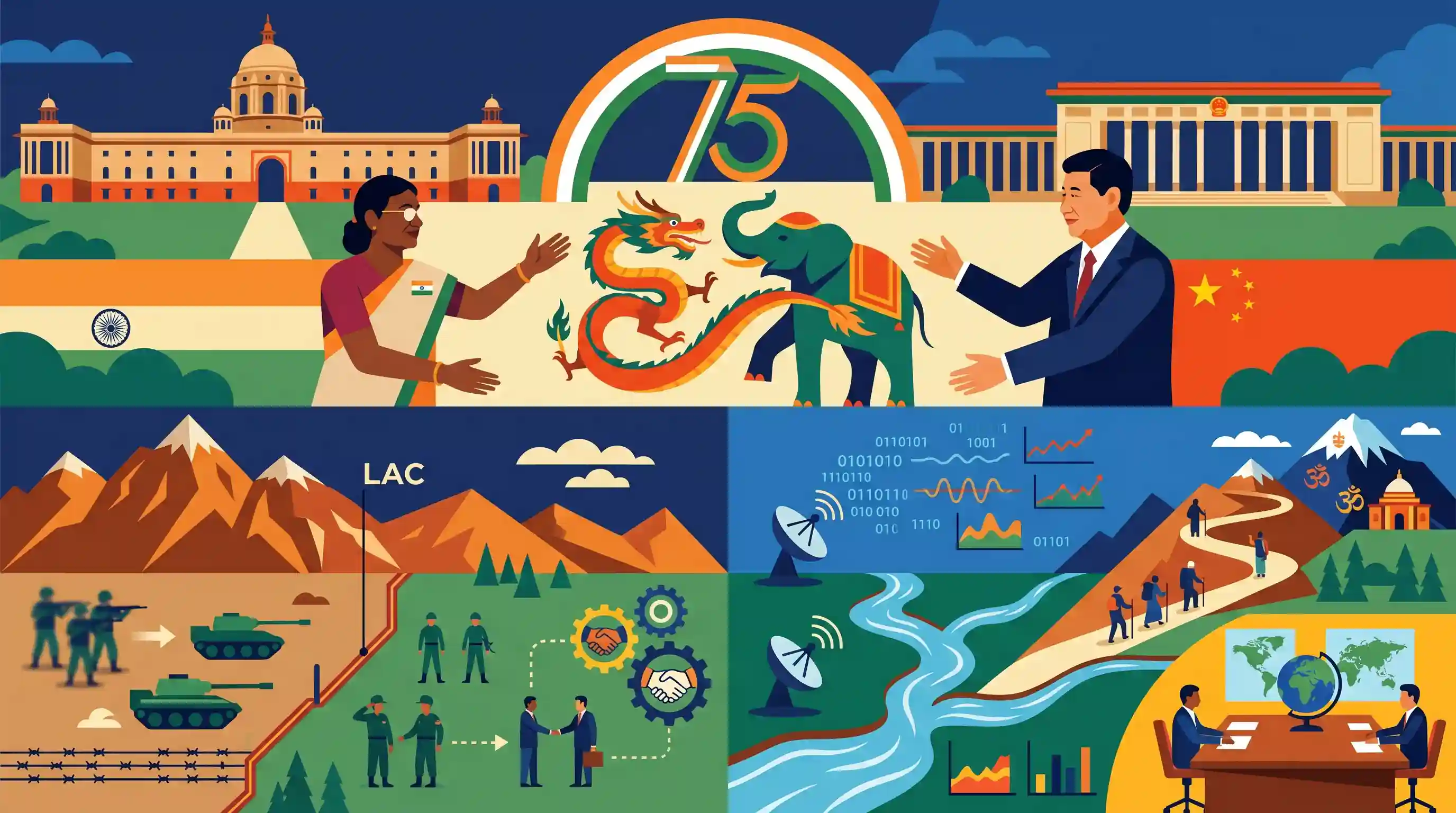
The India-China relationship is one of the most consequential bilateral dynamics in Asia. The shift from confrontation (post-2020 border clashes) to a cooperative stance ('Dragon-Elephant tango') directly impacts India's security posture, geopolitical strategies, and regional stability. Understanding this thaw is essential for GS2 IR and GS3 Border Management questions.
Summary
On the 75th anniversary of diplomatic ties between India and China, Chinese President Xi Jinping proposed a "Dragon-Elephant tango" to Indian President Droupadi Murmu, signaling a desire to strengthen bilateral relations. The diplomatic exchange comes on the heels of easing tensions following a four-year military standoff in eastern Ladakh, recently mitigated by a mutual agreement on patrolling arrangements along the Line of Actual Control (LAC). Both sides are working towards resuming Special Representative talks on the boundary question and re-initiating cross-border cooperation, including data sharing on trans-border rivers and facilitating the Kailash Mansarovar Yatra.
Key Points
- India and China marked the 75th anniversary of their diplomatic ties, with leaders exchanging congratulatory messages.
- Chinese President Xi Jinping advocated for a 'Dragon-Elephant tango' to strengthen the bilateral partnership.
- Tensions have significantly eased following an October agreement on border patrolling arrangements along the LAC, resolving the 2020 military standoff.
- Recent talks between the foreign ministers have focused on border management and resuming the Special Representative talks on the boundary question.
- The two nations are exploring the restart of cross-border cooperation concerning trans-border rivers and the Kailash Mansarovar Yatra.
Important Terms
Line of Actual Control (LAC)

The effective border between India and China, separating Indian-controlled territory from Chinese-controlled territory. It remains undemarcated, leading to varying perceptions and occasional military standoffs.
UPSC context
GS Paper III: Internal Security; GS Paper II: International Relations. Essential for understanding territorial disputes and border management strategies.
Special Representative (SR) Talks
A high-level diplomatic mechanism established in 2003 to resolve the India-China boundary question. It is led by India's National Security Advisor and China's Foreign Minister or equivalent official.
UPSC context
GS Paper II: Bilateral Relations. Tests knowledge of institutional frameworks used to manage long-standing territorial conflicts.
Kailash Mansarovar Yatra
A religious pilgrimage to Tibet's Mount Kailash and Lake Mansarovar. It serves as a vital soft-power tool and confidence-building measure between India and China.
UPSC context
GS Paper I: Culture; GS Paper II: IR. Important for examining people-to-people ties and religious diplomacy in bilateral relations.
Dragon-Elephant Tango
A diplomatic metaphor used by Chinese leaders, particularly Xi Jinping, to emphasize that a cooperative partnership between the two Asian giants is the only rational choice for regional stability.
UPSC context
GS Paper II: International Relations. Relevant for analyzing diplomatic rhetoric and strategic signaling in India-China engagement.
Working Mechanism for Consultation and Coordination (WMCC)
An institutional framework established in 2012 for frequent consultations between diplomatic and military officials to maintain peace and tranquility along the India-China border.
UPSC context
GS Paper III: Border Security. Tests understanding of operational mechanisms for crisis management and de-escalation on the LAC.
Trans-border River Hydrological Data Sharing
Non-binding cooperation where China provides monsoon-season water flow information for the Brahmaputra and Sutlej rivers to assist India in flood forecasting and disaster management.
UPSC context
GS Paper II: IR; GS Paper III: Disaster Management. Important for water diplomacy and regional environmental security discussions.
Prelims Trap
"India was the first country in the world to recognize the People's Republic of China in 1950."
India was the first *non-socialist* bloc country to recognize the PRC, not the first overall. The Soviet Union recognized the PRC first.
Static Concepts Connected
What is the Special Representative (SR) mechanism on the India-China boundary question?
- Foundational Agreement: It is guided by the 2005 Agreement on Political Parameters and Guiding Principles to seek a fair and mutually acceptable boundary settlement.
- Political Objective: It aims to explore a framework for boundary settlement from the broader political perspective of the overall bilateral relationship.
- Leadership: Currently led by India's National Security Advisor (NSA) and China's Foreign Minister.
Which trans-border rivers have hydrological data sharing mechanisms between India and China?
- Brahmaputra (Yarlung Tsangpo): China shares flood-season data (May to October) to assist downstream flood forecasting in Northeast India.
- Sutlej (Langqen Zangbo): Data sharing for this river operates under the Expert Level Mechanism (ELM) established by both nations in 2006.
Cross-Topic Patterns
Trans-border rivers & Water Security
Links GS1 Himalayan drainage with GS2 IR. China's dam-building on the Yarlung Tsangpo makes the resumption of hydrological data-sharing crucial for downstream flood management in Assam.
Eastern Ladakh mapping & LAC geography
UPSC frequently tests border geography. The resolution at Depsang and Demchok means aspirants must know the North-South sequence of Ladakh friction points (e.g., DBO, Galwan, Hot Springs, Pangong Tso, Demchok).

Mapping Eastern Ladakh friction points (Depsang to Demchok) or statements on the 2005 SR parameters are highly probable in 2026.
Linked PYQs · 3
Linked PYQs · 3
- 2014MainsGS2
With respect to the South China sea, maritime territorial disputes and rising tension affirm the need for safeguarding maritime security to ensure freedom of navigation and over flight throughout the region. In this context, discuss the bilateral issues between India and China.
- 2024MainsGS2
‘The West is fostering India as an alternative to reduce dependence on China's supply chain and as a strategic ally to counter China's political and economic dominance.’ Explain this statement with examples.
- 2024MainsGS3
India has a long and troubled border with China and Pakistan fraught with contentious issues. Examine the conflicting issues and security challenges along the border. Also give out the development being undertaken in these areas under the Border Area Development Programme (BADP) and Border Infrastructure and Management (BIM) Scheme.
