US and China Bilateral Summit and Global Geopolitical Dynamics
Source:Indian Express ↗
Why It Matters
The US-China relationship is central to contemporary global geopolitics. Summits between the leaders of these two superpowers have profound implications for global trade, security architectures, and regional balances of power, which are key areas of focus in the UPSC GS2 syllabus (Effect of policies and politics of developed and developing countries).
Summary
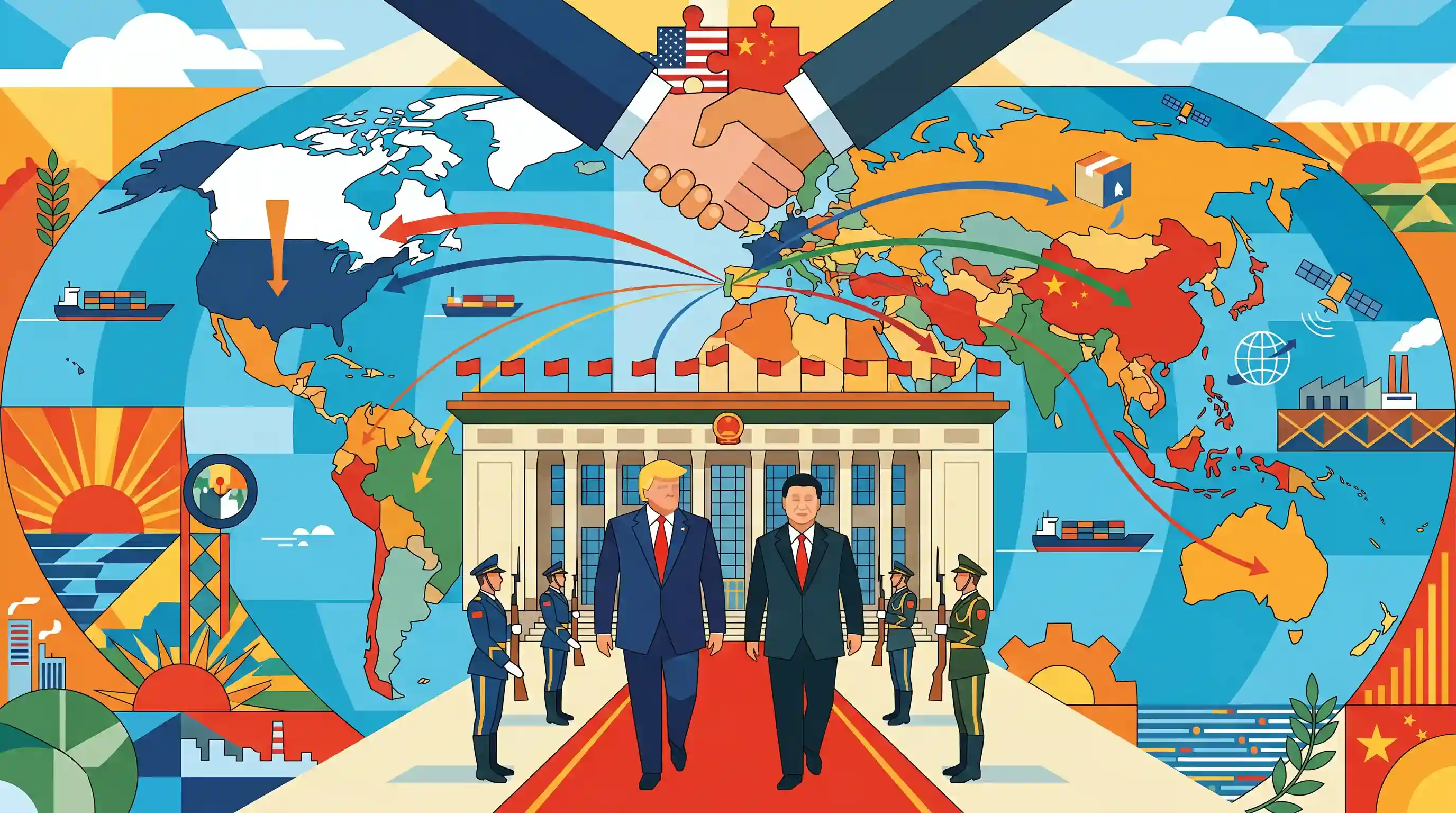
US President Donald Trump has arrived in Beijing for a two-day summit with Chinese President Xi Jinping. The leaders began their talks following a welcome ceremony at the Great Hall of the People, marking a critical moment for US-China bilateral relations and global geopolitics.
Key Points
- US President Donald Trump and Chinese President Xi Jinping commenced a two-day high-stakes summit in Beijing on May 14, 2026.
- The summit began with a welcome ceremony at the Great Hall of the People.
- The talks occur against the backdrop of significant geopolitical shifts and complex US-China relations.
Prelims Trap
The United States officially follows the 'One China Principle', accepting Taiwan as an inalienable part of China.
The US follows the 'One China Policy' (acknowledging Beijing's claim without legally endorsing it). It does not follow the 'One China Principle' (endorsing it). This subtle word swap is a classic trap.
Static Concepts Connected
What is the 'Thucydides Trap' in International Relations?
- Origin & Meaning: Coined by Graham Allison, it refers to the high risk of war when a rising power threatens to displace an existing ruling power (historically Athens and Sparta).
- Modern Context: It serves as the defining framework to describe the structural stress and geopolitical risks inherent in the modern US-China strategic rivalry.
How do the US-led AUKUS and Quad differ in their strategic intent?
- AUKUS: A trilateral military and technology partnership (US, UK, Australia) explicitly focused on hard security, defense tech sharing, and nuclear-powered submarines to counter China.
- The Quad: A broader strategic dialogue (US, India, Japan, Australia) emphasizing a free, open Indo-Pacific, regional public goods, and maritime domain awareness, rather than a hard military alliance.
Cross-Topic Patterns
US-China decoupling and China-Plus-One
Fluctuations in US-China bilateral relations dictate the urgency of the 'China-Plus-One' strategy, directly impacting India's push for global manufacturing FDI and supply chain integration.
Superpower rivalry stalling UN reforms
Intensifying geopolitical entanglement between Washington and Beijing creates a deadlock in the UN Security Council, stalling structural reform and pushing global diplomacy toward minilaterals.

US-China bilateral volatility and its impact on India's strategic autonomy, 'China-Plus-One', and minilaterals is a likely 2026 Mains theme.
Linked PYQs · 3
Linked PYQs · 3
- 2025MainsGS2
"The reform process in the United Nations remains unresolved, because of the delicate imbalance of East and West and entanglement of the USA vs. Russo-Chinese alliance.” Examine and critically evaluate the East-West policy confrontations in this regard.
- 2021MainsGS2
“The USA is facing an existential threat in the form of a China, that is much more challenging than the erstwhile Soviet Union.” Explain.
- 2024MainsGS2
‘The West is fostering India as an alternative to reduce dependence on China's supply chain and as a strategic ally to counter China's political and economic dominance.’ Explain this statement with examples.
