Trade Protectionism and Geopolitical Rivalry Between Superpowers
Source:Indian Express ↗
Why It Matters
The US-China rivalry is the defining geopolitical and geo-economic contest of the 21st century. Their trade policies, protectionist measures, and diplomatic maneuvering have profound implications for global supply chains, economic stability, and India's strategic choices in the Indo-Pacific region.
Summary
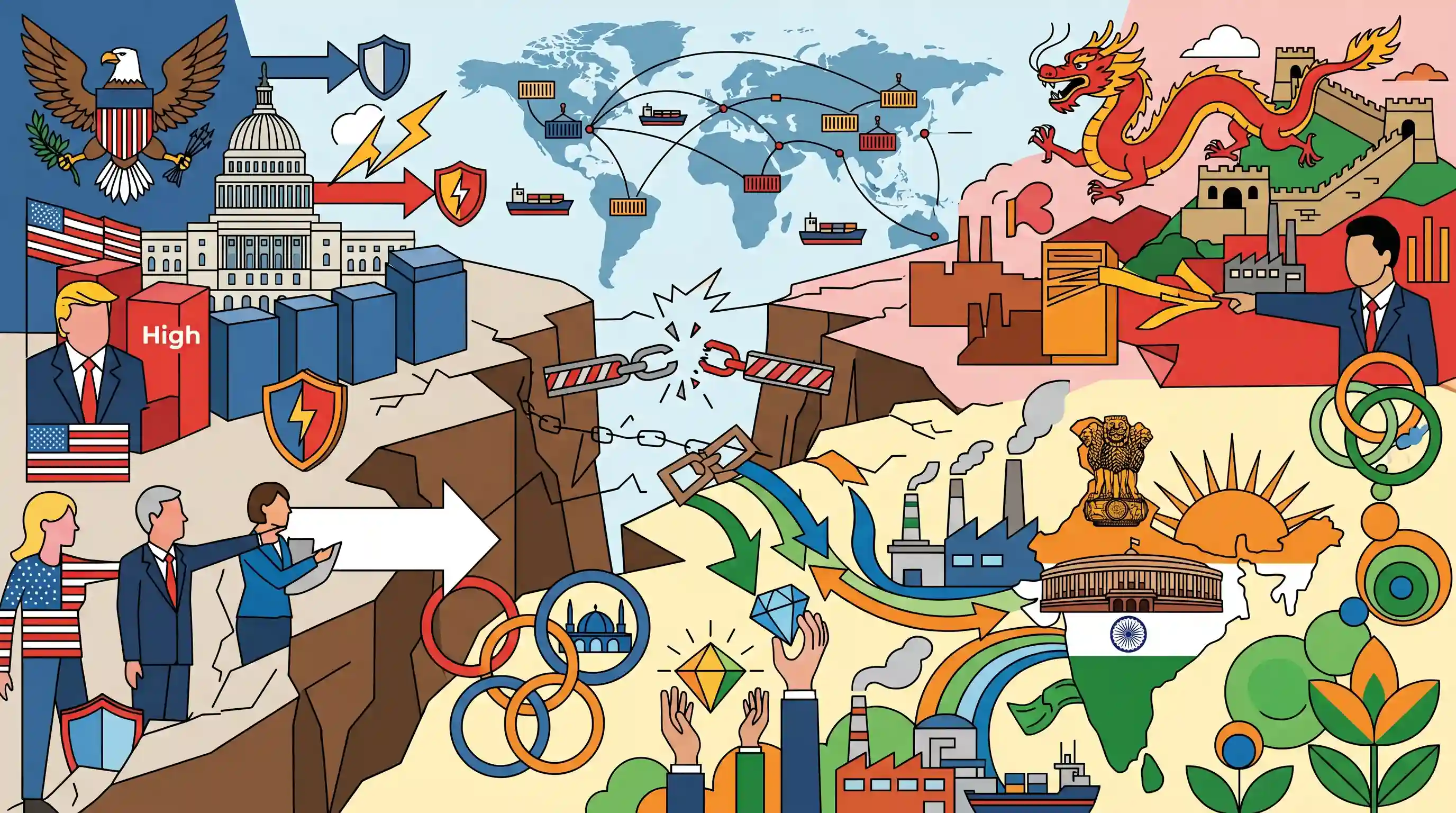
The article examines the complex and evolving geopolitical and economic dynamics between the United States and China under the leadership of Donald Trump and Xi Jinping. It focuses on the resurgence of protectionist trade policies, escalating tariff wars, and the broader structural rivalry between the two superpowers. The piece analyzes China's strategic responses to US pressure, including its push for economic resilience and supply chain dominance. Furthermore, it highlights the global implications of this great power competition, particularly the realignment of global supply chains as the West pursues 'de-risking' strategies, and discusses the resultant strategic and economic opportunities for middle powers like India.
Key Points
- The renewed trade tensions between the US and China, spearheaded by Donald Trump's protectionist economic policies and tariff imposition on Chinese goods.
- How the economic 'decoupling' and 'de-risking' between the two superpowers reflect a deeper structural geopolitical rivalry spanning trade, technology, and security.
- Xi Jinping's strategies to counter US pressure, which include enhancing domestic economic self-reliance, diversifying export markets, and reinforcing China's dominance in critical supply chains.
- The impact of the US-China trade war on global supply chains, pushing Western nations to seek alternative manufacturing hubs to reduce dependence on China.
- Opportunities and challenges for India in this shifting geopolitical landscape, particularly as a potential beneficiary of supply chain relocation and as a strategic partner to the West in countering China's influence.
Important Terms
De-risking

A strategic approach focusing on reducing economic dependencies on a single nation (typically China) in critical sectors to mitigate vulnerabilities, while maintaining broader commercial engagement.
UPSC context
GS Paper 2 (International Relations); tests understanding of evolving global trade paradigms and supply chain security.
Decoupling
The deliberate and comprehensive severing of deep economic interdependencies between nations, involving the dismantling of shared trade, investment, and supply chain networks to ensure strategic independence.
UPSC context
GS Paper 2; critical for analyzing US-China strategic competition and its structural impact on global trade.
Supply Chain Resilience Initiative (SCRI)
A trilateral framework between India, Japan, and Australia aimed at diversifying supply sources and reducing collective reliance on China to ensure economic security in the Indo-Pacific.
UPSC context
GS Paper 2 (Regional Groupings); tests India's proactive diplomacy in addressing regional economic vulnerabilities.
Middle Power
A sovereign state with significant economic and diplomatic influence that acts as a balancer or bridge-builder in international relations, without having superpower status.
UPSC context
GS Paper 2; pertains to India’s role as a 'leading power' and stabilizer in a multipolar order.
World Trade Organization (WTO)
An international organization that regulates global trade and settles disputes through a rules-based multilateral system, currently facing challenges due to unilateral protectionism.
UPSC context
GS Paper 2 (International Institutions); tests the effectiveness of global governance amid trade wars.
Protectionism
Economic policies like tariffs and quotas used by governments to restrict imports, shielding domestic industries and workers from foreign competition.
UPSC context
GS Paper 3 (Economy); relevant for questions on 'slowbalisation' and its impact on India's export-led growth.
Prelims Trap
"The Indo-Pacific Economic Framework (IPEF) provides mutual tariff concessions and enhanced market access to its members."
IPEF is a non-traditional economic arrangement. It explicitly excludes tariff reductions and market access concessions, focusing instead on standards, supply chains, and clean energy.
Static Concepts Connected
How does the IPEF differ from traditional Free Trade Agreements (FTAs)?
- No Market Access: It deliberately excludes tariff exemptions and market access concessions, which are the hallmarks of traditional FTAs.
- Four Pillars: It is structured around four pillars: Trade, Supply Chains, Clean Economy, and Fair Economy. India opted out of the Trade pillar.
- Crisis Response: It establishes a dedicated Supply Chain Council to monitor vulnerabilities, prevent bottlenecks, and coordinate crisis response among partners.
What is China's 'Dual Circulation' economic strategy?
- Internal Circulation: Focuses on expanding domestic consumption, indigenous innovation, and technological self-reliance to insulate the economy from external shocks and sanctions.
- External Circulation: Continues foreign trade and investment to ensure global supply chains remain fundamentally reliant on Chinese manufacturing and exports.
Cross-Topic Patterns
De-risking + Critical Mineral Security
The push to 'de-risk' from China's supply chains directly drives India's integration into the Mineral Security Partnership (MSP) and domestic PLI schemes to secure critical mineral and electronics manufacturing.
WTO Paralysis + Economic Minilateralism
US protectionist tariffs and its continuous blocking of the WTO Appellate Body are accelerating the global shift toward issue-based economic minilaterals like IPEF rather than broad FTAs.

Expect a multi-statement Prelims question linking IPEF's supply chain pillar, India's PLI scheme, and the 'de-risking' strategy.
Linked PYQs · 3
Linked PYQs · 3
- 2025MainsGS3
What are the challenges before the Indian economy when the world is moving away from free trade and multilateralism to protectionism and bilateralism? How can these challenges be met?
- 2024MainsGS2
‘The West is fostering India as an alternative to reduce dependence on China's supply chain and as a strategic ally to counter China's political and economic dominance.’ Explain this statement with examples.
- 2021MainsGS2
“The USA is facing an existential threat in the form of a China, that is much more challenging than the erstwhile Soviet Union.” Explain.
