LNG Import Diversification Amid Strait of Hormuz Disruptions
Source:Indian Express ↗
ఇది ఎందుకు ముఖ్యం
This serves as a vital case study for India's energy security strategy, illustrating how diversifying supply sources can effectively insulate the domestic economy from severe geopolitical shocks and maritime trade route disruptions.
సారాంశం
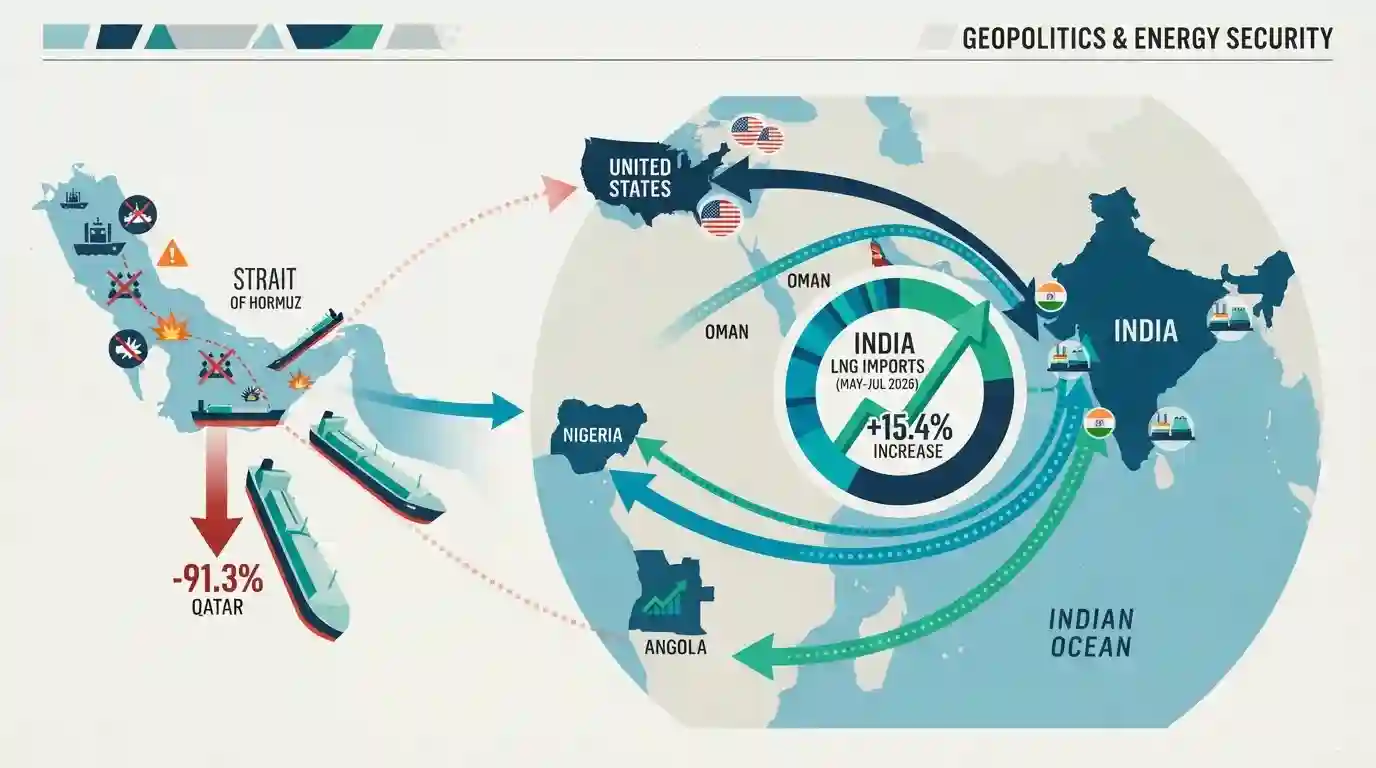
Despite severe disruptions in the Strait of Hormuz due to the West Asia conflict, India successfully increased its liquefied natural gas (LNG) imports by 15.4% during the May-July 2026 period. The maritime crisis led to a 91.3% collapse in LNG supplies from Qatar, India's historically largest supplier. However, India showcased strategic agility by rapidly diversifying its energy sources, significantly ramping up LNG cargoes from the US, Nigeria, Oman, and Angola to offset the shortfall and ensure energy security.
ముఖ్య అంశాలు
- India's LNG imports grew by 15.4% year-on-year to 7.08 million tonnes during May-July 2026.
- The West Asia war and effective closure of the Strait of Hormuz caused a 91.3% crash in LNG imports from Qatar, traditionally India's largest supplier.
- India successfully mitigated this disruption by aggressively diversifying its supply chain, massively increasing imports from the US, Nigeria, Oman, and Angola.
- This supply agility prevented domestic energy shortages and showcased the strategic value of diversifying import sources away from vulnerable maritime chokepoints.
ముఖ్యమైన పదాలు
Strait of Hormuz

A strategically critical narrow waterway connecting the Persian Gulf with the Gulf of Oman, serving as the world's primary oil and gas transit chokepoint.
UPSC context
GS Paper 1 (Geography) and GS Paper 2; tests key global maritime chokepoints and geopolitical energy supply vulnerabilities.
Energy Security
The continuous, reliable availability of energy sources at affordable prices, while minimizing environmental impacts and reducing vulnerability to external supply shocks.
UPSC context
GS Paper 3 (Economic Development); tests strategies for reducing import dependence, resource diversification, and achieving national strategic autonomy.
Liquefied Natural Gas (LNG)
Natural gas, primarily methane, cooled to a liquid state at approximately -162°C for safe, efficient non-pipeline maritime transport and storage.
UPSC context
GS Paper 3 (Energy/Infrastructure); tests understanding of cleaner fossil fuel transitions and India's energy import basket.
Supply Chain Resilience
The capacity of a trade network to withstand, adapt to, and rapidly recover from unexpected natural or geopolitical disruptions by diversifying suppliers.
UPSC context
GS Paper 3 (Economy) and GS Paper 2; tests trade diversification policies like SCRI to counter supply shocks.
Kpler
A leading global commodity market intelligence and ship-tracking analytics firm that provides real-time data on energy, freight, and cargo movements.
UPSC context
GS Paper 3 (Energy/Economy); tests ability to analyze global commodity flows and shipping data during disruptions.
ప్రిలిమ్స్ ఉచ్చు
"LNG exports from Middle Eastern nations like Oman must transit through the Strait of Hormuz to reach India."
Oman is strategically located on the Gulf of Oman and the Arabian Sea. Its shipping ports completely bypass the Strait of Hormuz, unlike Qatar or Bahrain.
అనుసంధానమైన స్థిర భావనలు
Which water bodies are connected by key West Asian maritime chokepoints?
- Strait of Hormuz: Connects the Persian Gulf to the Gulf of Oman. Vital for Qatar, Bahrain, and UAE's Persian Gulf exports.
- Bab el-Mandeb: Connects the Red Sea to the Gulf of Aden and the Arabian Sea. A major transit route for global shipping.
- Suez Canal: Connects the Mediterranean Sea to the Red Sea, enabling direct shipping between Europe and Asia.
What is the role of Natural Gas in India's energy transition?
- Target 2030: India aims to increase the share of natural gas in its primary energy mix from the current ~6% to 15% by 2030.
- Bridge Fuel: It acts as a crucial 'bridge fuel' offering lower carbon emissions than coal while renewable energy capacity scales up to handle baseload demand.
అంతర-అంశ నమూనాలు
Chokepoint geography & energy resilience
Disruption in the Strait of Hormuz highlights the strategic advantage of Oman's location on the Arabian Sea, combining map-based geography with energy security themes.
Shifting energy vectors to Africa/Americas
Sourcing LNG from Nigeria, Angola, and the US aligns with India's broader macroeconomic strategy to de-risk critical supply chains from Middle Eastern geopolitical volatility.

Prelims 2026 will likely test the geographical location of West Asian ports vis-a-vis the Strait of Hormuz and their energy supply lines.
అనుసంధాన PYQలు · 1
అనుసంధాన PYQలు · 1
- 2026PrelimsGS1
Ships from which of the following countries have to cross the Strait of Hormuz to reach out to the Indian Ocean ? 1. Bahrain 2. Syria 3. Qatar 4. Egypt Select the answer using the code given below :
