Jaipur Hosts WWF Global Conservation Conference
Source:drishtiias ↗
Why It Matters
Important for RPSC RAS aspirants tracking international and national environmental conferences hosted in Rajasthan, biodiversity frameworks, and wildlife conservation policies.
Summary
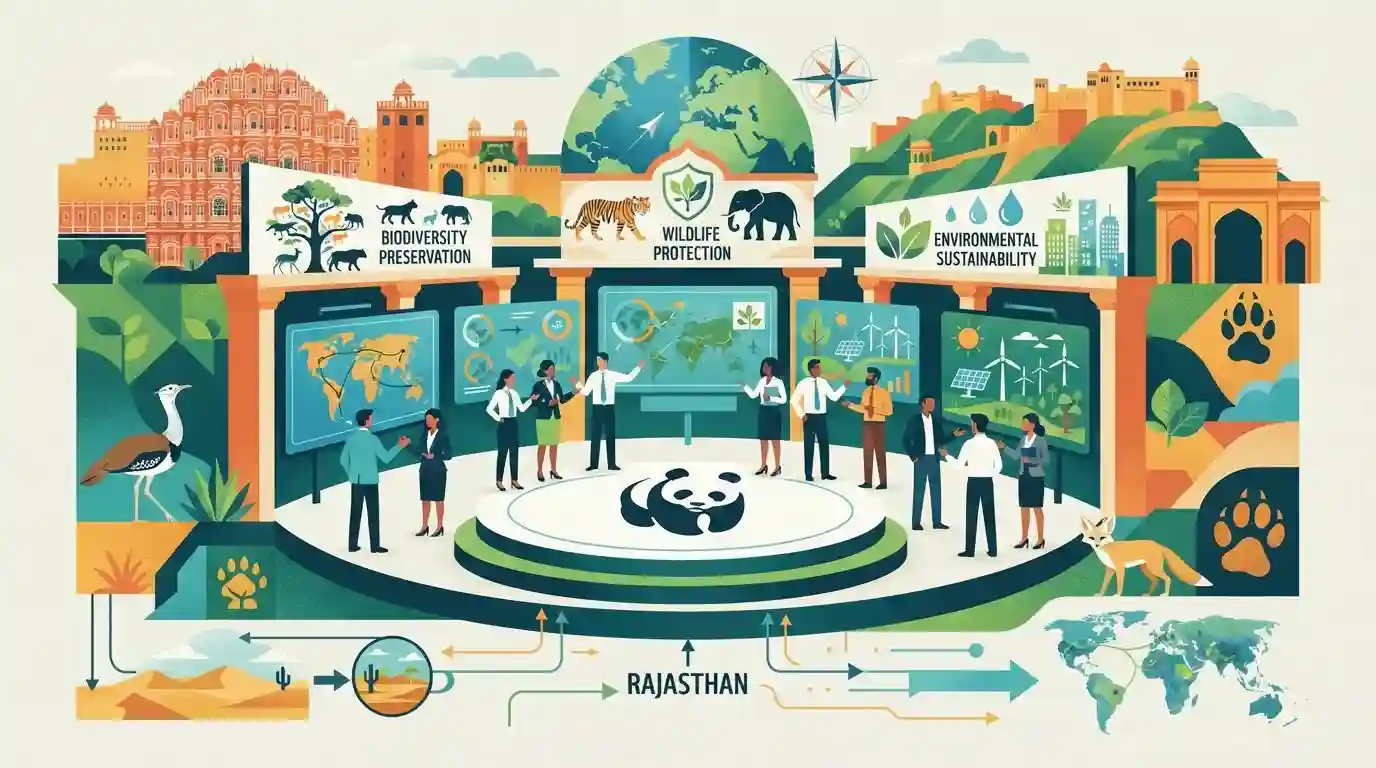
The WWF Global Conservation Conference was inaugurated in Jaipur, Rajasthan, serving as a major forum for discussions on global biodiversity preservation, wildlife protection, and environmental sustainability. The event emphasizes Rajasthan's prominence as a venue for high-level ecological dialogues and conservation initiatives.
Key Points
- The WWF Global Conservation Conference was inaugurated in Jaipur, Rajasthan, highlighting international and national focus on biodiversity conservation, ecological restoration, and environmental protection.
- The event brought together conservationists, experts, and policymakers to discuss global strategies for addressing climate change and habitat loss.
- Serving as a significant platform for Rajasthan, the conference underscored the state's ecological importance and initiatives in wildlife management.
Important Terms
WWF (World Wide Fund for Nature)

An international non-governmental organization founded in 1961 working in the field of wilderness preservation and the reduction of human impact on the environment.
UPSC context
RPSC Paper III (Environment & Biodiversity); tests knowledge of international conservation bodies and major ecological summits hosted in Rajasthan.
Great Indian Bustard
A critically endangered large ground bird native to the Indian subcontinent, with its largest remaining wild population located in Rajasthan, notably in the Desert National Park.
UPSC context
RPSC Rajasthan Geography & Environment; tests awareness of endangered state wildlife and ongoing captive-breeding/rewilding projects.
Orans
Traditional sacred groves protected by local communities in Rajasthan, serving as vital community-led ecological refuges and grass habitats for regional biodiversity conservation.
UPSC context
RPSC Rajasthan Culture and Environment; tests understanding of traditional community conservation practices and sacred ecosystems in arid landscapes.
Prelims Trap
India's Ramsar wetland sites stand at 24 and tiger reserves at 47.
Aspirants often confuse the old figures of Ramsar sites (24) or tiger reserves (47) with the updated figures presented at the conference (101 and 58 respectively).
Static Concepts Connected
What are the key statutory bodies and legal frameworks under the Wildlife Protection Act, 1972?
- Statutory Bodies: Establishes statutory bodies like the National Board for Wildlife (NBWL) chaired by the Prime Minister and State Boards for Wildlife chaired by the Chief Minister.
- Protected Areas: Provides for the creation of Protected Areas divided into Sanctuaries, National Parks, Conservation Reserves, and Community Reserves.
- Schedules: Lists endangered species across Schedules (Schedule I to VI) with varying degrees of legal protection and penalties.
Cross-Topic Patterns
Rajasthan Wildlife + Ramsar Wetlands expansion
The conference showcased Rajasthan's conservation milestones in tiger reserves and Ramsar sites alongside breeding programs for the critically endangered Great Indian Bustard.

RPSC frequently tests exact numbers for Ramsar sites (101) and Tiger Reserves (58) alongside state-specific icons like the Great Indian Bustard.
Linked PYQs · 3
Linked PYQs · 3
- 2023RPSC_PRELIMSGS1
The National Tiger Conservation Authority has conferred the status of the fifth tiger sanctuary in Rajasthan, to which of the following sanctuaries?
- 2025RPSC_PRELIMSGS1
Which of the following pairings is incorrect? Protected Area (as of May 2023) – District
- 2023RPSC_PRELIMSGS1
According to a recently released notification by the Forest, Environment and Climate Change Department of Rajasthan, how many wet-lands are there in the state?
