Assam Civil Militia Plan and State Monopoly on Violence
Source:The Hindu ↗
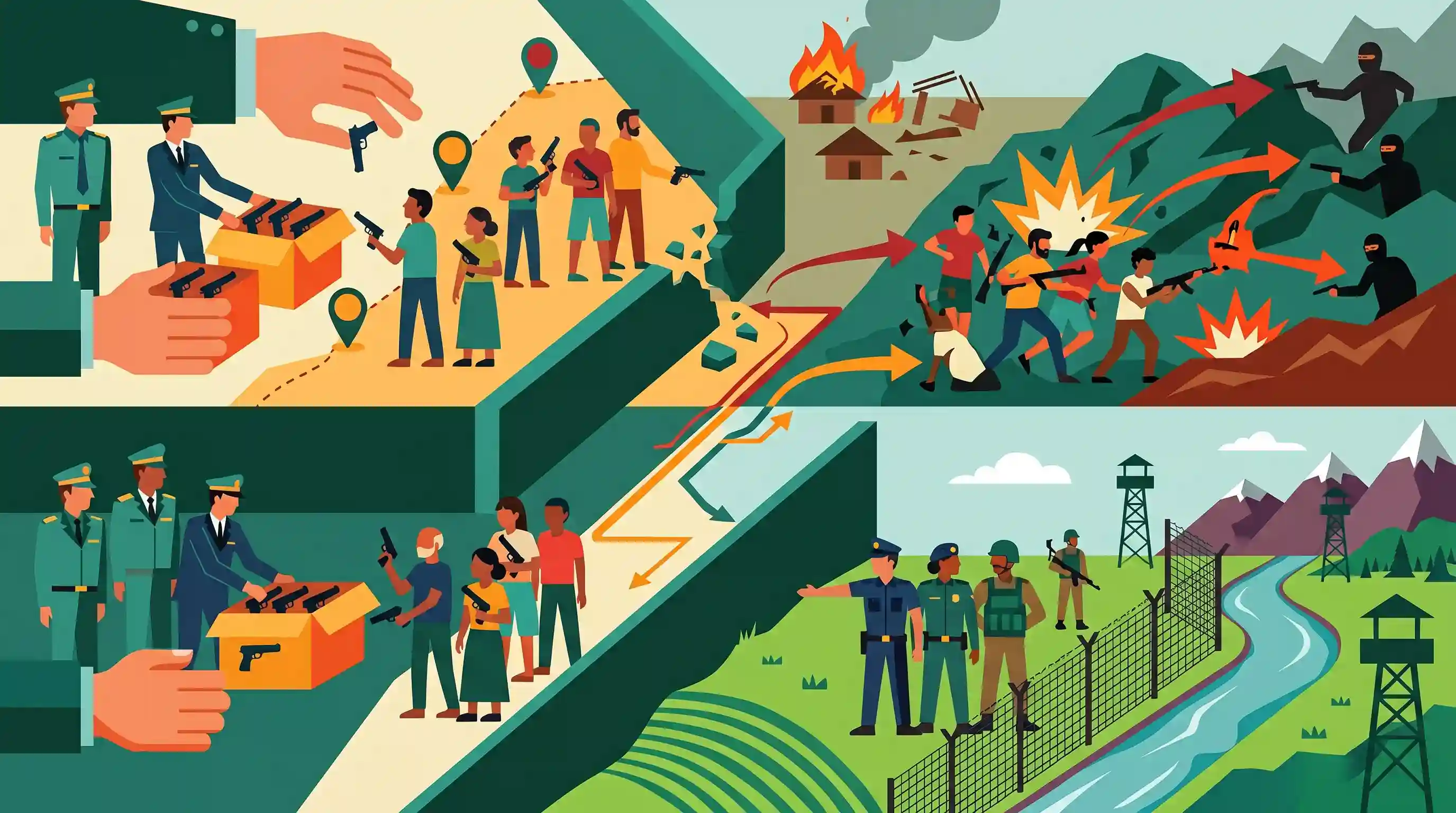
Why It Matters
The article addresses a critical debate in internal security policy: whether the State can or should arm civilians for self-defense and counter-insurgency. It connects current policy in Assam to the historical precedent of Salwa Judum, providing vital context for GS3 answers on border area management, internal security challenges, and the role of state and non-state actors.
Summary
The editorial criticizes the Assam government's decision to arm eligible indigenous communities in vulnerable areas, particularly those bordering Bangladesh. Drawing parallels with the disastrous 'Salwa Judum' campaign in Chhattisgarh, which the Supreme Court ruled illegal, the piece argues that outsourcing law enforcement to civilians blurs the State's monopoly on violence. Furthermore, it risks arms falling into insurgent hands and could exacerbate violence in the insurgency-prone Northeast. The author asserts that the government should focus on strengthening institutional law enforcement and border security rather than creating civilian militias.
Key Points
- The Assam government's decision to arm eligible indigenous civilians in vulnerable areas, particularly near the Bangladesh border, is a flawed approach to internal security.
- The policy blurs the lines between law enforcement and private citizens, outsourcing the State's legal monopoly on violence.
- Historically, similar strategies like the 'Salwa Judum' in Chhattisgarh led to severe human rights abuses and were ultimately declared illegal by the Supreme Court.
- In an insurgency-prone state like Assam, circulating more firearms among civilians risks these weapons entering the grey market and falling into insurgent hands.
- Instead of arming civilians, the state should focus on bolstering institutional law enforcement and improving border management.
Important Terms
Salwa Judum

A state-sponsored militia in Chhattisgarh (2005–2011) comprising tribal youth armed to counter Naxalism. The Supreme Court declared it unconstitutional in 2011 for violating fundamental rights.
UPSC context
GS-III (Internal Security). Relevant for analyzing state-led counter-insurgency strategies and judicial oversight of security policies.
ULFA (Independent)
The anti-talk, hardline faction of the United Liberation Front of Asom led by Paresh Baruah. It demands a sovereign Assam and continues armed struggle from Myanmar bases.
UPSC context
GS-III (North-East Insurgency). Essential for understanding the fragmented nature of militant groups and hurdles in peace negotiations.
State Monopoly on Violence
A sociological concept by Max Weber stating the State alone has the legitimate authority to use or authorize physical force within its territory.
UPSC context
GS-II/GS-III (Governance/Security). Tests understanding of the State's core responsibilities and the risks of privatizing law enforcement.
Indigenous Arms Licensing Policy
A 2025 Assam Cabinet decision to issue arms licenses to "original inhabitants" in border areas to counter perceived security threats and demographic challenges.
UPSC context
GS-III (Internal Security/Border Management). Crucial for evaluating community-based security vs. institutional policing in sensitive regions.
Village Defence Parties (VDPs)
Community-based voluntary organizations in Assam established for rural policing, which the government aims to modernize to support law enforcement in remote areas.
UPSC context
GS-III (Internal Security). Relates to community policing models and local participation in maintaining order.
Nandini Sundar Judgment (2011)
The landmark 2011 ruling (Nandini Sundar v. State of Chhattisgarh) that prohibited arming untrained civilians for counter-insurgency, citing violations of Articles 14 and 21.
UPSC context
GS-II (Judiciary/Fundamental Rights). A vital precedent for the constitutional limits on state power in conflict zones.
Prelims Trap
"The Supreme Court declared all schemes arming civilian volunteers for internal security as unconstitutional in the Nandini Sundar case."
The 2011 judgment specifically struck down the Salwa Judum in Chhattisgarh. Other civilian-arming frameworks, like J&K's Village Defence Guards (VDGs), still legally operate under state provisions.
Static Concepts Connected
What was the Supreme Court's ruling on Salwa Judum (Nandini Sundar case)?
- Article 21: Banning the scheme, the SC ruled that deploying untrained civilians in counter-insurgency endangers their right to life.
- Article 14: It created an arbitrary equivalence between poorly trained civilian 'Special Police Officers' and regular armed forces.
- Sovereign function: Outsourcing the legitimate monopoly on violence to private militias violates the State's constitutional duty to maintain public order.
What is the Comprehensive Integrated Border Management System (CIBMS)?
- Objective: Deploys technological solutions on borders where physical fencing is impossible due to rugged, marshy, or riverine terrain.
- Key technologies: Utilizes thermal imagers, radar, aerostats, and underground sensors to create an invisible electronic barrier against infiltration.
- BOLD-QIT: A specific CIBMS project deployed in Assam's Dhubri district to monitor the unfenced Brahmaputra river border.
Cross-Topic Patterns
Border Tech vs. Militia Policies
The move to arm civilians near the Bangladesh border highlights persistent gaps in tech-led initiatives like CIBMS and BOLD-QIT in managing porous, riverine terrain.
J&K VDGs vs. Assam Militia
The Assam proposal parallels the Village Defence Guards (VDGs) in J&K, raising overlapping GS-3 questions regarding vigilantism, counter-insurgency ethics, and the State's monopoly on violence.

GS-3 internal security questions will likely contrast tech-driven border management (CIBMS) with the socio-legal perils of civilian militias.
Linked PYQs · 4
Linked PYQs · 4
- 2017MainsGS3
The North-East region of India has been infested with insurgency for a very long time. Analyze the major reasons for the survival of armed insurgency in this region.
- 2018MainsGS3
Left Wing Extremism (LWE) is showing a downward trend, but still affects many parts of the country. Briefly explain the Government of India's approach to counter the challenges posed by LWE.
- 2021MainsGS3
Analyse the multidimensional challenges posed by external state and non-state actors, to the internal security of India. Also discuss measures required to be taken to combat these threats.
- 2025MainsGS3
What are the major challenges to internal security and peace process in the North-Eastern States? Map the various peace accords and agreements initiated by the government in the past decade.
