Wholesale Price Inflation Rises Amid Global Supply Chain Disruptions
Source:The Hindu ↗
Why It Matters
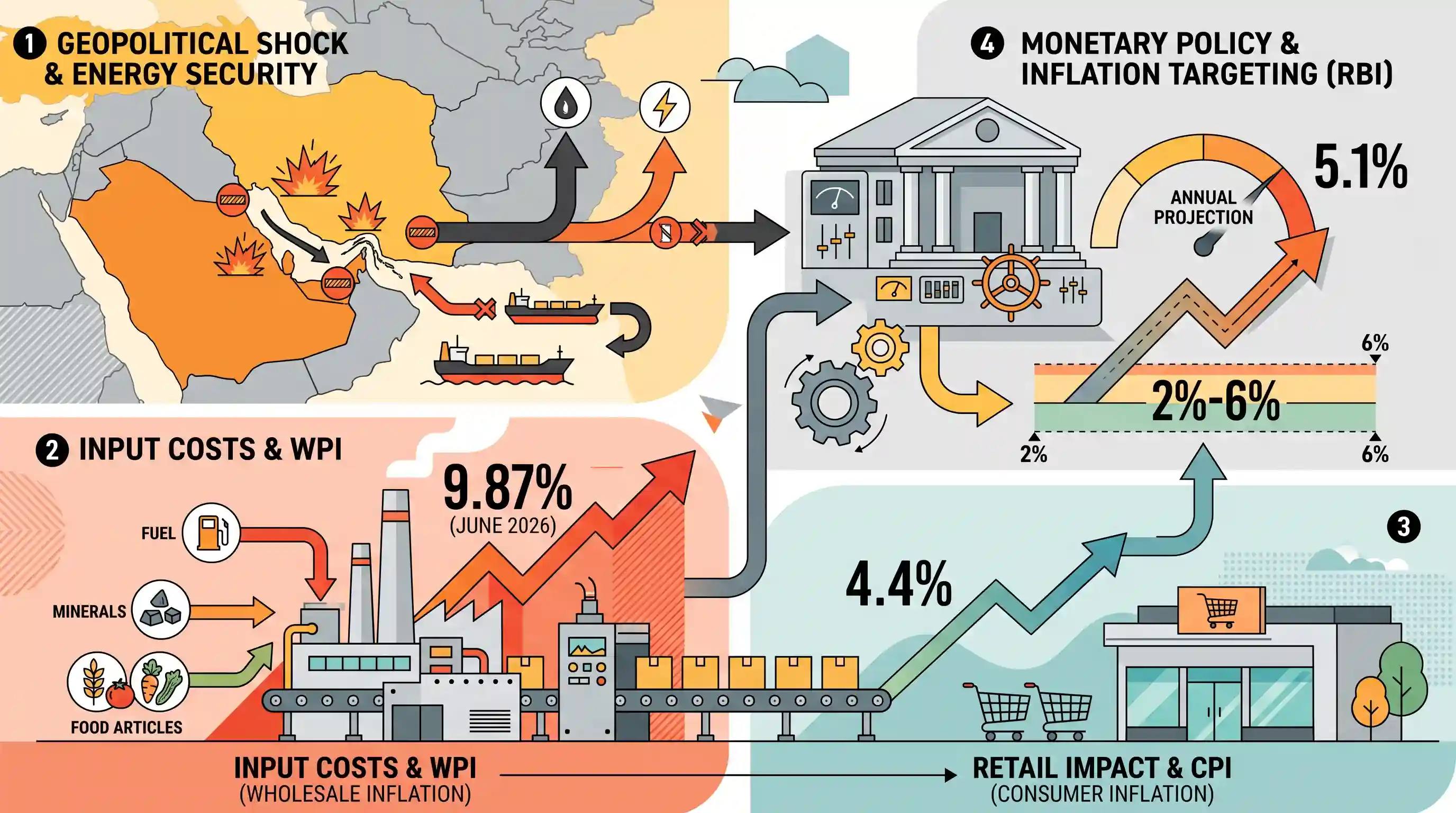
The article highlights how supply-side global shocks, particularly at maritime chokepoints like the Strait of Hormuz, directly threaten India's macroeconomic stability by driving up fuel, input, and food prices. This demonstrates the limitations of purely demand-side monetary tools (such as interest rate hikes by the RBI) when dealing with external geopolitical disruptions.
Summary
WPI-based wholesale inflation in India accelerated to 9.87% in June 2026, driven by rising costs of fuel, minerals, and food articles. The sharp inflationary trend is closely tied to the West Asia crisis and a blockade in the critical Strait of Hormuz chokepoint, disrupting crude oil shipments and inflating input costs. Concurrently, retail inflation (CPI) climbed to 4.4%, leading the RBI to raise its annual inflation projection to 5.1% as it attempts to manage supply-side shocks within its 4% (+/-2%) targeting mandate.
Key Points
- India's Wholesale Price Index (WPI) inflation rose to 9.87% in June 2026 from 9.68% in May 2026, driven largely by food articles, mineral oils, and basic metals.
- The calculation of WPI in 2026 utilizes the updated base year of 2022-23.
- The primary supply-side triggers for this spike are geopolitical tensions in West Asia, specifically the effective blockade of the Strait of Hormuz, which has severely disrupted crude oil imports into India and pushed wholesale fuel and power inflation to 27.41%.
- Sectoral inflation figures show food articles at 5.49% (up from 3.6% in May), non-food articles at 11.07%, and minerals at 9.45%, while manufacturing inflation remained unchanged at 7.48%.
- Retail inflation (CPI) also hit an 18-month high of 4.4% in June 2026, prompting the RBI to increase its annual inflation projection from 4.6% to 5.1% due to high input-cost pass-throughs.
- While WPI experiences double-digit pressure, the RBI's official mandate is to anchor CPI-based headline inflation at 4% (with a tolerance band of +/- 2%).
Important Terms
Wholesale Price Index (WPI)

An economic index that measures price changes of goods traded in bulk at the wholesale or producer level before they reach final consumers, reflecting supply-side price pressures.
UPSC context
GS Paper III (Indian Economy); tests knowledge of inflation metrics, their components, and supply-side price pressures.
Consumer Price Index (CPI)
An economic indicator that measures average retail-level price changes of a representative basket of goods and services consumed by households, reflecting the cost of living.
UPSC context
GS Paper III (Indian Economy); tests retail inflation concepts, household consumption surveys, and baseline revisions.
Inflation Targeting Framework
A monetary policy strategy where the central bank adjusts policy rates to maintain retail inflation within a predetermined target, legally set at 4% (+/-2%) in India.
UPSC context
GS Paper III (Monetary Policy); tests Monetary Policy Committee operations, statutory mandates, and demand-side price stability.
Reserve Bank of India (RBI)
India's central bank and apex monetary authority established in 1935, responsible for regulating currency, operating monetary policy, and maintaining financial and price stability.
UPSC context
GS Paper III (Banking & Monetary Policy); tests central banking functions, financial regulation, and external sector management.
Ministry of Commerce and Industry
A Union ministry of India responsible for formulating and implementing foreign trade policy, industrial facilitation, and compiling the Wholesale Price Index.
UPSC context
GS Paper III (Industrial Policy & Trade); tests export-import frameworks, industrial development, and governmental economic departments.
Strait of Hormuz
A highly sensitive geopolitical maritime chokepoint between the Persian Gulf and Gulf of Oman, handling over 20% of global petroleum and liquid natural gas trade.
UPSC context
GS Paper II (IR) & GS Paper III (Energy Security); tests maritime trade chokepoints, West Asian conflicts, and crude imports.
Prelims Trap
The revised 2022-23 WPI series captures service-sector price movements through the newly integrated Service Producer Price Index.
WPI remains a goods-only index. The Service Producer Price Index (Service PPI) is a completely separate statistical metric, not part of the WPI basket.
Static Concepts Connected
What are the core differences between CPI and WPI in India?
- Compilation authority: CPI is published by the National Statistical Office (MoSPI), while WPI is released by the Office of Economic Adviser (DPIIT, Ministry of Commerce and Industry).
- Services and goods: CPI covers both goods and services, whereas WPI tracks only goods, completely excluding services from its basket.
- Food weight disparity: CPI assigns a heavy weight (~45.86%) to food, whereas WPI's food weight is significantly lower (~25%), making CPI more sensitive to agricultural supply shocks.
Why is the Strait of Hormuz a vital global chokepoint?
- Geographic location: It links the Persian Gulf with the Gulf of Oman and the Arabian Sea, serving as the sole maritime exit for major oil exporters.
- Landed export escape: Nations like Qatar, Kuwait, and Bahrain depend entirely on it, whereas Saudi Arabia can bypass it via western Red Sea ports.
Cross-Topic Patterns
Chokepoint geopolitics and domestic monetary policy
External maritime blockades drive supply-side oil shocks, forcing the RBI to raise inflation projections despite domestic monetary policy's limited efficacy against non-demand inflation.
Green energy integration and structural reforms
Adding solar and wind to the WPI electricity basket reflects India's energy transition, structurally altering how industrial input costs respond to global fossil fuel shocks.

Revised WPI base (2022-23) methodology changes and Strait of Hormuz transit dependencies are highly probable multi-statement prelims targets.
Linked PYQs · 4
Linked PYQs · 4
- 2020PrelimsGS1
Consider the following statements: 1. The weightage of food in Consumer Price Index (CPI) is higher than that in Wholesale Price Index (WPI). 2. The WPI does not capture changes in the prices of services, which CPI does. 3. Reserve Bank of India has now adopted WPI as its key measure of inflation and to decide on changing the key policy rates. Which of the statements given above is/are correct?
- 2010PrelimsGS1
With reference to India, consider the following statements : 1. The Wholesale Price Index (WPI) in India is available on a monthly basis only. 2. As compared to Consumer Price Index for Industrial Workers (CPI(IW)), the WPI gives less weight to food articles. Which of the statements given above is/are correct ?
- 2026PrelimsGS1
Ships from which of the following countries have to cross the Strait of Hormuz to reach out to the Indian Ocean ? 1. Bahrain 2. Syria 3. Qatar 4. Egypt Select the answer using the code given below :
- 2024MainsGS3
What are the causes of persistent high food inflation in India? Comment on the effectiveness of the monetary policy of the RBI to control this type of inflation.
