Wholesale Price Inflation Remains in Deflationary Territory
Source:The Hindu ↗
Why It Matters
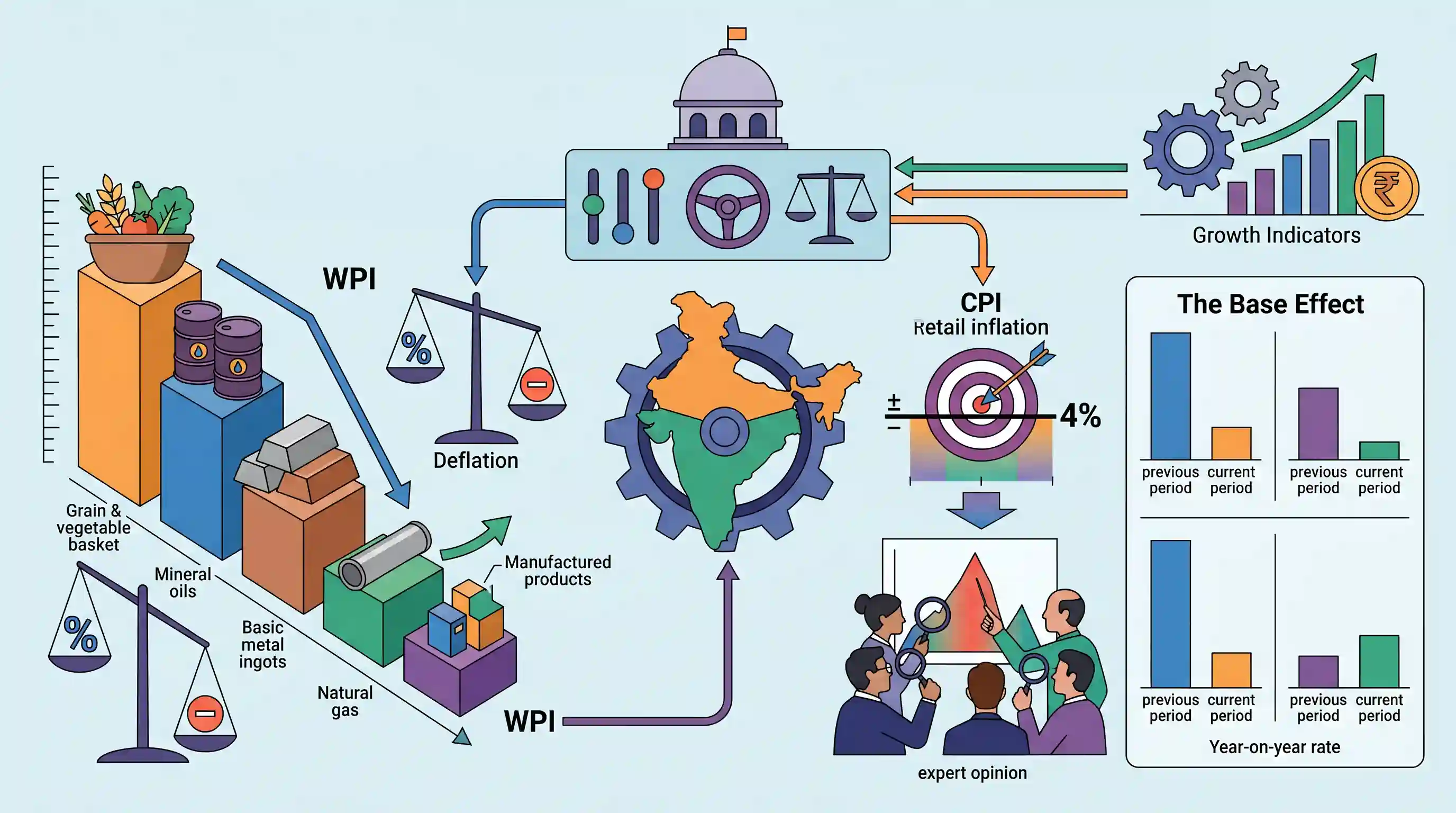
Understanding the divergence between wholesale and retail inflation indices is crucial for evaluating India's macroeconomic stability. It demonstrates how different weightages (like food vs manufactured goods) affect CPI and WPI differently, directly impacting the RBI's monetary policy formulation.
Summary
India's Wholesale Price Index (WPI) remained in deflationary territory, recording -0.58% in July, primarily driven by a steep decline in the prices of food articles, mineral oils, basic metals, and natural gas. Despite an uptick in manufactured product inflation, the easing in primary articles and a favorable base effect kept wholesale inflation negative. Concurrently, retail inflation (CPI) dipped to 3.54%, dropping below the RBI's 4% target, though experts attribute this dip to statistical base effects rather than a permanent structural cooling of prices.
Key Points
- India's Wholesale Price Index (WPI) inflation remained negative at -0.58% in July for the second consecutive month, slightly up from -0.53% in June.
- The deflation was driven by a sharp drop in wholesale food article inflation, which plunged to 2.10% in July from 8.69% in June, along with declines in fuel, power, and basic metals.
- Manufactured products, which constitute the largest weightage in the WPI basket, saw a slight increase in inflation to 1.58%.
- Retail inflation (CPI) also saw a significant drop to 3.54% in July, falling below the RBI's 4% medium-term target for the first time in nearly five years, largely due to statistical base effects.
Important Terms
Wholesale Price Index (WPI)

Measures the change in average prices of goods traded in bulk by wholesale businesses. In India, it is used to monitor price drifts reflecting demand-supply in manufacturing and industry.
UPSC context
GS Paper III (Indian Economy). Tests understanding of inflation measurement and sector-specific price movements.
Consumer Price Index (CPI)
Tracks the change in retail prices of a basket of goods and services consumed by households. It serves as the primary benchmark for the RBI’s inflation targeting.
UPSC context
GS Paper III. Essential for understanding retail inflation and its impact on monetary policy.
Base Effect
The distortion in current inflation figures caused by exceptionally high or low price levels in the previous year’s corresponding reference period.
UPSC context
GS Paper III (Economy). Tests the ability to interpret statistical data versus structural price changes.
Monetary Policy Framework
A formal arrangement between the RBI and the Central Government setting quantifiable inflation targets (4% ± 2%) to ensure price stability while supporting economic growth.
UPSC context
GS Paper III. Key to understanding the institutional mechanism for inflation targeting and accountability.
Reserve Bank of India (RBI)
India's central bank responsible for formulating monetary policy, issuing currency, and maintaining financial stability and foreign exchange reserves.
UPSC context
GS Paper III. Core institution for questions on banking, credit control, and macroeconomic stability.
Ministry of Commerce and Industry
The Union ministry responsible for trade and industrial policies. Its Office of the Economic Adviser compiles and releases monthly Wholesale Price Index (WPI) data.
UPSC context
GS Paper III. Relevant for identifying nodal agencies responsible for economic data and trade.
Prelims Trap
"A negative WPI ensures that retail consumer prices are also experiencing deflation."
WPI excludes services and gives ~64% weight to manufactured goods. CPI is dominated by food and services. Because of these divergent baskets, WPI can experience deflation while CPI remains inflationary.
Static Concepts Connected
How do the WPI and CPI baskets differ in composition and usage?
- Coverage: WPI tracks bulk wholesale goods and excludes services. CPI tracks both retail goods and services (like housing and education).
- Weightage: WPI is dominated by manufactured products (~64.2%). CPI is heavily weighted toward food and beverages (~45.9%).
- Policy Targeting: Under the Flexible Inflation Targeting (FIT) framework, the RBI is legally mandated to target CPI-Combined, entirely ignoring WPI for its 4% target.
What is the Base Effect in macroeconomic data?
- Definition: It is a statistical distortion in the current year's inflation rate caused by abnormally high or low price levels in the corresponding month of the previous year.
- Distortion Impact: A high inflation rate last year creates a "high base," making this year's inflation rate appear artificially lower, even if actual prices are still rising month-on-month.
Cross-Topic Patterns
Imported Inflation & Global Shocks
WPI is heavily influenced by global crude and metal prices, often acting as a leading indicator for imported inflation before it eventually passes through to retail consumers and affects CPI.
Corporate Margins & K-Shaped Recovery
Persistent WPI deflation alongside sticky CPI indicates firms are absorbing lower input costs without passing benefits to consumers, a dynamic often linked to K-shaped economic recoveries and weak rural demand.

Expect a 2026 Prelims multi-statement question testing the structural divergence between WPI/CPI baskets and the mechanics of base effects.
Linked PYQs · 4
Linked PYQs · 4
- 2020PrelimsGS1
Consider the following statements: 1. The weightage of food in Consumer Price Index (CPI) is higher than that in Wholesale Price Index (WPI). 2. The WPI does not capture changes in the prices of services, which CPI does. 3. Reserve Bank of India has now adopted WPI as its key measure of inflation and to decide on changing the key policy rates. Which of the statements given above is/are correct?
- 2010PrelimsGS1
With reference to India, consider the following statements : 1. The Wholesale Price Index (WPI) in India is available on a monthly basis only. 2. As compared to Consumer Price Index for Industrial Workers (CPI(IW)), the WPI gives less weight to food articles. Which of the statements given above is/are correct ?
- 2011PrelimsGS1
Economic growth is usually coupled with
- 2024MainsGS3
What are the causes of persistent high food inflation in India? Comment on the effectiveness of the monetary policy of the RBI to control this type of inflation.
