Wholesale Price Index Inflation Trends and Monetary Policy Context
Source:The Hindu ↗
આ શા માટે મહત્વનું છે
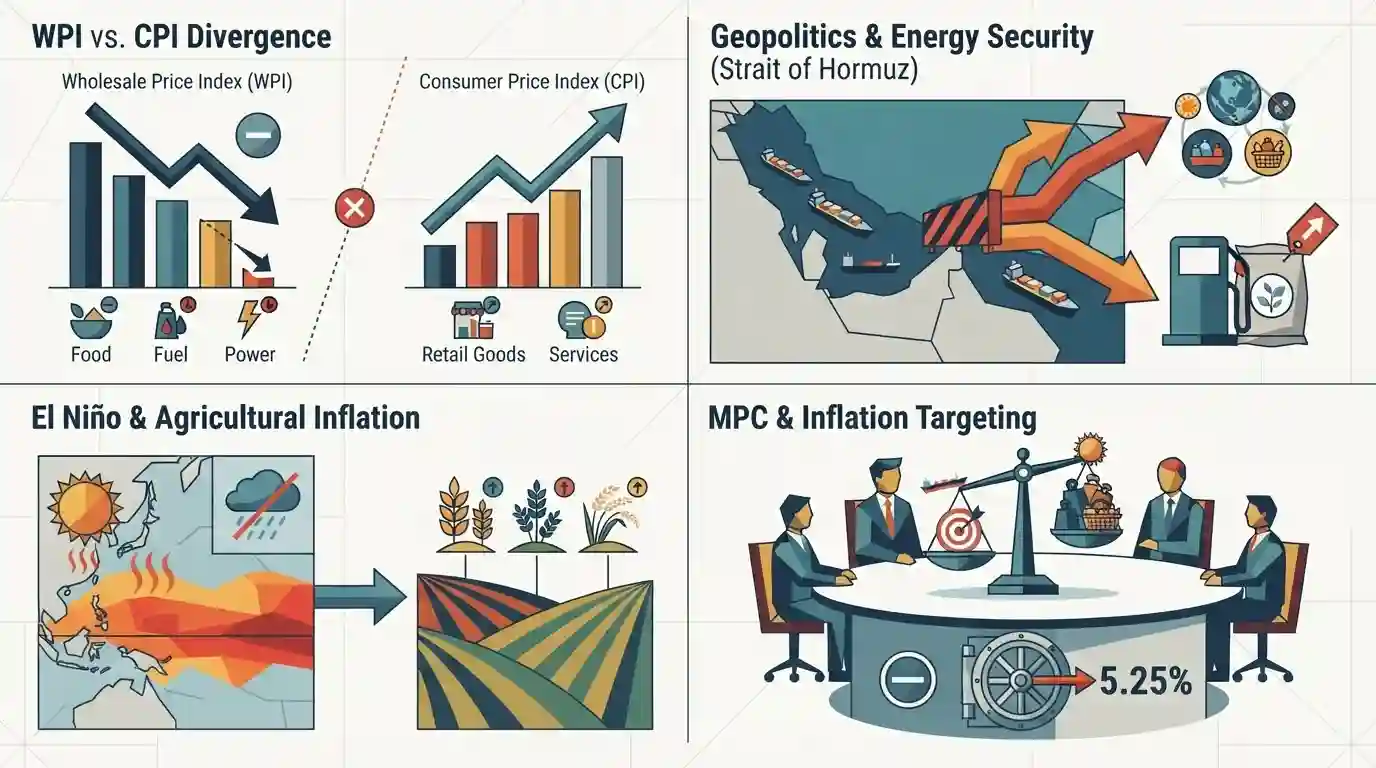
The article provides a real-world study of the integration between global geopolitical vulnerabilities (chokepoints like the Strait of Hormuz), climate phenomena (El Niño), and macroeconomic policy implementation (updated WPI base years and MPC's interest rate stance). It demonstrates how supply-side structural shocks challenge inflation-targeting frameworks in emerging markets.
સારાંશ
The Wholesale Price Index (WPI) inflation in India eased marginally to 9.78% in July 2026, marking the first contraction under the updated 2022-23 base year due to a cooling of food, fuel, and power prices. However, supply-side vulnerabilities remain high due to geopolitical tensions in West Asia blocking the Strait of Hormuz, driving up global crude oil and fertilizer prices. On the domestic front, retail inflation (CPI) increased to 4.45%. Given these pressures, alongside the adverse impacts of a deficient monsoon and El Niño conditions on agriculture, the RBI's Monetary Policy Committee chose to hold benchmark interest rates steady at 5.25%.
મુખ્ય મુદ્દા
- Wholesale Price Index (WPI) inflation eased marginally to 9.78% in July 2026 (from 9.87% in June), marking the first month-on-month decline under the newly updated base year of 2022-23.
- The easing of wholesale inflation was primarily driven by cooling prices in food, fuel, and power categories.
- External supply-side pressures persist, specifically the West Asia war causing a blockade at the strategic Strait of Hormuz, which has pushed up international crude oil and fertilizer prices.
- Retail inflation (CPI-Combined) rose to 4.45% in July, and remains the primary targeting metric for the central bank's monetary policy.
- The RBI's Monetary Policy Committee (MPC) maintained benchmark interest rates at 5.25% and projected a 5% retail inflation target for FY27, citing structural risks from deficient monsoon and El Niño conditions on agricultural output.
મહત્વપૂર્ણ શબ્દો
Wholesale Price Index (WPI)

A measure of the average change in prices of goods sold in bulk at the producer or wholesale level, tracked before they reach retail consumers.
UPSC context
Crucial for Economy (GS-3). Tests understanding of inflation types, base years, and producer-side price pressures.
Monetary Policy Committee (MPC)
A six-member committee under the Reserve Bank of India responsible for fixing the benchmark policy interest rate (repo rate) to contain inflation within target levels.
UPSC context
Important for GS-3 Economy. Tests knowledge of RBI's inflation-targeting framework, monetary policy tools, and institutional structures.
Strait of Hormuz
A narrow, strategically vital waterway connecting the Persian Gulf to the Gulf of Oman, handling roughly 20% of global oil trade.
UPSC context
Relevant for GS-2 (IR) & GS-1 (Geography). Tests map-based locations and understanding of global energy security chokepoints.
El Niño
An abnormal warming of surface waters in the central and eastern Pacific Ocean, which typically weakens the Indian southwest monsoon and reduces rainfall.
UPSC context
Key for GS-1 (Geography) and GS-3 (Agriculture). Tests impacts on Indian monsoon patterns, agricultural yields, and food inflation.
Reserve Bank of India (RBI)
India's central bank and regulatory body responsible for managing monetary policy, issuing currency, and ensuring domestic financial system stability.
UPSC context
Foundational for GS-3 Economy. Evaluates central banking functions, macro-economic management, and interest rate setting.
Consumer Price Index (CPI)
A comprehensive measure of retail-level price changes for a fixed basket of consumer goods and services, used as India's primary inflation gauge.
UPSC context
Essential for GS-3 Economy. Tests differences between retail and wholesale inflation, basket weights, and inflation targeting targets.
પ્રિલિમ્સ ટ્રેપ
"WPI gives a higher weightage to food items than CPI, making it more sensitive to monsoon and agricultural shocks."
CPI assigns a much higher weight to food and beverages (~45%) than WPI. Therefore, agricultural supply shocks like El Niño disproportionately spike retail inflation (CPI), not WPI.
સંલગ્ન સ્થિર ખ્યાલો
How does WPI structurally differ from CPI in India?
- Coverage: WPI tracks only goods at the wholesale level, while CPI tracks both goods and services (like health, education, rent) at the retail level.
- Weightage: CPI assigns a much higher weight to food and beverages (~45%); WPI gives its maximum weight to manufactured products.
- Publishing Authority: WPI is published by the Office of Economic Adviser (MoCI); CPI is released by the National Statistical Office (MoSPI).
What is the composition and mandate of the Monetary Policy Committee (MPC)?
- Mandate: Determines the policy repo rate to achieve the inflation target (4% +/- 2%) under the flexible inflation targeting framework of the RBI Act.
- Composition: Six members (three from RBI, including the Governor who has a casting vote, and three external members appointed by the Government).
- Target Anchor: Since 2014 (following the Urjit Patel Committee), the MPC strictly uses CPI-Combined as its primary nominal anchor, not WPI.
આંતર-વિષય પેટર્ન
West Asia Chokepoints & Imported Inflation
Strait of Hormuz disruptions directly cause supply-side 'imported inflation' in India due to inelastic domestic demand for imported crude oil and fertilizers.
El Niño's Monetary Policy Limits
El Niño-driven monsoon deficits cause structural food inflation. RBI's demand-side monetary tools (repo rates) cannot easily resolve these supply-side agricultural constraints.

Expect a multi-statement question contrasting the new WPI base year (2022-23) with CPI, alongside the macroeconomic impacts of El Niño.
સંલગ્ન PYQ · 4
સંલગ્ન PYQ · 4
- 2020PrelimsGS1
Consider the following statements: 1. The weightage of food in Consumer Price Index (CPI) is higher than that in Wholesale Price Index (WPI). 2. The WPI does not capture changes in the prices of services, which CPI does. 3. Reserve Bank of India has now adopted WPI as its key measure of inflation and to decide on changing the key policy rates. Which of the statements given above is/are correct?
- 2017PrelimsGS1
Which of the following statements is/are correct regarding the Monetary Policy Committee (MPC)? 1. It decides the RBI's benchmark interest rates. 2. It is a 12-member body including the Governor of RBI and is reconstituted every year. 3. It functions under the chairmanship of the Union Finance Minister. Select the correct answer using the code given below:
- 2026PrelimsGS1
Ships from which of the following countries have to cross the Strait of Hormuz to reach out to the Indian Ocean ? 1. Bahrain 2. Syria 3. Qatar 4. Egypt Select the answer using the code given below :
- 2011PrelimsGS1
La Nina is suspected to have caused recent floods in Australia. How is La Nina different from El Nino? 1. La Nina is characterised by unusually cold ocean temperature in equatorial Indian Ocean whereas El Nino is characterised by unusually warm ocean temperature in the equatorial Pacific Ocean. 2. El Nino has adverse effect on south-west monsoon of India, but La Nina has no effect on monsoon climate. Which of the statements given above is/are correct?
