Climate Change Drives Extreme Heatwaves and Energy Demands in India
Source:The Hindu ↗
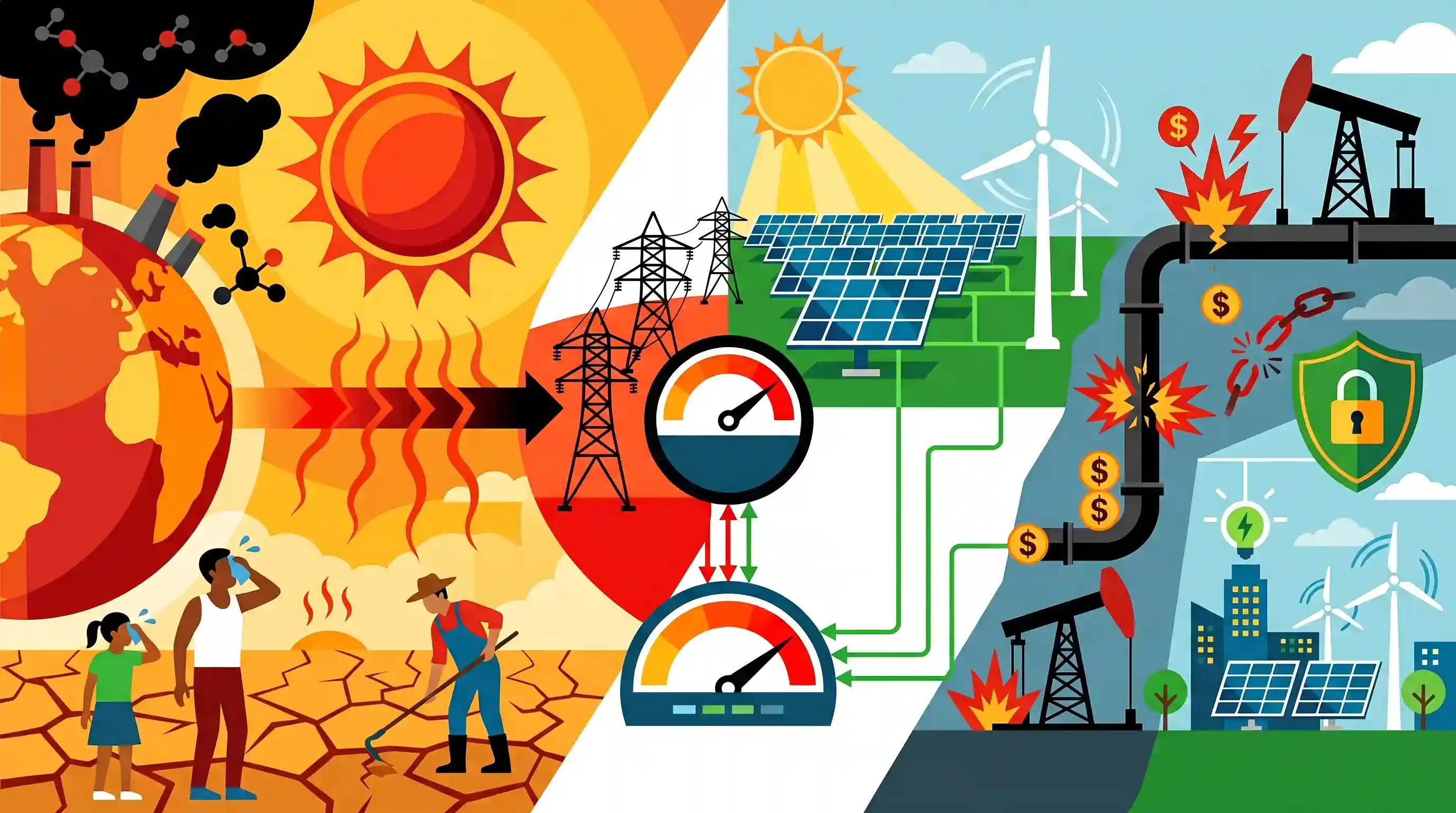
Why It Matters
Highlights the interconnected challenges of climate-induced extreme weather (heatwaves), record-breaking electricity demand, and global energy security. It underscores the practical importance of India's renewable energy transition in meeting peak power demands and reducing dependence on volatile imported fossil fuels.
Summary
UN climate chief Simon Stiell attributed India's extreme heatwaves to climate change driven by fossil fuel consumption, emphasizing the severe economic and human toll on vulnerable populations. The intense heat led to a record-breaking peak electricity demand of 270.8 GW in India. Stiell highlighted that solar and renewable energy have been instrumental in meeting daytime peak loads. He stressed the necessity of homegrown clean energy and energy-efficiency measures for climate adaptation and energy security, particularly as conflicts in West Asia drive up imported fossil fuel costs.
Key Points
- India's extreme heatwave is primarily driven by climate change resulting from the burning of fossil fuels, according to the UN climate chief.
- The soaring temperatures drove India's peak power demand to a record 270.8 GW in late May.
- Solar and other renewable energy sources played a crucial role in meeting the daytime peak electricity demand.
- Homegrown clean energy and energy efficiency are vital for climate adaptation and ensuring affordable electricity for vulnerable populations.
- The crisis highlights the dual challenge of climate extremes and energy security, exacerbated by spiraling imported fossil fuel prices due to conflict in West Asia.
Important Terms
United Nations Framework Convention on Climate Change (UNFCCC)

A 1992 international environmental treaty aimed at stabilizing greenhouse gas concentrations to prevent dangerous human interference with the climate system. It serves as the parent treaty for the Paris Agreement.
UPSC context
GS Paper 2 (International Relations) and GS Paper 3 (Environment); core body for global climate negotiations and COPs.
India Meteorological Department (IMD)
The principal government agency under the Ministry of Earth Sciences responsible for meteorological observations, weather forecasting, and early warnings for hazards like heatwaves and cyclones.
UPSC context
GS Paper 1 (Geography) and GS Paper 3 (Disaster Management); tests knowledge of institutional frameworks for weather monitoring.
Climate Adaptation
Adjustments in social, economic, or ecological systems in response to actual or expected climatic stimuli to moderate harm or exploit beneficial opportunities.
UPSC context
GS Paper 3 (Environment); focuses on resilience-building measures for vulnerable sectors like agriculture and infrastructure.
Energy Security
The uninterrupted availability of energy sources at an affordable price, balancing domestic production, import dependencies, and the transition to sustainable energy to withstand geopolitical shocks.
UPSC context
GS Paper 3 (Infrastructure and Energy); critical for evaluating India's strategic autonomy and economic stability amidst global conflicts.
Nationally Determined Contributions (NDCs)
Climate action plans submitted by countries under the Paris Agreement to communicate their targets for reducing greenhouse gas emissions and adapting to climate impacts.
UPSC context
GS Paper 3 (Environment); tests India's specific global commitments, such as the 'Panchamrit' targets and net-zero goals.
Peak Power Demand
The highest point of electricity consumption reached during a specific period, often driven by extreme weather conditions requiring extensive use of cooling appliances.
UPSC context
GS Paper 3 (Energy/Infrastructure); relates to grid stability, the role of renewables in load management, and urban heat islands.
Prelims Trap
"Solar energy guarantees grid stability and offsets peak power demand during summer heatwaves."
While solar successfully mitigates daytime peaks, India's highest grid stress often occurs in late evening when solar generation drops to zero but cooling demand remains high.
Static Concepts Connected
What are the IMD criteria for declaring a Heat Wave in India?
- Plains threshold: The maximum temperature of a station must reach at least 40°C for Plains.
- Hills and Coasts: The maximum temperature must reach at least 30°C for hilly regions and 37°C for coastal stations.
- Normal departure: A departure from normal of 4.5°C to 6.4°C constitutes a heat wave, while a departure of >6.4°C is declared a severe heat wave.
How does solar power impact the 'Duck Curve' in electricity grids?
- The phenomenon: It is a graph showing the timing imbalance between peak electricity demand and renewable energy generation over a day.
- Daytime dip: High solar generation during daylight hours drastically reduces the net load on conventional power plants, creating the "belly" of the duck.
- Evening ramp: As the sun sets, solar generation drops just as evening domestic demand peaks, requiring rapid ramp-up of coal, hydro, or battery storage to stabilize the grid.
Cross-Topic Patterns
Climate Extremes & Import-Dependent Energy Security
Extreme heat spikes cooling demand, forcing reliance on imported fossil fuels exactly when geopolitical conflicts (like in West Asia) make them prohibitively expensive, straining forex reserves.
Heatwaves, Grid Strain & Macro-Inflation (Heatflation)
Prolonged heatwaves not only strain the power grid but also destroy standing crops and perishables. This causes food inflation, directly impacting RBI's inflation-targeting monetary policy.

Expect a 2026 multi-statement question linking IMD heatwave criteria, solar grid integration (Duck Curve), and battery storage economics.
Linked PYQs · 3
Linked PYQs · 3
- 2017MainsGS3
'Climate change' is a global problem. How India will be affected by climate change? How Himalayan and coastal states of India will be affected by climate change?
- 2020MainsGS3
Describe the benefits of deriving electric energy from sunlight in contrast to the conventional energy generation. What are the initiatives offered by our Government for this purpose?
- 2022MainsGS3
Do you think India will meet 50 percent of its energy needs from renewable energy by 2030 ? Justify your answer. How will the shift of subsidies from fossil fuels to renewables help achieve the above objective ? Explain.
